Earthquake Strikes Russia’s Kamchatka Peninsula
Eduteria Insights · 23 Oct 2026
Why in News?
Recently, according to the National Centre for Seismology (NCS) and international seismic monitoring agencies, a powerful earthquake of magnitude 7.0 struck Russia’s Kamchatka Peninsula region. No tsunami threat was reported following the tremor.
About Kamchatka Peninsula
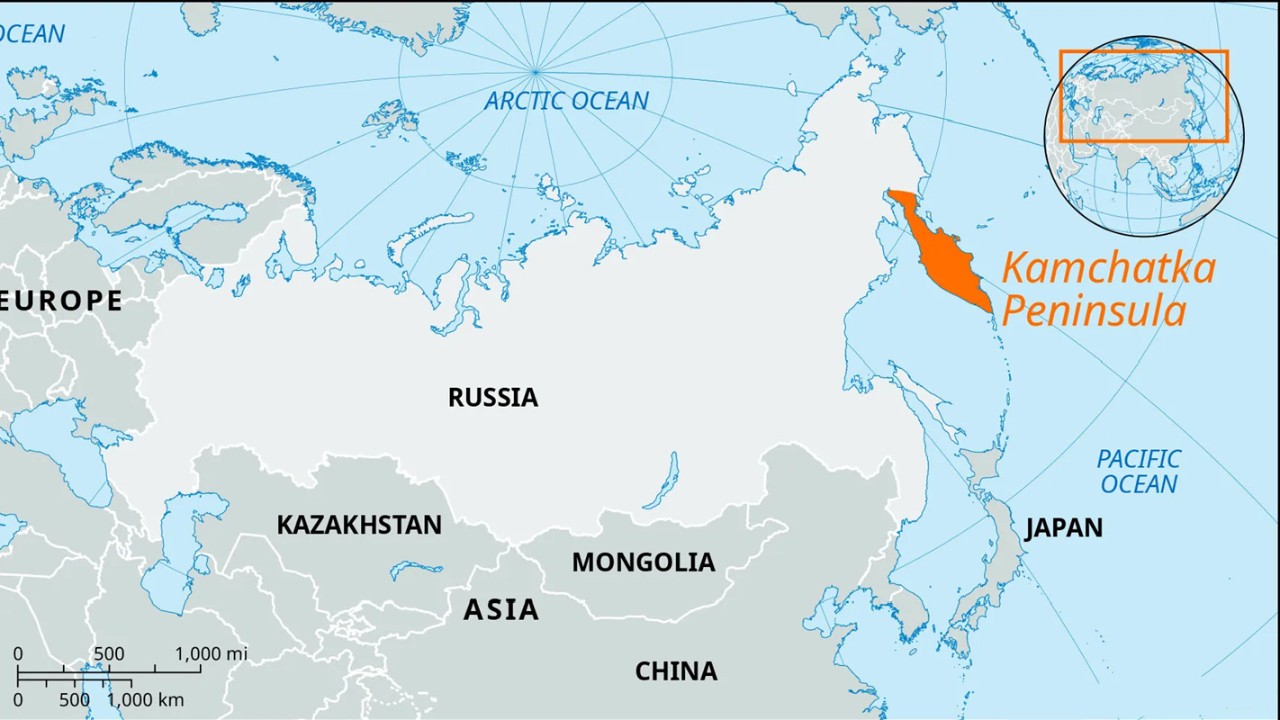
The Kamchatka Peninsula lies in Russia's Far East, between the Sea of Okhotsk on the west and the Pacific Ocean and Bering Sea on the east.
It is part of the Pacific Ring of Fire, which makes it highly prone to earthquakes and volcanic eruptions due to the subduction of the Pacific Plate under the Okhotsk microplate. The climate is harsh, mostly subarctic and tundra type, which leads to very low population density.
Key features:
Tectonic Setting: Highly earthquake-prone region due to plate subduction.
Mountain Ranges: Two main ranges, the Sredinny Range and the Vostochny Range.
Volcanoes: Has numerous volcanoes, including the Volcanoes of Kamchatka UNESCO World Heritage Site with six protected components. Klyuchevskoy is the highest active volcano in Eurasia.
Major River: The Kamchatka River is the principal waterway.
Biodiversity: Rich in wildlife, including salmon, sea otters, brown bears, and Steller's sea eagles.
Kuril Archipelago: Chain of islands from Kamchatka towards Japan, disputed between Russia and Japan.
About the National Centre for Seismology (NCS)
The National Center for Seismology (NCS) is the nodal agency of the Government of India for monitoring earthquake activity in the country.
NCS maintains a National Seismological Network of more than 170 stations, each having state-of-the-art equipment and spreading all across the country.
NCS monitors earthquake activity all across the country through its 24x7
Swipe up (or press ↓) for the next news