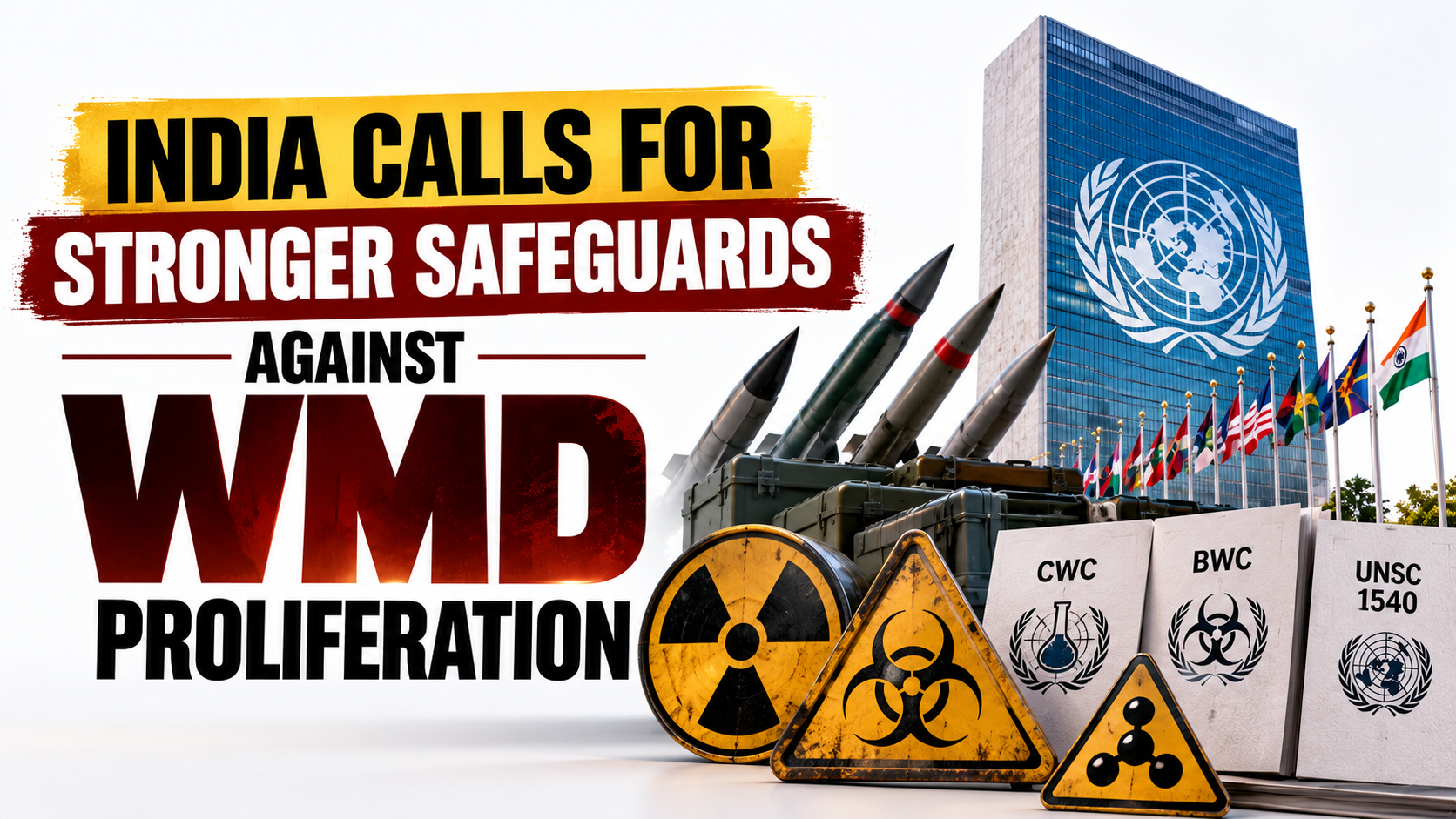
India Calls for Stronger WMD Safeguards
Eduteria Insights · 23 Oct 2026
Why in news?
Recently, India called for stronger safeguards against Weapons of Mass Destruction (WMD) proliferation and terrorist access to sensitive technologies at the UNGA First Committee discussion on "Other Weapons of Mass Destruction."
India's Position: Reaffirmed commitment to full and non-discriminatory implementation of CWC and BWC and stressed stronger international cooperation.
Emerging Risks: Advances in science and technology pose risks through misuse of dual-use technologies having both civilian and military use.
India-Sponsored Resolution: Since 2002, India has introduced a UNGA resolution on "Measures to prevent terrorists from acquiring WMDs" to strengthen national and global measures.
Domestic Safeguards: India has the WMD Act, 2005, and export controls on sensitive dual-use materials and technologies.
CWC: Chemical Weapons Convention (CWC) Came into force in April 1997, banning the development, production, and use of chemical weapons. India ratified in 1996.
BWC: Biological Weapons Conventions Came into force in March 1975, banning biological and toxin weapons. India ratified in 1974.
UNSC Resolution 1540: Adopted in 2004 under Chapter VII, it requires states to prevent non-state actors from acquiring WMDs.
First Committee: Also called Disarmament and International Security Committee, deals with disarmament and global security threats.
Significance: Stronger safeguards can reduce proliferation risks, prevent WMD access to terrorists, and strengthen the global disarmament framework.
About UNGA
The UN General Assembly (UNGA) is the main deliberative and policymaking body of the UN. Established in 1945 under the UN Charter, it is headquartered in New York and represents all member states.
Swipe up (or press ↓) for the next news