Why in News?
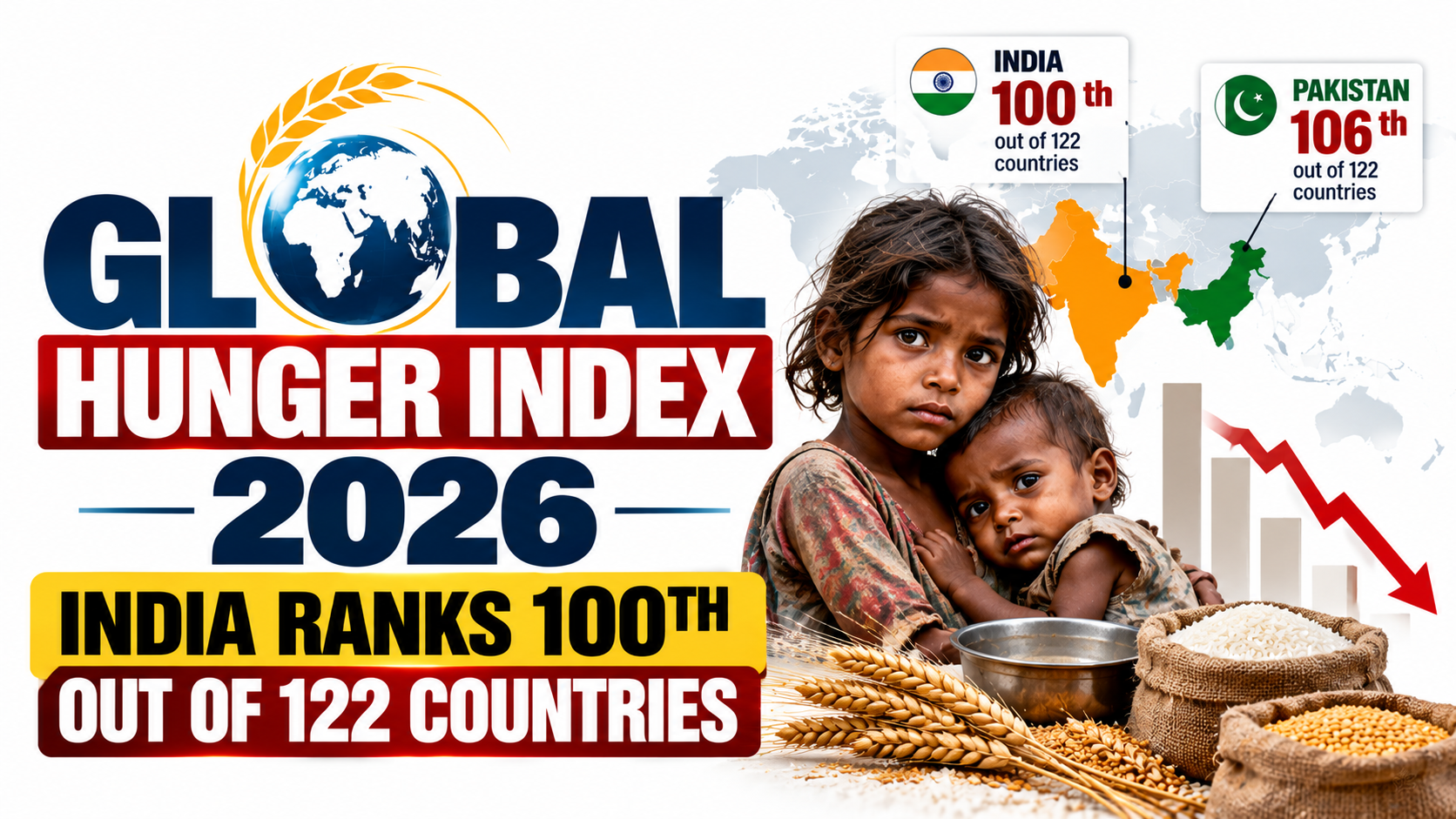
According to the Global Hunger Index (GHI) 2026, India ranked 100th out of 122 countries, while Pakistan ranked 106th. The report highlights persistent nutritional challenges in India, particularly child stunting and wasting.
About the Global Hunger Index
Released by: Jointly published by Welthungerhilfe (Germany) and Concern Worldwide (Ireland), in collaboration with partner institutions.
Frequency: The index is published annually, not once every six years.
Objective: Measures and tracks hunger and undernutrition across countries.
Four Indicators Used in GHI
Undernourishment: Share of the population unable to obtain sufficient dietary energy.
Child Stunting: Children under five with low height for their age, indicating chronic undernutrition.
Child Wasting: Children under five with low weight for their height, indicating acute undernutrition.
Child Mortality: Mortality rate among children below five years of age.
Global and Regional Comparison
South Asia: GHI score of 23.5.
World: GHI score of 18.1.
South Asia's higher score indicates a greater hunger burden compared with the global average.
There is no single country that holds the absolute first rank. Instead, 24 countries are collectively tied for the first rank (Rank 1–24) because they all achieved the lowest possible hunger tier with individual scores below 5.0.
Armenia, Belarus, Bosnia & Herzegovina, Bulgaria, Chile, China, Costa Rica, Croatia, Estonia, Georgia, Hungary, Kuwait, Latvia, Lithuania, Montenegro, North Macedonia, Paraguay, Romania, the Russian Federation, Serbia, Türkiye, the United Arab Emirates, Uruguay, and Uzbekistan
The last 122nd rank is given to Sudan.
SDG 2: Zero Hunger by 2030
The Global Hunger Index 2026 is a wake-up call for India. Despite being a food surplus, India still faces hidden hunger—malnutrition, stunting, wasting, and micronutrient deficiency. Achieving SDG 2: Zero Hunger by 2030 needs more than just grain distribution.