IIT Guwahati Study Reveals How Plants Adapt Their Water Transport System During Drought
Eduteria Insights · 27 Oct 2026
Why in News?
Researchers at the Indian Institute of Technology (IIT) Guwahati have studied how plants modify their internal water transport system under drought-induced water stress. The findings were published in the journal Applied Physics Reviews.
Key Highlights
Plant Studied: Indian mustard.
Research Methodology: Combined experiments, advanced imaging, microscopic force measurements, chemical tracking and realistic 3D computer simulations.
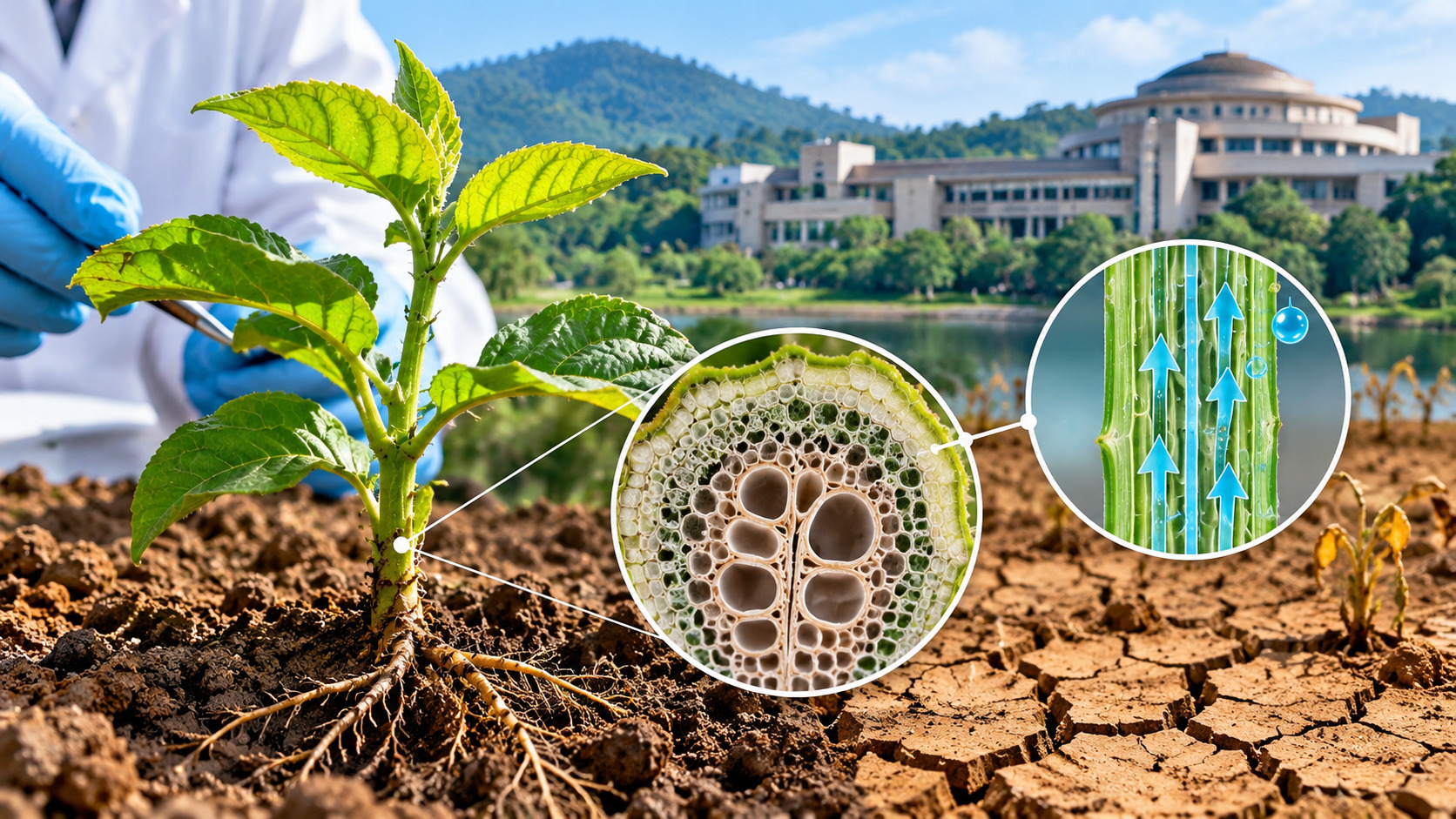
Xylem: Microscopic tubes in plant stems that transport water and dissolved minerals from roots to leaves.
Pits: Tiny openings connecting adjacent xylem vessels, enabling water movement between them.
Major Findings
Narrower Xylem: During acute water stress, xylem tubes become narrower, increasing resistance to water flow.
Smaller Pits: The connecting openings also become smaller, changing the movement of water within the plant.
Reduced Water Loss: These changes restrict water transport towards the leaves, helping reduce water loss through transpiration.
Lateral Water Movement: Water can move sideways through pits between adjacent xylem vessels, helping maintain water balance and preserve the transport network.
Improved Modelling: Unlike earlier models that treated xylem as rigid pipes, the study incorporated changes in vessel dimensions, wall elasticity and fluid movement.
Significance
The findings could help scientists develop drought-tolerant crop varieties and improve water-use efficiency in agriculture. They may also support strategies to reduce crop losses and maintain agricultural productivity under climate change and water scarcity.
Swipe up (or press ↓) for the next news