UPI: Transforming India's Payment Landscape
Why in News?
The Unified Payments Interface (UPI), developed by the National Payments Corporation of India (NPCI), has completed 10 years of revolutionizing India's digital payments. What started as a domestic innovation is now a core pillar of India's Digital Public Infrastructure (DPI), making payments fast, secure, interoperable, and cashless.
From a small Kirana shop in Patna to a mall in Paris, its reach is growing—UPI is now live in 11 foreign countries, showcasing India's leadership in building global digital payment systems.
What is UPI?
Unified Payments Interface (UPI) is a real-time payment system developed by NPCI. It lets you access multiple bank accounts through one mobile app and combines fund transfers, bill payments, and merchant payments on a single platform. It works 24x7 and is secured by two-factor authentication and end-to-end encryption.
Explosive Growth:
Volume: From just 2 crore transactions in FY 2016-17 to over 24,162 crores in FY 2025-26—a 12,000x jump.
Value: From ₹0.07 lakh crore to around ₹314 lakh crore in the same period—over 4,000x growth.
Scale: As of July 2026, 741 banks are live on UPI. In July 2026 alone, UPI processed 2,365.8 crore transactions worth ₹29.87 lakh crore.
Impact: It has transformed India’s payments—fast, interoperable, and accessible for everyone.
Evolution of UPI
| Launch (2016): | Dynamic |
| Merchant Push (2017): | Dynamic |
| UPI 2.0 (2018): | Added invoice in the inbox, signed intent & QR, UPI mandate for recurring payments, and overdraft account linking. |
| Wider Adoption (2019): | SEBI |
Inclusion Phase (2020-22):
1. UPI AutoPay for subscriptions, EMIs, SIPs
2. UPI 123PAY for feature phones via IVR/missed call/sound
3. UPI Lite for fast, PIN-less small payments
4. Credit card linking with UPI
5. Crossed 5 billion monthly transactions in March 2022, $1 trillion+ annual value in FY22
6. First cross-border launch in Bhutan Credit & Dominance (2023): Credit Line on UPI launched. UPI handled ∼70% of India’s digital payments in FY24. Accessibility Boost (2024): UPI Circle for delegating payments, tax payment limit raised to ₹5 lakh, UPI 123PAY limit to ₹10,000, UPI Lite wallet to ₹5,000, and per-transaction to ₹1,000. Security & Inclusion (2025): On-device biometric authentication and Aadhaar-based face authentication for easy UPI PIN setup, helping first-time and senior users.
UPI's Global Footprint
Global Leader: As of 2024, UPI alone handled around 49% of the world's real-time payment volume, as noted by the IMF in its June 2025 report on "Growing Retail Digital Payments."
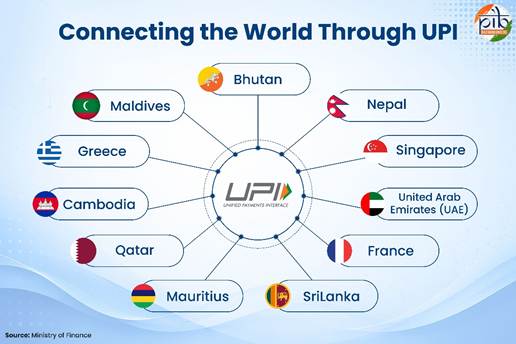
Present in 11 Countries: UPI is now live abroad via merchant acceptance and cross-border remittances in Bhutan, Nepal, Singapore, the UAE, France, Sri Lanka, Mauritius, Qatar, Cambodia, Greece, and Maldives.
Recent Expansions:
Cambodia: In June 2026, NIPL partnered with ACLEDA Bank to launch UPI acceptance in Cambodia.
Greece: In June 2026, UPI went live in Greece for instant remittances between India and Greece through Eurobank.
Maldives: On 30th July 2026, India's UPI was linked with Maldives' instant payment system 'Favara' for cross-border transfers, boosting bilateral digital ties.
Conclusion
From 2 crore transactions in 2016 to over 24,000 crores in 2026, UPI's journey is not just about numbers—it's about financial inclusion. It turned a mobile phone into a bank, empowered small vendors, and made India a global leader in digital public infrastructure. With its expansion to 11 countries and accounting for nearly half of the world's real-time payments, UPI has shown that a simple, interoperable, and secure Indian innovation can become a global model. The next phase will be about deepening credit access, security, and global interoperability—taking UPI from India's payment revolution to the world's payment standard.