BRICS: The POWER Framework
Why in News?
With India chairing the 18th BRICS Summit in New Delhi this year, top finance officials and central bankers from BRICS countries met in Jaipur to push for deeper financial teamwork, from settling trade in local currencies to building their own cross-border payment systems.
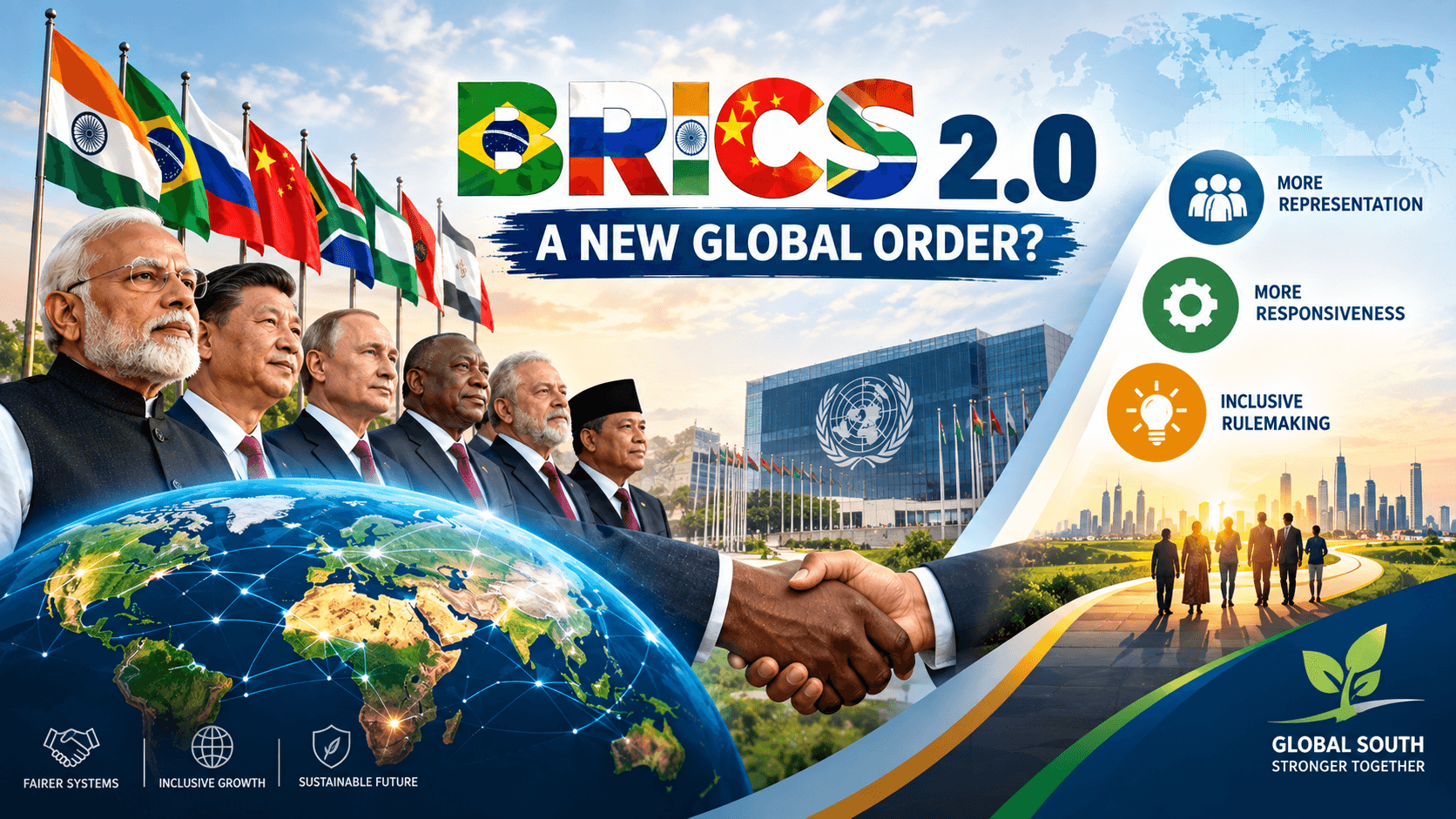
China's recent diplomatic push, including its five-point 'POWER' framework, has once again highlighted the bloc's role in giving more power and voice to the Global South.
Key points
- BRICS is looking at new ways to make cross-border payments using local currencies, digital currencies issued by central banks, UPI-type networks, and platforms like Project Nexus and Mobridge. The aim is to cut transaction costs, lower settlement risks, and reduce dependence on the traditional global financial system.
- But there are still big challenges, differences between countries on political issues, different regulations, questions over whether these systems can handle large volumes, cybersecurity risks, and concerns that the Chinese yuan could dominate.
- India should focus on building payment systems that are neutral, work well with others, and are secure, while also staying connected to the existing global financial network.
What is the BRICS 'POWER' Framework proposed for global cooperation?
| P for Principle: | It says all countries should follow the core principles of the UN Charter, like treating all countries as equal, not interfering in each other's internal matters, solving disputes peacefully, and saying no to dominance by any one power. |
| O for Openness: | It calls for an open global economy built around the WTO system, protecting equal treatment for all countries, opposing high tariffs and breaking of supply chains, and working together more on minerals, energy, and infrastructure. |
| W for Win-Win: | It links the BRICS agenda with the UN Sustainable Development Goals and future development plans after 2030. It also pushes for better coordination on economic policies, easier trade, better cross-border payment systems, and stronger networks for food and energy security. |
| E for Engine: | BRICS is a huge bloc; it has almost half the world's population, about 30% of global GDP, and 20% of global trade. Its growth is expected to be three times faster than the G-7 by 2028. The idea is to use this scale to push cooperation in the digital economy and AI. |
| R for Responsibility: | It asks BRICS members to act as a force for global peace and a more balanced, multipolar world. This is supported by India chairing BRICS in 2026 and China in 2027 and by improving India-China ties, like restarting direct flights and reopening border trade. |
Problems with the Current Cross-Border Payment System
Dependence on Correspondent Banking: Payments between developing countries often must go through intermediary banks in big financial centers, which makes them costly and slow.
Dependence on Dollars: Since many countries don't have direct currency links, payments must be converted into US dollars first, which increases cost and makes them vulnerable to US monetary policy.
High Transaction Costs: Because of multiple middlemen and currency conversions, costs can go as high as 8-20% in some developing country routes.
Dependence on SWIFT: Heavy reliance on the SWIFT messaging system makes countries vulnerable to financial sanctions and political pressure. This dependence on dominant currencies and networks exposes countries to sanctions and shocks, like when several Russian banks were removed from SWIFT in 2022.
Shrinking Banking Network: The number of global correspondent banking connections fell by about 20% between 2011 and 2018, which means fewer channels for payments and higher risk.
Why Does BRICS Want an Alternative Payment System?
| Lower Costs: | Settling trade in local currencies and using multi-CBDC systems like mBridge, built by central banks of China, Thailand, Hong Kong, and the UAE, can cut middleman fees and conversion costs, which helps exporters and small businesses. |
| Faster and Safer Settlement: | Wholesale CBDCs can allow instant payment-versus-payment settlement, which reduces risk and saves time. RBI has also suggested linking CBDCs across BRICS to make trade and tourism payments easier. |
| More Financial Independence: | An independent system like BRICS Clear, discussed at the 2024 Kazan Summit, can reduce dependence on existing networks and protect against sanctions and disruptions. |
| Real-Time Payments: | Linking fast payment systems like UPI with other countries' systems can make remittances and tourism payments faster and cheaper, without many intermediaries. |
What are the challenges in adopting alternative cross-border payments?
Different Political Goals: Russia wants to move away from the dollar quickly to avoid sanctions, while India is more focused on reducing costs and improving technology, not directly challenging the dollar. Also, any move away from the dollar could face pushback, including threats of higher tariffs if BRICS tries to create a common currency.
Risk of Secondary Sanctions: If banks join a SWIFT alternative like BRICS Clear along with heavily sanctioned countries, they could face trade action from Western countries.
Risk of Yuan Dominance: Trying to avoid the dollar could lead to over-dependence on the Chinese yuan. Right now, over 95% of transactions on the Mobridge platform are in China's digital yuan.
Scalability Issues: While two-country UPI linkages work well, creating a similar system for many different countries together is operationally very difficult.
Infrastructure and Cost: Expanding fast-payment systems globally needs huge investment in technology, security, and cyber protection. Keeping it free or low-cost at a large scale is hard.
Different Regulations: Every country has different rules on capital controls, data storage, and anti-money laundering. Bringing them all into one system is a big challenge.
Cyber and Stability Risks: Shared CBDC networks can become targets for cyberattacks. Also, very easy transfers could lead to sudden outflow of money and currency instability in smaller economies.
What Measures Can Strengthen BRICS Alternative Cross-Border Payments?
| Use Common Hub Models: | Instead of many separate bilateral links, use a common multilateral hub like BIS's Project Nexus to connect domestic instant payment systems through one standard gateway. |
| Strengthen Domestic Digital Systems: | Speed up the rollout of safe and stable CBDCs like India's e-Rupee, which will form the base for secure cross-border payments. |
| Start Small with Pilot Projects: | Take a gradual approach, starting with specific useful areas like trade invoicing and tourism payments in selected country pairs, to test viability and reduce political friction. |
| Align Rules and Compliance: | Create common technical standards that meet global anti-money laundering and FATF norms, while still respecting each country's data and regulatory rules. |
| Stay Connected with Global Systems: | Make sure new payment platforms can work with existing global bodies like the IMF, BIS Innovation Hub, and even SWIFT, so that global finance does not get split into separate blocs. |
About BRICS
BRICS is an intergovernmental forum of major emerging economies that coordinates on global economic, political, and development issues. Originally it was Brazil, Russia, India, China, and South Africa. It represents South-South cooperation and the voice of the Global South. Evolution from BRIC to BRICS+: The term "BRIC" was coined by economist Jim O'Neill of Goldman Sachs in 2001 for large emerging economies. It became BRICS+ in Jan 2024 with Egypt, Ethiopia, Iran, Saudi Arabia, and the UAE joining, and Indonesia in Jan 2025. Saudi Arabia is listed as a member but has not formally confirmed its membership. Nature of the Grouping: It is an informal, consensus-based grouping, not a treaty-based organization. It has no charter, no permanent secretariat, and no supranational authority. Decisions are taken by consensus through summit declarations and MoUs.
Stated Objectives and Areas of Cooperation:
1. Political and Security: Meetings of Foreign Ministers, NSAs, and coordination in UN, G20, WTO, IMF, and World Bank.
2. Economic and Financial: Regular meetings of finance ministers and central bank governors. Key bodies are the New Development Bank (NDB), the Contingent Reserve Arrangement, and the Interbank Cooperation Mechanism.
3. Cultural and People-to-People: Forums like Business Council, Think Tanks Council, Academic Forum, Women’s Business Alliance, Youth Council, and Civil Forum.
India and BRICS: India was a founding member of BRICS and attended the first summit in 2009. It hosted summits in New Delhi (2012), Goa (2016), and virtually in 2021. In 2012, India proposed the NDB for infrastructure financing. The first NDB president was Indian K.V. Kamath, and its India office is in GIFT City, Gujarat. India assumed BRICS chair on 1st Jan 2026 with the theme “Building for Resilience, Innovation, Cooperation, and Sustainability” and a people-centric, humanity-first approach.
What Role Does BRICS Play in Advancing India's Strategic Interests?
Platform for Strategic Autonomy: Allows India to work with non-Western powers without joining any military bloc. India can be in BRICS, SCO, Quad, G20, EU, and US partnerships at the same time, supporting its multi-alignment policy. Greater Voice in Global Governance Reform: BRICS gives a collective platform to demand reform of the UNSC, IMF, World Bank, and WTO. The 2025 Rio Declaration called for such reforms, with Russia supporting India and Brazil for a bigger UN role. Leadership of the Global South: Strengthens India’s role in raising issues like food security, climate finance, debt, health, and technology access, along with its Voice of Global South Summits and G20 presidency. Access to Alternative Development Finance: NDB gives long-term finance. As of Dec 2024, India is its largest borrower, 26% of the portfolio, 28 projects worth $9.09 bn, and nearly $10 bn by April 2025. Projects include Chennai, Indore, Mumbai metros, and Delhi-Meerut RRTS. Expansion of Trade and Markets: BRICS+ connects India to large markets in Eurasia, Latin America, Africa, West Asia, and SE Asia, helping diversify its $825 bn exports in 2024-25 beyond Western markets. Energy and Critical-Mineral Security: Members include major oil, gas, coal, and mineral producers like Russia, the UAE, Iran, Brazil, South Africa, and Indonesia (nickel, coal). This helps India secure long-term supplies and cooperation in green hydrogen, nuclear, and critical minerals. Technology and Digital Cooperation: A platform to share India’s digital public goods like Aadhaar, UPI, CoWIN, and India Stack and cooperate in AI, fintech, space, and renewables through science and satellite programs. Local Currency Settlement: Promotes trade in local currencies, cross-border digital payments, and currency swaps, reducing dollar dependence, forex volatility, and sanction risks, while helping internationalize the rupee. What are the major challenges hindering BRICS’ effectiveness for India? Internal Heterogeneity: Members have very different political systems, economies, and foreign policies. This leads to weak, lowest-common-denominator declarations. E.g., India-China border tensions, Russia-West confrontation. China-Centered Asymmetry: China is far larger economically, so the BRICS agenda may tilt towards China. India’s $99.2 bn trade deficit with China in 2024-25 shows deep import dependence in electronics, pharma, and solar. Consensus-Based Inertia: No permanent secretariat and the need for consensus allow delays, weak monitoring, and poor follow-through between chairships. Gap Between Declarations and Delivery: Progress on local currency trade, payment systems, and reforms is slow. NDB approved $42.9 bn across 139 projects by the end of 2025, much smaller than the World Bank.
What Strategies Can India Adopt to Maximize the Benefits of BRICS?
Institutionalize BRICS in 2026 Chair ship: Use chair ship to make BRICS result-oriented. Propose an implementation index with deadlines, funding, and measurable outcomes.
Drive Global Financial Reform and De-dollarization: Push for voting reform in the IMF/World Bank and promote local currency settlement systems to reduce dollar dependence and protect from sanctions. Create a BRICS Critical Minerals Partnership: Lead cooperation on lithium, cobalt, nickel, and rare earths, from joint exploration and processing to stockpiles, greehydrogen,en and recycling. Make BRICS an Export Platform: Seek preferential market access and sector-wise trade facilitation, mutual recognition, and simpler customs, rather than a full BRICS FTA, which may benefit China more. Lead on Digital Public Infrastructure: Offer the Aadhaar, UPI, and DigiLocker model to others. Create a BRICS DPI repository and regulatory sandbox with safeguards for privacy, cybersecurity, and data sovereignty. Build Issue-Based Coalitions: Form smaller groups within BRICS, work with Brazil and South Africa via IBSA for UN reform, and work with African members on climate finance and debt. Position India as a Bridge: Keep BRICS inclusive, not anti-Western or China-led. Use India’s presence in BRICS, G20, Quad, SCO, and IBSA to build cooperation on climate, food, health, counterterrorism, and supply chains, while protecting national interests.
Conclusion
BRICS is not a formal organization like the UN but an informal platform of major emerging economies that gives the Global South a stronger voice. For India, it is useful because it supports strategic autonomy, helps push for reform of global institutions like the UNSC, IMF, and WTO, provides alternative finance through NDB, opens new export markets, and strengthens energy, critical minerals, and digital cooperation.
However, BRICS faces real challenges: different political systems and interests among members, economic dominance of China, slow implementation due to consensus-based working, and a gap between big declarations and actual delivery.
India, as chair in 2026, has an opportunity to make BRICS more result oriented. By focusing on neutral and secure payment systems, practical trade facilitation, critical mineral partnerships, and sharing its Digital Public Infrastructure, while maintaining interoperability with the existing global system, India can ensure BRICS remains a bridge for inclusive multilateralism, not an anti-Western bloc, and truly serves the interests of the Global South.