Why in News?
On the sidelines of the BRICS ICT Track Meeting in Pune, Union Minister of Communications Shri Jyotiraditya Scindia and his Brazilian counterpart signed an MoU on Telecommunications and ICTs.
The MoU covers everything from telecom policies, AI, 5G & 6G, Open RAN, IoT, Direct-to-Device, LEO satellites, and Non-Terrestrial Networks to spectrum management, optical fiber, and submarine cables. It also touches on equally important areas like cybersecurity, digital inclusion, universal connectivity, consumer protection, private networks, and making ICTs greener and more sustainable.
The Nature of India-Brazil Relationship
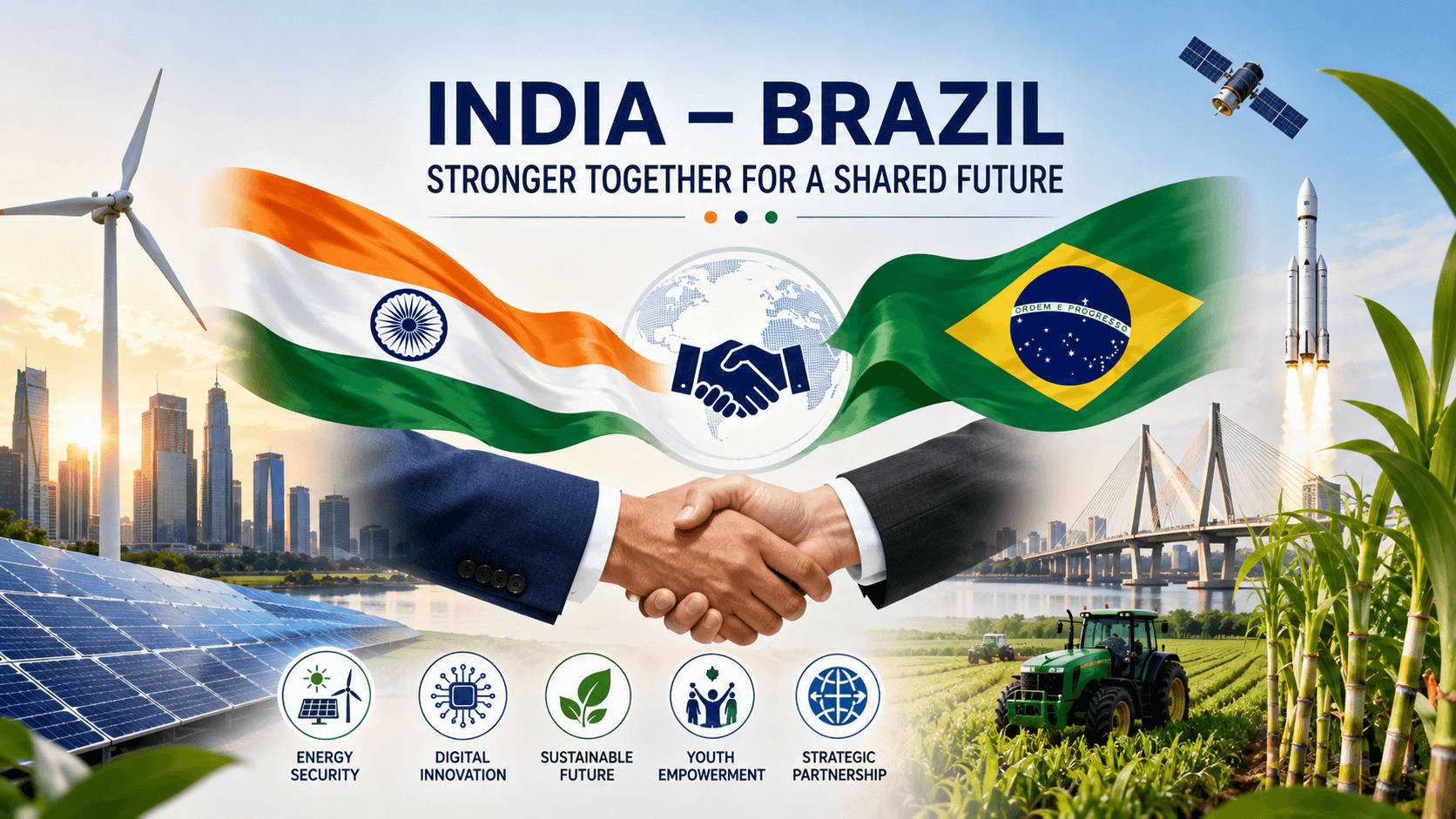
India and Brazil share a close, strategic, and multifaceted partnership that goes back to 1948, when both opened embassies and established diplomatic ties. In 2023, they celebrated 75 years of this friendship.
Over the years, the relationship has been elevated based on a common global vision, shared commitment to development, and democratic values.
It's not just a bilateral bond. The two countries work closely together in major plurilateral and multilateral forums like BRICS, BASIC, G-20, G-4, IBSA, the International Solar Alliance, the UN, the WTO, UNESCO, and WIPO. A major boost came during President Bolsonaro’s visit to India as Chief Guest for Republic Day in January 2020, which added fresh momentum to the ties.
Why is Brazil important to India?
Brazil isn’t just another country for India. It’s a key partner in the Global South and plays a big role in India’s growth, energy security, and global strategy.
| Critical Supplier of Resources: | Brazil has what India needs to keep its economy running. It’s a major supplier of minerals and hydrocarbons, especially crude petroleum oil. For a country like India with huge energy demands, having a reliable partner like Brazil for resources is strategically vital. |
| A Big Market & Investment Hub: | Brazil is the largest economy in Latin America, and it’s diverse. That makes it a natural destination for Indian businesses and investors. From pharma and IT to agriculture and manufacturing, there’s a lot of room for Indian companies to grow there. |
| Partner in South-South Cooperation: | Both India and Brazil are giants of the Global South — large populations, fast-growing economies, and a shared push for a more balanced world order. Together, they represent the voice of developing nations and work to make sure the concerns of the South are heard globally. |
| Teamwork on the World Stage: | India and Brazil stand together in almost every major global forum: BRICS, G20, WTO, IBSA, and more. They share the same goal: strengthening multilateralism and reforming global governance so it’s fairer for developing countries. |
While India and Brazil are strategic partners, their relationship isn't without friction. Here are the key pain points:
| The Sugar Fight at the WTO: | This is the biggest economic irritant. Both are sugar giants, but Brazil says India's subsidies keep global prices artificially low. In 2021, the WTO ruled against India after a complaint by Brazil, Australia, and Guatemala, and India has appealed. The idea to use Brazil's ethanol tech to absorb India's extra sugar sounds good, but pricing issues, infrastructure gaps, and regulations are slowing it down. |
| Narrow Trade Basket: | Trade is stuck on a few raw materials, so any price shock hits hard. There's no full free trade deal. The India-MERCOSUR PTA from 2004 still covers only 450 items despite years of promises to expand it. This blocks Indian strengths like IT and pharma from getting deeper access. |
| G4 and UNSC Deadlock: | Both want a permanent seat at the UN Security Council and push together as G4, but it's leading to fatigue. Their bids are blocked by regional rivals and by existing P5 veto powers, and even within BRICS there is resistance. |
| BRICS+ Dilemma: | India wants BRICS to stay non-aligned and multipolar, not become an anti-West bloc led by China. Brazil under Lula also balances ties with the West but sometimes leans towards Sino-Russian narratives. Plus Brazil's heavy trade dependence on China makes coordination tricky. |
| Critical Minerals vs. Tech Transfer: | India urgently needs Brazil's rare earths for its green transition to cut dependence on China. But Brazil doesn't want to just export raw ore—it wants technology and local processing in return. A rare earth agreement was signed in Feb 2026, but whether it works on the ground is still to be seen. |
| Biofuels—Cooperation and Competition: | Both lead the Global Biofuels Alliance, but Brazil guards its advanced flex-fuel and bio-refinery tech closely. India wants deeper tech transfer for its blending targets, while Brazilian companies don't want to give it away cheap. B2B commercial terms are still a tough negotiation. In short, the frictions are less about politics and more about competition in agriculture, trade, minerals, and technology—and how to balance protection with partnership. |
To take India-Brazil ties to the next level, both sides need to move from just trading to building things together. Here’s what needs to happen:
| 1 | Secure Critical Minerals Together: | Stop just buying and selling raw ore. India and Brazil should jointly explore mining and processing rare earths using AI-based surveying that’s cleaner and faster. Add secure shipping routes and aligned reserve policies so both countries are safe from global supply shocks. A closed-loop chain that benefits both. |
| 2 | Connect Digital Public Infrastructure: | Imagine UPI-like systems talking to each other. Linking digital IDs and verifiable credentials, building AI models trained for the Global South, and having common data protection and ethical AI rules. This will help deploy better governance tech and fintech and give both a stronger voice in global digital rules. |
| 3 | Build Green Fuel Corridors: | Both are biofuel powers. They should harmonize blending targets, create certified Sustainable Aviation Fuel corridors with fast-track green customs, and do joint research on next-gen ethanol so fuel doesn’t fight with food. |
| 4 | Co-Produce Defense, Not Just Buy: | Move beyond buying and selling. Co-production in aerospace and naval platforms, logistics support pacts for better interoperability, and joint ventures for aircraft parts and drones. That builds real self-reliance. |
| 5 | Sync Pharma Rules: | Mutually recognize drug approvals, fast-track clearances for APIs, and align clinical trial norms. Linking traditional medicine knowledge and smart hospital systems can make medicines reach faster and cheaper and remove non-tariff barriers. |
| 6 | Modernize | Simplify phytosanitary rules with e-certificates, jointly develop drought-resistant seeds for tropical climates, and use satellite data and precision farming for better soil and fertilizer use. Good for food security and farmers on both sides. |
| 7 | Team Up in Space: | A joint roadmap for satellites, earth observation for disaster and climate tracking, maritime awareness, and even a joint microgravity and astrobiology research program. It boosts their space power status and brings real benefits down to earth. |
Conclusion
India-Brazil can become a model for how the Global South builds its own autonomy—if it focuses on joint production, policy alignment, and political will, not just trade. Indeed, it has grown into a pillar of Global South strategic autonomy—covering critical minerals, digital public infrastructure, defense co-production, and clean energy. Yes, frictions remain over sugar, trade deals, and UNSC reform, but the institutional linkages are only getting deeper. If both sides push with clear policies and political will, this partnership can truly become a blueprint for what fair, multipolar cooperation should look like.
Topics on India-Brazil bilateral cooperation fall under Current Events of National and International Importance in the BPSC Exam syllabus. It also falls under General Studies Paper I, which explicitly includes questions on current international and national events, global groupings (such as BRICS, G20, and IBSA), and bilateral ties.