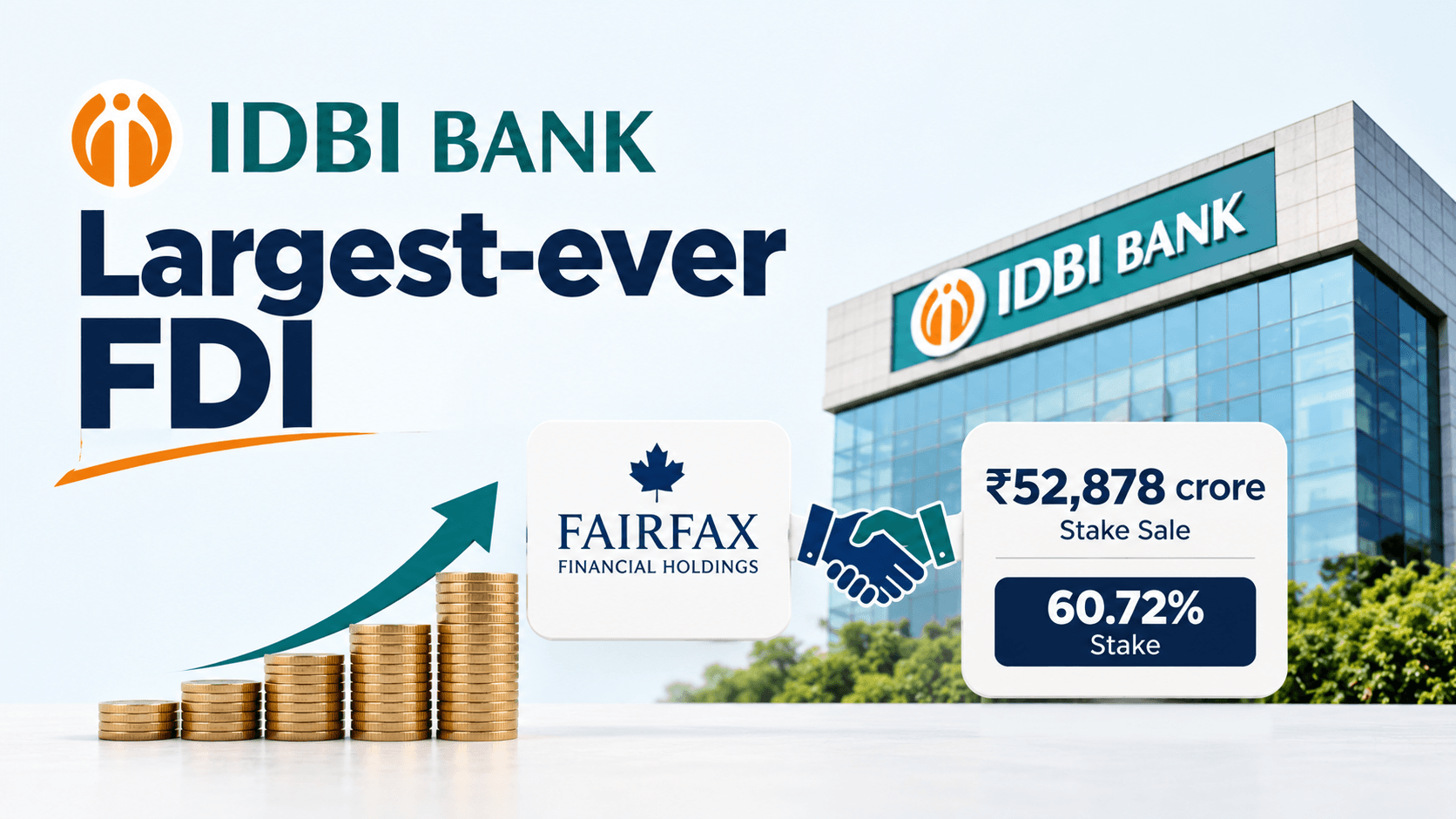
Sale of IDBI Bank: Largest-ever FDI
Recently, India’s banking sector was set for a major transformation as the Union Cabinet has approved the strategic restructuring of IDBI Bank through a ₹52,878 crore stake sale to Fairfax Financial Holdings. The deal is being described as the largest-ever Foreign Direct Investment (FDI) in India’s financial sector.
The proposed transaction marks an important milestone in the government’s efforts to restructure public sector-linked banking assets, attract foreign investment, and strengthen the financial system.
Other key points
The Union Cabinet approved the strategic restructuring of IDBI Bank, paving the way for Canada-based Fairfax Financial Holdings to acquire a significant stake in the lender. Fairfax Financial Holdings is a Canada-based financial services and investment holding company. It has investments across insurance, reinsurance, and other financial businesses.
Under the proposed deal, the government and the Life Insurance Corporation of India (LIC) will collectively sell a 60.72% stake in the bank for ₹52,878 crore. Following the transaction, the government’s shareholding will decline to 15%, while LIC’s stake will come down to 19%. The transaction is expected to become the largest foreign direct investment in India’s financial sector.
What Is the Difference Between Strategic Restructuring and Strategic Disinvestment?
The government has described the IDBI Bank transaction as strategic restructuring rather than strategic disinvestment.
Disinvestment means the government sells its assets, mainly in Central and State PSUs, to reduce fiscal burden or to raise money to cover revenue shortfalls.
Strategic disinvestment is different; it is not just selling shares but transferring both ownership and management control of a PSU to another entity, mostly a private player. So, it is a form of privatization.
As per the Disinvestment Commission, it means selling a substantial part of government holdings in a CPSE, up to 50% or more as decided, along with the transfer of management.
In simple terms, strategic disinvestment generally refers to the sale of a government stake in an enterprise, often accompanied by the transfer of management control.
Here, in the case of such a transaction, it is intended to change the bank’s ownership and control structure while allowing it to continue operating under the existing banking regulatory framework.
Strategic restructuring is a planned change in a company's business model, operations, or ownership to improve its financial health, efficiency, and long-term competitiveness. The term "strategic restructuring," in this case, highlights the broader reorganization of IDBI Bank’s ownership structure through the sale of stakes held by both the government and LIC.
Why does India do it?
The basic principle is that the government should not run businesses in sectors where competitive markets have developed. In private hands, these companies can do better due to more capital, better technology, and efficient management.
How Did IDBI Bank Reach This Stage?
IDBI Bank’s journey towards private ownership has been shaped by years of financial difficulties and subsequent recovery.
1. Financial Stress and RBI’s PCA Framework
IDBI Bank faced serious financial challenges for several years. In 2017, the Reserve Bank of India (RBI) placed the bank under the Prompt Corrective Action (PCA) framework.
The PCA framework is designed to help banks facing financial weaknesses improve their financial position. Depending on the circumstances, it can involve restrictions on lending, expansion, and other activities.
2. LIC Took Control in 2019
In January 2019, LIC infused ₹21,624 crore into IDBI Bank and received preferential shares in return.
This investment gave LIC a controlling stake in the bank. As the government’s shareholding fell below 51%, the RBI classified IDBI Bank as a private sector bank for regulatory purposes.
3. A Major Financial Turnaround
Over the following years, IDBI Bank recorded a significant improvement in its financial performance. Its asset quality strengthened, capital adequacy improved, and profitability recovered.
The proposed Fairfax transaction represents another major step in the bank’s ownership transformation.
What Does the Deal Mean for the Government and LIC?
For the government, the transaction represents a major change in its relationship with IDBI Bank. Its stake will fall to 15%, while LIC will retain 19%.
The sale will also allow the government and LIC to realize value from their investments in the bank. However, the final implications for public finances, LIC’s investment returns, and the bank’s future performance will depend on the transaction’s completion and subsequent developments.
The deal should therefore be viewed not only as a stake sale but also as a significant change in the bank’s ownership and strategic direction.
Conclusion
The transaction is significant for three main reasons: a major foreign investment, a substantial change in ownership, and a new phase in IDBI Bank’s development. For banking customers, the government has clarified that regulatory supervision, deposit insurance provisions, and applicable banking obligations will continue. The key question now is how the change in ownership will shape IDBI Bank’s long-term growth, competitiveness, and role in India’s financial system.
Reference: