India’s Growth Outlook: IMF Sees 7% in FY27
Why in News?
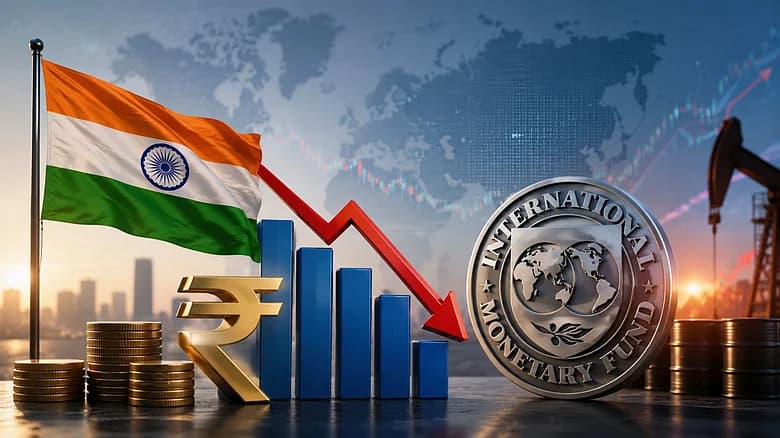
Recently, the International Monetary Fund (IMF) has raised India’s GDP growth forecast for the financial year 2026–27 (FY27) by 60 basis points to 7%, citing strong domestic demand, a growing services sector, and better-than-expected economic performance.
In its latest World Economic Outlook (WEO) report, the IMF noted that India continues to be one of the fastest-growing major economies, even as higher oil prices and geopolitical tensions create challenges for the global economy.
The World Economic Outlook (WEO) is published by the International Monetary Fund (IMF) twice a year, typically in April and October.In addition to these two full, comprehensive reports, the IMF also releases two shorter WEO Updates in January and July to account for major unexpected shifts in the global economy.
Why Is India’s Economy Growing at 7%?
India’s strong growth outlook is mainly supported by three key factors:
- Strong domestic demand: Household consumption and demand within the country continue to support economic activity.
- Robust services sector: Growth in sectors such as IT, financial services, trade, and other service activities is strengthening the economy.
- Improved growth momentum: Better-than-expected economic performance has encouraged global institutions to revise their forecasts upward.
However, rising crude oil prices remain a concern for India, which depends heavily on imported oil. Higher oil prices can increase inflation, raise import costs, and put pressure on the country’s trade balance.
IMF vs RBI vs World Bank: India’s FY27 GDP Growth Forecast
Several major economic institutions have upgraded their growth projections for India, reflecting confidence in its economic performance.
| Institution | FY27 GDP Growth Forecast |
| International Monetary Fund (IMF) | 7.0% |
| Reserve Bank of India (RBI) | 7.1% |
| World Bank | 7.1% |
| Organisation for Economic Co-operation and Development (OECD) | 7.1% |
These estimates suggest that India is expected to maintain strong growth momentum in FY27. However, forecasts may differ because institutions use different assumptions about oil prices, inflation, global trade, and domestic economic conditions.
How Can Free Trade Agreements Boost India’s Economy?
The IMF has also highlighted the importance of Free Trade Agreements (FTAs) in strengthening India’s economic prospects.
FTAs reduce or remove trade barriers between participating countries, making it easier for businesses to export goods and services, access new markets, and build stronger supply chains.
The IMF noted that trade agreements involving India and the European Union (EU), as well as the United Kingdom’s agreement with India, could help reduce tariffs and non-tariff barriers.
FTAs Could Add $140 Billion to India’s GDP by 2035
According to a Bloomberg Economics report cited in the news, India’s FTAs, including agreements with the EU and New Zealand, could deliver significant economic benefits by 2035.
The report estimates that these agreements could:
- Add around $140 billion to India’s GDP.
- Increase economic output by 1.7%.
- Raise export volumes by 6.2%.
These projections assume that the agreements with the EU and New Zealand are implemented from 2027. The actual benefits will depend on implementation, market access, business competitiveness, and the ability of Indian exporters to take advantage of new opportunities.
Global Economic Outlook: Inflation and Geopolitical Risks
Despite India’s positive outlook, the global economy continues to face uncertainty due to geopolitical conflicts, higher commodity prices, and trade disruptions.
According to the IMF’s latest projections:
| Global Economic Indicator | 2026 | 2027 |
| Global GDP growth | 3.1% | 3.4% |
| Global headline inflation | 4.7% | 4.1% |
The IMF expects global inflation to rise in 2026, mainly because of higher commodity prices, before easing in 2027.
Geopolitical tensions, particularly in the Middle East, could further disrupt energy supplies, increase transportation costs, and weaken economic activity in countries that depend heavily on imported energy.
The IMF has called for stronger policy measures to restore fiscal space, improve supply-side resilience, and support sustainable economic growth.
India’s Medium-Term Growth Outlook Looks Stronger
The IMF has also expressed greater confidence in India’s medium-term growth potential.
It projects that global economic growth will average around 3.2% annually during 2028–2031, below the pre-pandemic average of 3.7% recorded during 2000–2019.
However, India stands out from several other emerging economies, with its growth outlook receiving upward revisions.
The IMF attributes this improvement to:
- Favorable demographics: India’s large working-age population can support production, consumption, and economic expansion.
- A growing domestic market: Rising demand creates opportunities for businesses and investment.
- Structural reforms: Continued reforms can improve productivity, strengthen competitiveness, and support long-term growth.
These factors could help India sustain its economic momentum, provided that employment generation, investment, infrastructure development, and productivity keep pace with growth.
What Does the IMF’s Growth Forecast Mean for India?
A higher GDP growth forecast signals confidence in India’s economic resilience and future potential. Strong domestic demand and services activity are helping the country maintain momentum despite external challenges.
However, sustaining this growth will require India to manage several risks, including volatile oil prices, inflation, global trade uncertainty, and potential slowdowns in external demand.
India will also need to ensure that economic growth translates into more jobs, higher incomes, and broader development opportunities.
Quick Revision for UPSC and BPSC
| Key Fact | Details |
| Report | World Economic Outlook (WEO) |
| Publishing institution | International Monetary Fund (IMF) |
| India’s FY27 growth forecast | 7% |
| Revision by IMF | Upward by 60 basis points |
| Main growth drivers | Domestic demand and services |
| Global GDP growth forecast for 2026 | 3.1% |
| Global inflation forecast for 2026 | 4.7% |
| Potential GDP addition from FTAs by 2035 | $140 billion, according to Bloomberg Economics |
Conclusion
The IMF’s upgraded forecast reinforces India’s position as a major growth engine in the global economy. Strong domestic demand, services-sector expansion, favorable demographics, and trade agreements provide important opportunities. The key challenge will be to convert this growth potential into sustainable, inclusive, and employment-generating development.
Reference: