Uniform Civil Code (UCC)
Why Is UCC in the News?
The most burning and debatable issue of the Uniform Civil Code (UCC) is once again making headlines in the news. Bills on the UCC passed by Assam, Gujarat, and Madhya Pradesh are now waiting for the president's approval. This shows that more states want to have one common law for all people on matters like marriage, divorce, inheritance, and adoption. Uttarakhand has already started UCC from January 2025.
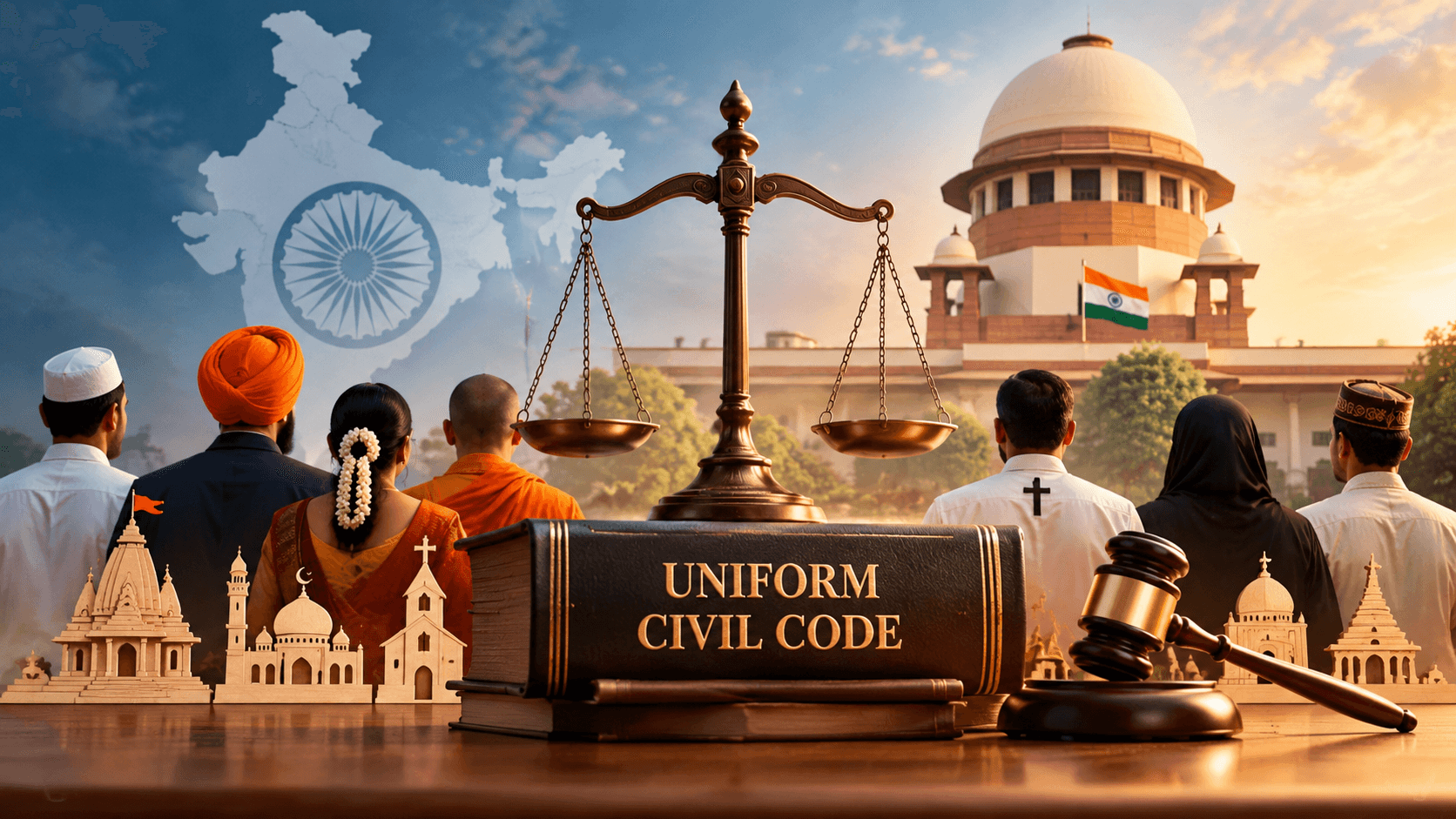
The Uniform Civil Code (UCC) aims to have one common civil law for all citizens on matters like marriage, divorce, inheritance, adoption, and succession. It promotes gender justice, equality, and national integration. The debate on UCC is about balancing equality and individual rights with religious freedom, cultural diversity, and tribal customary laws. So, reform with consensus is very important.
Key Facts You Should Know
UCC means one common set of civil laws for all citizens of India. It will apply equally to everyone in matters like marriage, divorce, custody, adoption, maintenance, inheritance, and succession, irrespective of religion or community.
Dichotomy in Indian Law: India already has uniform laws for criminal and commercial matters, like Bharatiya Nyaya Sanhita 2023, the Indian Contract Act 1872, and the Transfer of Property Act 1882. But in personal matters, people are still governed by their own community-specific personal laws based on religious texts, traditions, and customs.
UCC and the Indian Constitution
Article 44 under Part IV (Directive Principles of State Policy) says, "The State shall endeavor to secure for the citizens a Uniform Civil Code throughout the territory of India.
"Under Article 37, DPSPs are fundamental in governance, but they are non-justiciable, meaning they cannot be enforced by courts.
India’s Personal Laws: Current Framework
Hindus, Buddhists, Jains, and Sikhs: They are largely governed by the codified Hindu Code Bills of 1955-56. These include the Hindu Marriage Act, the Hindu Succession Act, the Hindu Minority and Guardianship Act, and the Hindu Adoptions and Maintenance Act. Sikh marriages can also be registered under the Anand Marriage Act, 1909 (amended in 2012).
Muslims: They are governed by uncodified or partially codified laws based on Shariat. The main laws are the Muslim Personal Law (Shariat) Application Act, 1937, and the Dissolution of Muslim Marriages Act, 1939.
Christians and Parsis: They are governed by laws like the Indian Christian Marriage Act, 1872, the Indian Divorce Act, 1869, and the Parsi Marriage and Divorce Act.
Tribal Customary Laws: Tribal customs are protected by the Constitution through the Fifth and Sixth Schedules and Article 371, which save their traditional family practices from being overridden by general laws.
Secular Legislation: There are also secular options for those who want to go beyond personal laws, like the Special Marriage Act, 1954.
UCC and the Supreme Court: Key Judgments
Mohd. Ahmed Khan v. Shah Bano Begum (1985): The Court said a divorced Muslim woman has the right to maintenance under Section 125 CrPC. It also said Article 44 has remained a "dead letter" and stressed the need for UCC.
Sarla Mudgal v. Union of India (1995): The Court held that a Hindu husband cannot convert to Islam just to marry again without divorcing his first wife. It said UCC is needed to prevent misuse of personal laws.
Daniel Latifi v. Union of India (2001): The Court upheld the Muslim Women (Protection of Rights on Divorce) Act, 1986, but ensured that a divorced Muslim woman must get fair and reasonable provision beyond the Iddat period.
John Vallamattom v. Union of India (2003): The Court struck down Section 118 of the Indian Succession Act, 1925, as discriminatory under Article 14 and linked UCC with national integration.
Shayara Bano v. Union of India (2017): The Court declared instant triple talaq (Talaq-e-Biddat) unconstitutional and said personal law practices can be tested on constitutional principles.
Jose Paulo Coutinho v. Maria Luiza Valentina Pereira (2019): The court called Goa a "shining example" where the uniform civil code applies to all irrespective of religion while protecting certain limited rights and called for its implementation across India.
UCC Debate: Arguments For and Against
| Arguments in Favor of UCC | Arguments Against UCC |
| Gender Justice & Equality: UCC can give equal rights to all in inheritance, divorce, marriage, and guardianship. This strengthens Articles 14, 15, and 21. | Erosion of Pluralism: One common law may harm India's religious and cultural diversity. This raises concerns under Articles 25 and 29. |
| Constitutional Secularism: Civil rights will be based on citizenship, not religion. This strengthens secularism. | Minority Alienation: Without wide consensus, minorities may feel that majority traditions are being imposed on them. |
| National Integration: "One Nation, One Law" can create common civil standards, reduce religion-based differences, and promote a shared civic identity. | Tribal & Customary Practices: UCC may clash with tribal customs, especially in Northeast and Fifth Schedule areas. For example, communities like Kurmis have raised concerns about inclusion under UCC and want protection of their customs. |
| International Obligations: India is a signatory to ICCPR 1966 and CEDAW 1979. UCC supports India's commitment to equality and non-discrimination, including gender equality. | Uniformity ≠ Equality: One uniform law does not automatically mean real equality. Instead, discriminatory parts can be reformed within existing personal laws. |
Way Forward
| Prioritising Gender Justice: | The main goal of reform should be to ensure equal rights for women of all religions in matters of marriage, divorce, maintenance, and inheritance. |
| Upholding Constitutional Morality: | As the Supreme Court observed in the Section 6A of the Citizenship Act case (2024), fundamental rights under Articles 25 and 29 are subject to constitutional morality and equality. Practices that go against the Constitution, like gender discrimination, cannot get protection under Article 29. So, reforming personal laws to remove discrimination is upholding the spirit of the Constitution. |
| A Voluntary Approach (Dr. B.R. Ambedkar's Vision): | To reduce fear among minorities, lawmakers can consider Dr. Ambedkar's idea in the Constituent Assembly. He suggested that UCC can be made voluntary in the beginning, applying only to those citizens who willingly declare that they want to be governed by it. |
| Focus on 'Equality Within Communities': | The 21st Law Commission in its 2018 Consultation Paper said that a blanket UCC is "neither necessary nor desirable at this stage." Instead of forcing 'equality between communities' through uniformity, the immediate focus should be on 'equality within communities.' This can be done by amending discriminatory provisions in existing personal laws related to custody, adoption, succession, etc. to ensure gender justice. |
Conclusion
The Uniform Civil Code is not just about having one common law; it is about ensuring equality, gender justice, and national integration while respecting India's diversity. The goal should not be forced uniformity but real equality. A gradual, voluntary, and consensus-based approach that focuses on equality within communities, as suggested by Dr. Ambedkar and the Law Commission, is the best way forward. This will help in building trust among all communities and upholding the true spirit of the Constitution.