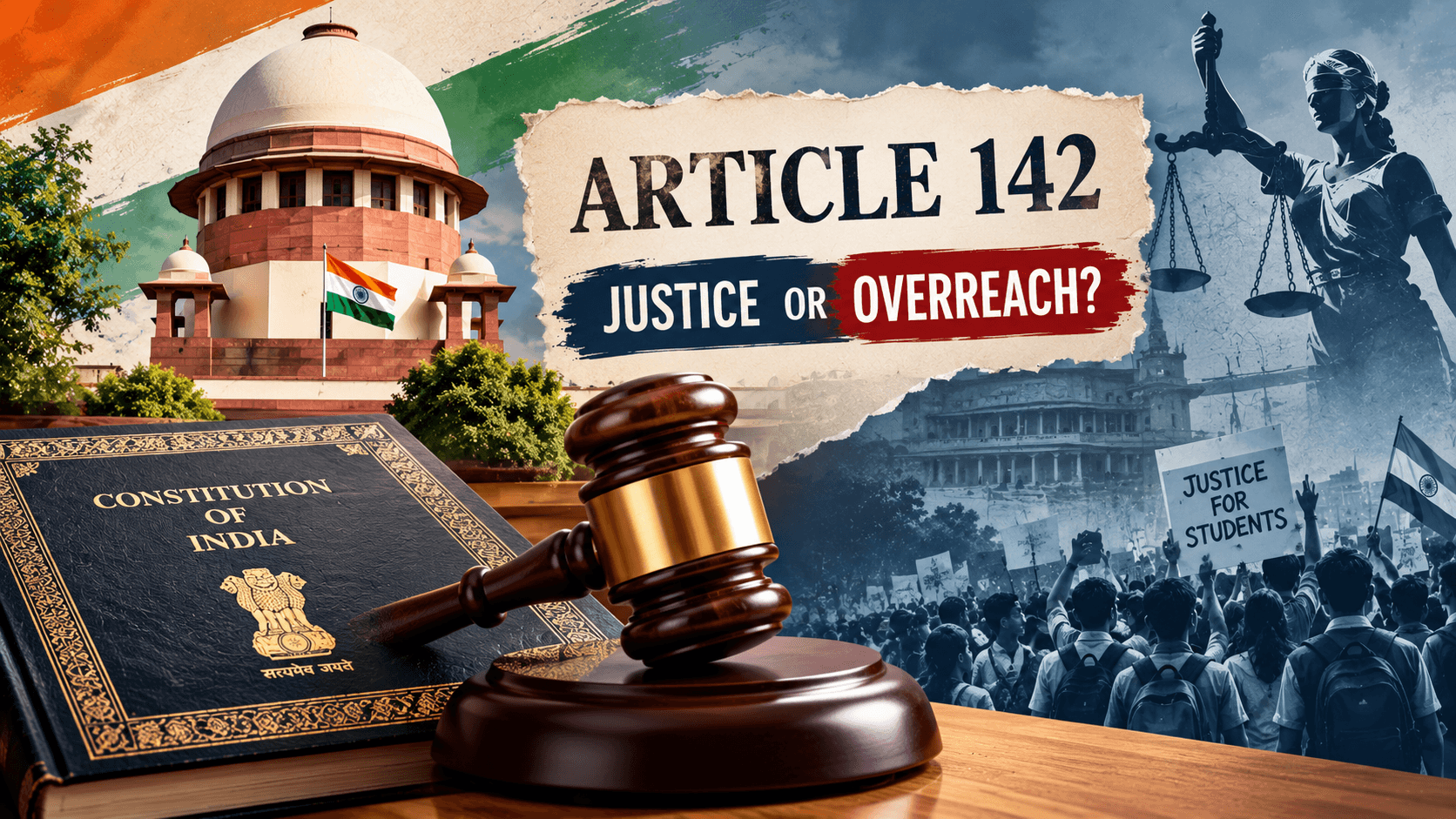
Article 142: Justice or Overreach?
Why in News?
Recently, the Supreme Court used its special powers under Article 142 of the Constitution to quash FIRs filed against those who took part in the nationwide exam protests led by the Cockroach Janta Party (CJP).
The Supreme Court's order gave legal backing to a deal worked out between the Union government and the protesting students over the NEET-UG 2026 paper leak.
By directly clubbing and quashing these FIRs, the court skipped the usual statutory procedure for quashing cases. This has triggered a fresh debate on how far Article 142 can be used and where its limits should lie.
What is Article 142 of the Constitution?
| Defining the Power: | Article 142(1) empowers the Supreme Court to pass any "decree or order as it is necessary for doing complete justice in any cause or matter pending before it." The Constitution notably does not define what "complete justice" means or when it can be used. |
| Article 142(2): | It empowers the Court to secure attendance of persons, discovery of documents, investigation, and punishment for contempt, subject to laws made by Parliament. |
| Historical Origins: | The provision traces back to Section 210 of the Government of India Act, 1935, and earlier colonial practice of deciding cases on "justice, equity, and good conscience" when written law was absent. |
| Constituent Assembly Adoption: | Originally drafted as Article 118, it was adopted in 1949 without any formal debate. Two amendments were moved but later withdrawn. |
| Undefined Scope: | Because it was passed without debate, the Assembly left its vast power open-ended, allowing the Court to shape its boundaries case-by-case over seven decades. |
Significant Historical Invocations
| Frequent Use: | Due to its open-ended nature, it has become one of the most used tools. An IIM Ahmedabad study found 1,579 references and 791 direct invocations between 1950 and 2023, mostly in civil matters. |
| Bhopal Gas Tragedy (1989): | In Union Carbide v. Union of India, the Court invoked Article 142 to approve a USD 470 million settlement and quash criminal proceedings against the corporation. |
| Vishaka Guidelines (1997): | In the absence of a law on workplace sexual harassment, the Court in Vishaka v. State of Rajasthan laid down Vishaka Guidelines, which remained binding till the PoSH Act, 2013, came into effect. |
| Ayodhya Title Dispute (2019): | Used to settle a long-standing dispute on "preponderance of probability" and direct allotment of 5 acres to the Sunni Waqf Board.A.G. |
| Perarivalan Case (2022): | The court invoked Article 142 to order the release of convict A.G. Perarivalan. |
| Matrimonial Disputes: | Regularly used to grant divorce on the ground of irretrievable breakdown of marriage, bypassing statutory waiting periods, and routinely in PILs. |
SC Attempts to Limit Powers under Article 142
| Supplementing, Not Supplanting: | In Supreme Court Bar Association vs. Union of India (1998), the Constitution Bench clarified that Article 142 is meant to supplement a statute by filling gaps, not to supplant or override the existing statutory framework. Despite these self-imposed guardrails, the court has frequently ignored its own cautionary precedents. |
| Consistent with Fundamental Rights: | In Prem Chand Garg vs. State of UP (1962), the court ruled orders under Article 142 must align with fundamental rights and existing substantive law. |
Is this the first time Article 142 has drawn criticism?
This is not the first time when Article 142 has drawn criticism. When the Court used the same provision last year to deem the long-pending Tamil Nadu Bills as assented to, Vice-President Jagdeep Dhankhar called it a "nuclear missile" against democratic institutions.
A similar concern was raised earlier by former Attorney General K K Venugopal. In 2017, he wrote that while Article 142 had done "tremendous good" for deprived sections, it was time to build in checks and balances.
A year later, after the Sabarimala judgment, he went further and described Article 142 as a "Kamdhenu from which unlimited powers flowed." He suggested that only 5 judges on the Constitution Benches should be allowed to invoke it so that its use does not depend on the view of a single smaller bench.
What are the concerns regarding SC's exercise of powers under Article 142?
Circumventing Statutory Schemes: In the CJP protest order, thousands of FIRs were clubbed and quashed without individual scrutiny. Normally, quashing must be examined on its own facts under Section 528 of BNSS, 2023, to see if the offense is made out. Critics say using Article 142 for mere "convenience" supplants legislative procedure.
Undefined and Unfettered Discretion: Absence of a precise definition of "complete justice" gives the Supreme Court very wide discretion. The provision is thus criticized for enabling broad and unchecked judicial power.
Magnification in a Polyvocal Court: The Supreme Court has 34 judges largely sitting in 2-judge Division Benches. When undefined discretion is used by smaller benches, the outcome depends more on the philosophy of that bench than on institutional consistency.
Judicial Overreach: The court has sometimes been criticized for entering areas of legislature or executive, raising concerns about separation of powers, which is part of the basic structure.
Highway Liquor Ban Example: Court invoked Article 142 to ban liquor shops within 500 metres of National Highways and extended it to State Highways, even though state governments had not issued similar notifications. Such interventions raise concerns about extent of judicial discretion and balance between judicial activism and judicial restraint.
Lack of External Checks: Limitations on Article 142 are entirely self-imposed by the judiciary itself. If a bench ignores limits set by earlier Constitution Benches, no outside institution can enforce those guardrails.
Global Perspective: Extraordinary Judicial Powers
South Africa: Section 172(1)(b) of its Constitution empowers courts to make "any order that is just and equitable" when deciding constitutional matters, providing a constitutional basis for remedial judicial intervention.
Canada: Courts can grant "appropriate and just" remedies under Section 24(1) of the Canadian Charter of Rights and Freedoms for violations of constitutional rights.
Way Forward
Larger Benches for Invocation: As suggested by legal experts, power to invoke Article 142 should be restricted to Constitution Benches of at least five judges to ensure collective wisdom and consistency.
Mandatory Reasoning on Record: Every exercise of Article 142 should be backed by reasoned orders and the principle of proportionality, clearly explaining what statutory gap is being filled and why intervention is necessary.
Strict Adherence to Precedent: The judiciary must institutionalize principles laid down in the Supreme Court Bar Association case, ensuring Article 142 is used strictly as a curative tool of last resort and not as a shortcut to bypass established criminal or civil procedure.
Conclusion
Article 142 is meant to be a power to do complete justice when law is silent, not a tool of convenience to bypass law when it exists. Its strength lies in its flexibility, but that same flexibility makes it risky if used without restraint. What it needs is not removal but discipline, larger benches, clear reasoning, and strict respect for precedent. Only then can it remain what the Constitution intended: an exceptional remedy to fill gaps, not a routine shortcut to override statute.