Parliamentary panel: Fixing India's Healthcare Affordability Crisis
Why in News?
The Parliamentary Standing Committee on Health and Family Welfare has dropped a reality check on India's healthcare system. Its latest report, titled 'Affordability and Accessibility of Healthcare Facilities in the Public and Private Sectors,' tabled in Parliament last month, has flagged serious gaps and made 368 recommendations to fix them.
The Big Finding: 40 Crore Indians Stuck in the Middle
More than 40 crore Indians, over 25% of our population, are stuck in a dangerous healthcare gap. They are too well-off for government subsidies but not rich enough to afford private healthcare. One illness, one hospitalization, and their finances collapse.
Where is the problem?
The report says the vulnerability comes from where we go for treatment:
Over 60% of inpatient care and 70% of outpatient care is provided by the private sector
Without proper insurance, families are forced to pay private hospital prices from their own pockets.
This pushes millions into debt every year.
India depends heavily on private hospitals but has no financial shield for those who use them.
The Real Financial Risk:
The primary financial risk for this 40-crore population is not a single catastrophic hospital admission but the slow, steady erosion of household income through recurring outpatient costs like medicines, consultations, and diagnostic tests.
Key Drivers of the Crisis:
| Escalating NCD Burden: | Rising prevalence of diabetes, hypertension, and cardiovascular diseases has turned outpatient care and medication into an unavoidable, lifelong recurring expense. |
| Stark Public-Private Cost Disparities: | Out-of-pocket expenditure differs sharply. The average cost of childbirth in private hospitals is Rs 37,630, more than 16 times higher than Rs 2,299 in public facilities. |
| High Outlay on Pharmaceuticals: | Medicines constitute nearly 30% of India's current health expenditure. This is worsened by unregulated trade margins and over-the-counter antibiotic sales without prescriptions. |
| Underfunding in Public Health: | Government health spending is only 1.43% of GDP, far below the National Health Policy 2017 target of 2.5% by 2025. Health expenditure as share of total government spending also dropped from 6.12% in 2021-22 to 4.89% in 2022-23, below pre-pandemic 5.02% in 2019-20. |
| Limitations of Insurance-Centric Models: | Insurance alone fails to address the gap. Private policies have high premiums, long waiting periods, co-payments, and disease exclusions, and they focus on secondary and tertiary hospitalization while ignoring primary and outpatient care, where the real burden lies. |
What are the key recommendations of the Parliamentary Standing Committee on Healthcare Affordability?
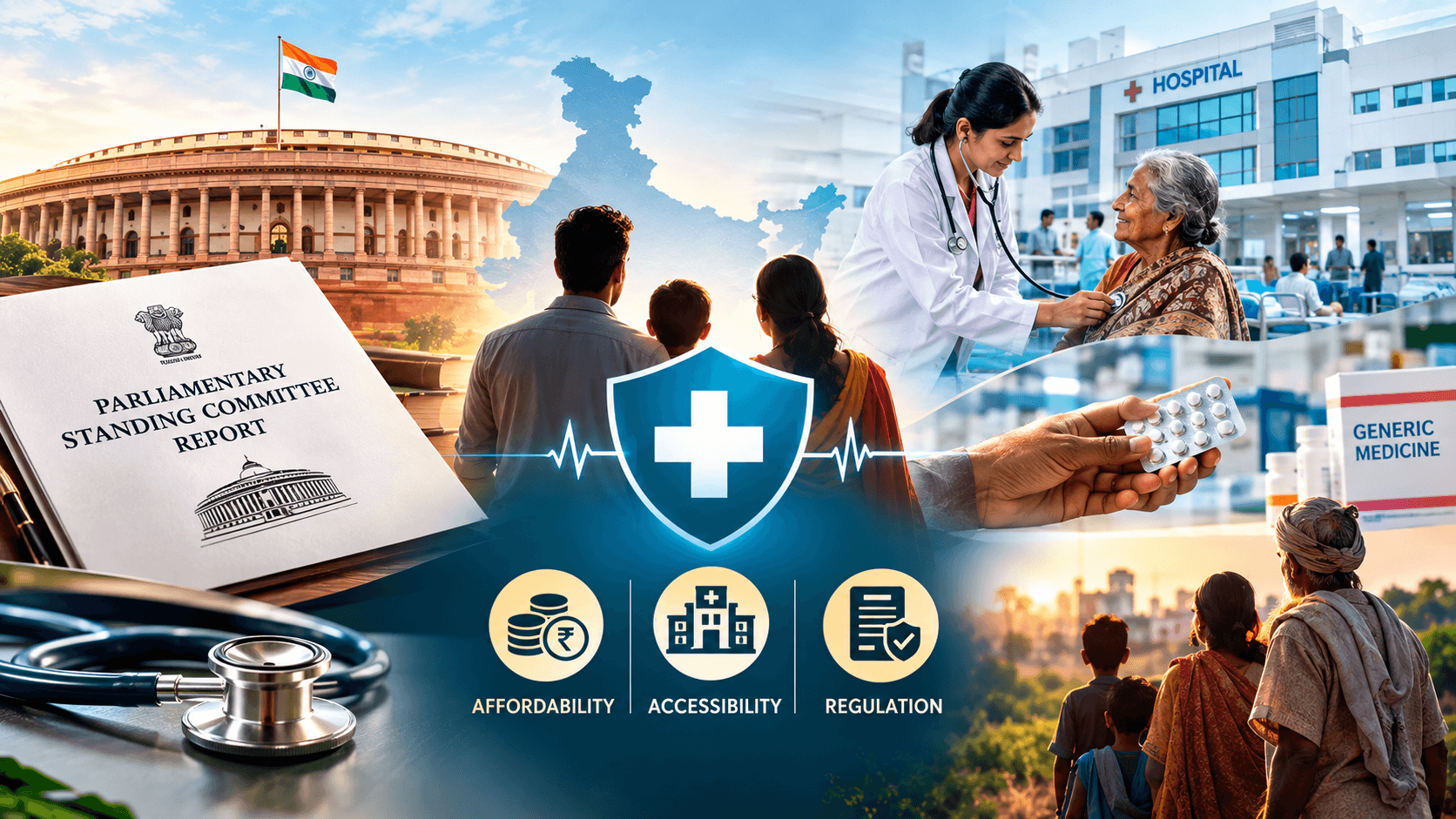
With 368 suggestions, the report pushes for a complete overhaul around three pillars:
| Affordability: | Capping costs, regulating private hospital billing, and expanding insurance coverage |
| Accessibility: | Strengthening public health facilities so people have a real choice beyond private care |
| Regulation: | Bringing transparency and accountability in pricing and quality of care in both public and private sectors |
Other key recommendations
Prioritize Public Capacity Over Insurance: The Committee says fix government hospitals first, instead of just buying care from private hospitals through insurance. It calls for urgent regulation of private hospital procedure prices to protect the uninsured 'missing middle' from exploitation.
Promoting Generic Medicines: Doctors should be mandated to prescribe drugs by generic names, not brand names. The public system must stock the full essential drug list at every facility to make it the primary affordable outlet. The report also flags excessive trade margins and the sale of antibiotics without prescription and calls for strict audits and enforcement.
Establishing a Public Health Management Cadre: A dedicated management cadre should run public hospitals so that specialist doctors are not burdened with administrative work and can focus on patients.
Nationwide Enforcement of the Clinical Establishments Act: The Clinical Establishments (Registration and Regulation) Act, 2010, must be implemented across all states to ensure standard treatment protocols, quality benchmarks, and mandatory price transparency in private hospitals.
Outpatient-Centric Protection Frameworks: Health financing must move beyond only covering big hospital admissions. It should include OPD care, diagnostic subsidies, and chronic disease management to stop families from falling into poverty due to daily costs of staying healthy.
About Universal Health Coverage (UHC)
Universal Health Coverage means everyone gets quality essential healthcare, from promotion, prevention, and treatment to rehabilitation and palliative care, without facing financial hardship.
Status of Health Coverage & Insurance in India: Ayushman Bharat Pradhan Mantri Jan Arogya Yojana (AB PM-JAY) is the anchor, covering the bottom 40% of the population. With the 2024 expansion, all citizens aged 70 and above are now covered irrespective of income under Ayushman Bharat Vay Vandana. This has driven the issuance of over 45.5 crore Ayushman Cards by August 2026.
India’s Foundational Health Insurance and Coverage Initiatives:
Ayushman Vaya Vandana Employees' State Insurance Scheme (ESIS), Central Government Health Scheme (CGHS), National Health Mission (NHM), and PM-Bharatiya Janaushadhi Pariyojana.
Conclusion
The Parliamentary Standing Committee report makes one thing clear: insurance alone cannot deliver universal health coverage. True UHC in India will come only when we strengthen public hospitals, regulate private prices, make generic medicines the norm, enforce the Clinical Establishments Act across all states, and shift focus from hospitalization to everyday OPD care. Covering 40 crore 'missing middle' Indians is not just a health target; it is an economic necessity. Unless everyday costs of medicines, tests, and consultations are protected, households will keep slipping into poverty while trying to stay healthy. The path to UHC is not about buying more private care but about building a public system people can trust.