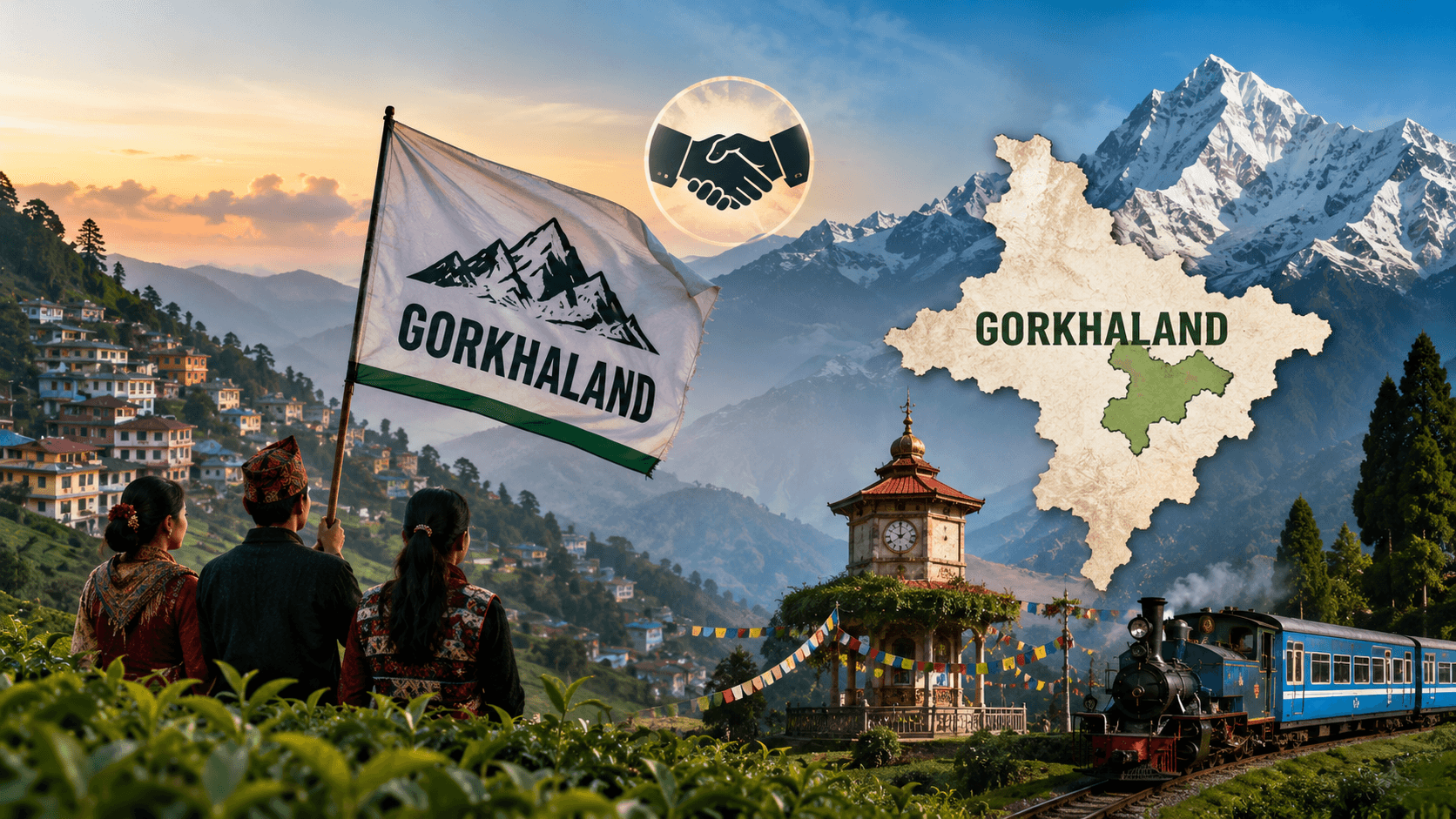
Gorkhaland: The Road Ahead to a Permanent Solution
Why in News?
The demand of Gorkhaland is making headlines once again. The Union Ministry of Home Affairs has formed a high-level committee after a key meeting of Gorkha leaders with the union home minister and West Bengal government representatives in Siliguri.
The mandate of this committee is big—to examine the Gorkhaland issue and prepare a framework for a "permanent political solution." The new MHA committee headed by Pankaj Kumar Singh is a crucial opportunity.
About the Gorkhaland Issue
The Gorkhaland issue is a century-old demand for a separate political and administrative identity for the Nepali-speaking Gorkha population living in the Darjeeling hills of West Bengal. It is essentially a demand for greater representation, protection of identity, and autonomy.
What is the core demand?
The main demand is for a separate state of Gorkhaland, covering Darjeeling hills and adjoining areas of Terai and Dooars in North Bengal. The exact territorial map has changed over time.
Why this demand?
| Ethno-linguistic difference: | The people of the Kalimpong, Kurseong, Terai, Dooars, and Darjeeling hills are ethnically, culturally, and linguistically distinct from the Bengali-majority plains. The region is predominantly Nepali speaking. Due to their distinct features, locals often face racial profiling and are wrongly seen as foreigners from Nepal or China. This alienation has created an identity crisis, pushing them to demand a separate state to assert themselves as Indian citizens. |
| Economic deprivation: | Despite earning huge revenue for the state through Darjeeling tea, timber, and tourism, the hills have long complained of neglect, poor infrastructure, and lack of development. |
Historical roots
This is not a new demand. It started way back in 1907, when the Darjeeling Hillmen's Association led by Sonam Wangel Laden La petitioned the Minto-Morley Reforms Committee to separate Darjeeling and Jalpaiguri from Bengal.
Later, groups like the Gorkha Officers' Association and the Kurseong Gorkha Library took it to the Simon Commission (1929) and demanded a Chief Commissioner's Province for direct British rule. In 1947, the undivided CPI even submitted a memorandum for "Gorkhasthan" to Nehru and Liaquat Ali Khan.
How Did the Gorkhaland Movement Evolve?
The demand turned violent and mainstream in the 1980s under Subhas Ghising, founder of the Gorkha National Liberation Front (GNLF), who coined the term "Gorkhaland." The unrest led to the creation of Darjeeling Gorkha Hill Council (DGHC) in 1988, a semi-autonomous body that ran the hills for 23 years.
In 2007, Bimal Gurung broke away and formed Gorkha Janmukti Morcha (GJM), reigniting the movement. This led to the Gorkha Territorial Administration (GTA) in 2011 replacing DGHC. When Telangana was announced in 2013, Darjeeling again erupted with strikes, and central forces had to be deployed.
The longest unrest came in 2017—104 days. The trigger was the West Bengal government's decision to make Bengali mandatory in state schools. On June 8, 2017, as the state cabinet met in Darjeeling, clashes broke out, outposts were burnt, and the army was called. 11 protesters died, bomb blasts killed a civic volunteer, and tourism collapsed.
What is the political landscape today?
2017 changed hill politics forever.
State action forced Bimal Gurung underground. His close aides Anit Thapa and Binay Tamang split and aligned with TMC, dividing the Gorkha vote bank—TMC for local bodies and BJP for national elections.
In the GTA elections of June 2022 (held after 10 years), Thapa's new party Bharatiya Gorkha Prajatantrik Morcha (BGPM) won 27 of 45 seats and took control. BJP and Gurung's GJM had boycotted.
But electorally, BJP remains dominant. It won Darjeeling Lok Sabha in 2019 and 2024, and in the May 2026 Assembly elections, it swept all three hill seats—Darjeeling, Kalimpong, and Kurseong.
What Will the New Committee Do?
The committee will examine all dimensions of the Gorkha issue within the framework of the Indian Constitution. As Home Minister Amit Shah said, the Centre aims for a "just, dignified, and lasting political resolution that respects the aspirations of the Gorkha community."
For aspirants, the key question to watch is—will the solution be another autonomous council with more powers, a union territory model, or a full statehood? The answer will have implications for Article 3, federalism, and the politics of smaller states.
What are the challenges in solving the Gorkhaland issue?
| Clash of Sub-Nationalisms: | Gorkhas want identity and statehood, but West Bengal strongly opposes any further division of the state due to concerns over territorial integrity, economy, and administrative unity. |
| Strategic Location—Siliguri Corridor: | Darjeeling borders Nepal, Bhutan, and Bangladesh and sits very close to the Chicken's Neck, the narrow strip that connects mainland India to the Northeast. Any political instability here directly impacts national security. |
| Too Many Stakeholders: | Hill politics is deeply fragmented—GJM, GNLF, BGPM, and others. It is very difficult to bring all rival leaders to agree on one solution short of full statehood. |
| Financial Viability: | The region's economy depends mainly on tea, which is struggling, and seasonal tourism. A new state, like UT, cannot survive on its own without huge central funding and a long-term economic plan. |
Way Forward
| Empowered Autonomy—Sixth Schedule Model: | Nepali is already recognized in the 8th Schedule by the 71st Amendment, 1992. Instead of a separate state, bringing Darjeeling hills under the Sixth Schedule (Article 244) can give real autonomy, democratic decentralization, and protection of land and cultural rights. |
| Fiscal Devolution: | Any new arrangement drafted by the Pankaj Kumar Singh Committee must have its own revenue powers and direct central grants, bypassing the state govt. bottleneck that made DGHC and GTA fail. |
| Economic Masterplan: | ecotourism, |
| Inclusive Development: | Invest in education, tea reforms, horticulture, and ecotourism through schemes like PM-DevINE and PRASAD to ensure long-term growth. |
Conclusion
The Gorkhaland issue is not just about a separate state; it is about identity, dignity, and development. A century of petitions, agitations, and failed councils like DGHC and GTA shows that half-hearted autonomy does not work. The solution must balance three things—Gorkha aspirations, West Bengal's territorial concerns, and national security around the Chicken's Neck.
This topic is equally significant for BPSC & UPSC aspirants, and they can Link this with demand for statehood under Article 3, 6th Schedule vs. special autonomous councils, and how identity movements are managed in a diverse democracy. it also connects identity politics, federalism, and regional aspirations - a recurring theme in GS-2.