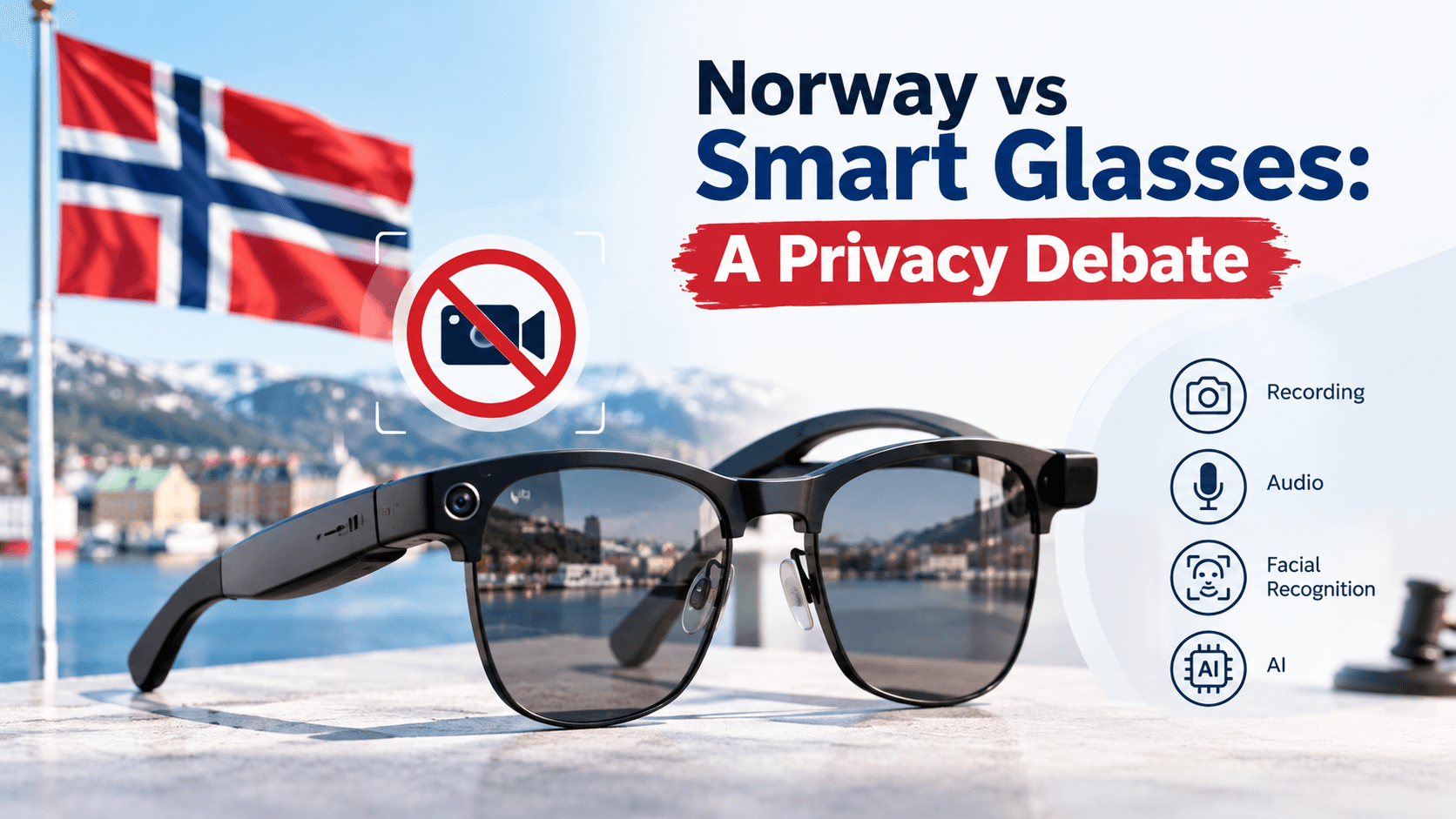
Norway vs Smart Glasses: A Privacy Debate
Why in News?
Norway, a European country, is proposing temporary restrictions on smart glasses in public and sensitive spaces due to rising concerns over covert recording, facial recognition, and privacy violations. The government plans to ban their use in places where people expect personal privacy.
This comes as smart glasses equipped with HD cameras, ambient audio recording, and AI are becoming common across Europe, blurring the line between innovation and privacy. Since these devices can capture photos, record conversations, and livestream without people nearby noticing, regulators across Europe are considering similar curbs.
The move could affect device sales and push manufacturers to strengthen privacy safeguards, as governments try to prevent misuse while still allowing technological innovation.
What Are Smart Glasses?
Smart glasses are wearable devices that look like ordinary spectacles but come with built-in cameras, microphones, speakers, and other smart features. Some models allow users to take photos, record videos, make calls, and access AI-powered assistance.
Although these devices offer convenience, their ability to record people discreetly has raised serious questions about privacy and personal security.
Why Are Smart Glasses Becoming a Privacy Concern?
| Risk of Unauthorized Recording | Unlike smartphones, smart glasses allow users to record images and videos without visibly holding a camera. This makes it difficult for people nearby to know when they are being recorded. |
| Threat to Personal Privacy | Continuous recording and livestreaming can turn public spaces into environments where people feel they are constantly being watched. The risk becomes more serious in private or sensitive locations, such as changing rooms, medical facilities, and other restricted areas. |
| Concerns Over Facial Recognition | When smart glasses are combined with facial recognition software, they may potentially be used to identify people without their knowledge or consent. This raises concerns about surveillance, misuse of personal information, and the protection of individual rights. |
| Security Risks in Sensitive Locations | Smart glasses equipped with cameras may pose security challenges in government buildings, courts, examination centers, and other restricted premises. Unauthorized recording in such locations could expose confidential information. |
Are Worldwide Governments Already Restricting Smart Glasses?
Restrictions on smart glasses are emerging in different places, although the rules vary by location.
- United States: Some nightclubs, gyms, and courts in New York have introduced local restrictions on smart glasses. Policy discussions have also focused on covert recording and privacy protection.
- Bangkok, Thailand: Smart glasses use is restricted in certain pubs and public venues.
- Security checkpoints: Some facilities require visitors to surrender smart glasses or other recording-capable devices before entering restricted areas.
These measures reflect a wider debate over how to balance technological progress with privacy and public safety.
What Is India's Legal Position on Privacy?
In India, there has been much buzz about privacy in recent years, such as the most debatable and, of course, burning & crucial issues related to Pegasus. But there is no such point of discussion regarding the restricted use of smart glasses being in the news. However, the debate of privacy has been making headlines off and on. Similarly, the phone-tapping issues were in the top headlines of the previous governments. The civil society in India has taken it seriously, and eventually it has been a precious tool to demonize opposition leaders. In the wake of such public outrage regarding the concern related to privacy, the Digital Personal Data Protection Act, 2023, has been passed by the parliament. There are many legal provisions related to the issue of privacy.
Right to Privacy under Article 21
The Supreme Court's Putt-Swamy judgment established privacy as a fundamental right. Restrictions on privacy must be assessed within the constitutional framework, including applicable requirements of legality, legitimate purpose, and proportionality.
Digital Personal Data Protection Act, 2023
The Digital Personal Data Protection (DPDP) Act, 2023, establishes a framework for processing digital personal data. The DPDP Rules were notified in November 2025, with commencement provisions applying on different timelines. The Act may be relevant when personal data collected through smart glasses is processed digitally. However, its precise application depends on the circumstances, applicable exemptions, and the provisions in force at the relevant time.
Information Technology Act, 2000
Section 66E of the Information Technology Act addresses the intentional or knowing capture, publication, or transmission of images of a person's private area without consent in circumstances violating privacy. It provides for imprisonment of up to three years, a fine of up to ₹2 lakh, or both. This provision is relevant to specific forms of privacy violations; it does not amount to a blanket prohibition on all recording through smart glasses.
How Could a Smart Glasses Ban Affect Manufacturers?
Strict restrictions could create challenges for smart-glasses manufacturers and technology companies.
- Impact on sales: Restrictions in public venues or specific markets could reduce consumer demand.
- Product redesign: Companies may need to introduce clearer recording indicators, stronger privacy controls, and safeguards against misuse.
- Higher compliance costs: Manufacturers could face additional expenses to meet different rules across countries and regions.
- Innovation challenges: Unclear or inconsistent regulations may make it harder for businesses to plan product launches and expand into new markets.
However, clear and balanced regulations could also build consumer trust and encourage responsible innovation.
What Is the Way Forward?
A complete ban may not always be necessary. Governments can consider targeted measures that address genuine risks without unnecessarily limiting useful technology.
Possible steps include:
- Requiring visible indicators whenever recording is active.
- Prohibiting recording in private and highly sensitive spaces.
- Establishing clear rules for collecting, storing, and sharing recorded data.
- Restricting unauthorized facial recognition and identification.
- Improving public awareness about privacy rights and responsible device use.
Manufacturers should also adopt privacy-by-design principles, ensuring that safeguards are built into devices from the beginning rather than added after problems arise.
Conclusion
Smart glasses highlight a growing challenge in the age of wearable AI: technology is becoming more powerful, but it is also becoming less visible. The key question is not simply whether smart glasses should be banned, but how society can protect privacy and security without blocking technological progress. A balanced regulatory approach, supported by responsible manufacturers and informed users, can help ensure that wearable technology remains useful without compromising individual rights.