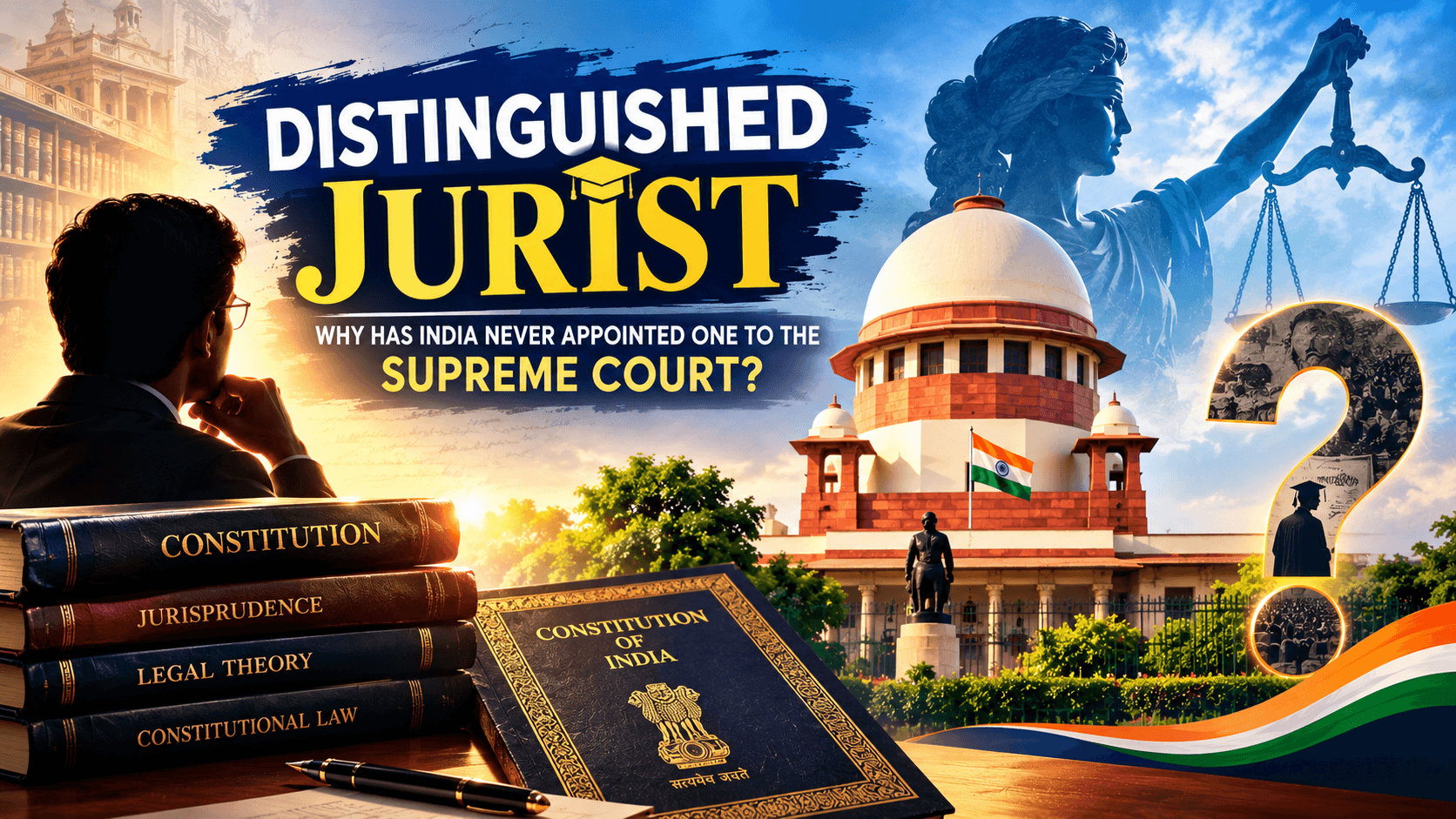
‘Distinguished jurist’: Why has India never appointed one to the Supreme Court?
Why in News?
Recently, while addressing a convocation at the National Law University, Delhi, a Supreme Court judge flagged a forgotten power of the Constitution, the provision to appoint a “distinguished jurist” directly to the Supreme Court.
Surprisingly, even after 76 years of the Constitution being in force, this clause has never been used to bring a legal academic or a scholar of law to the apex court.
What is the constitutional provision regarding ‘distinguished jurist'?
Article 124(3) of the Indian Constitution: It lays down who can become a Supreme Court judge.
As per the article, a person must be a citizen of India and fulfill any one of these three conditions:
Has been a judge of a high court for at least five years OR has been an advocate of a high court for at least ten years OR, in the opinion of the president, a "distinguished jurist."
While the first two routes are regularly used, such as judges elevated from High Courts and senior advocates picked from the Bar, the third route of a distinguished jurist has remained a dead letter, never used to date.
For High Court: Interestingly, High Courts originally had no such provision under Article 217. During the Emergency, the 42nd Constitutional Amendment Act, 1976, inserted a clause to allow a distinguished jurist to be appointed as a High Court judge.
However, this was seen as an Emergency-era overreach and was soon undone. The 44th Constitutional Amendment Act, 1978, repealed it to restore the original position.
Who is a "Distinguished Jurist"?
Distinguished Jurist: The Constitution does not define the term. But it is commonly understood as someone with outstanding expertise in legal theory, constitutional law, teaching, or jurisprudence: a person who has made a mark through serious and pathbreaking legal scholarship. Crucially, this route opens the door for brilliant legal minds to reach the Supreme Court even without a long career as a judge or a courtroom lawyer.
Historical Background:
| Constituent Assembly Debates: | This visionary clause was introduced in May 1949 by H.V. Kamath. He argued that the Supreme Court should not be limited to only judges and practicing lawyers; it must also welcome great legal thinkers. |
| Global Precedents: | The world already showed the way. Judges to the International Court of Justice (ICJ) and even the US Supreme Court, like Harvard professor Felix Frankfurter in 1939, have been picked straight from academia. |
| Dr. B.R. Ambedkar’s View: | Dr. Ambedkar backed the idea. He even debated whether the word "eminent" would be more appropriate than "distinguished," showing how seriously the framers took the need for scholarly wisdom on the bench. |
Why Does the Supreme Court Need Distinguished Jurists?
| Diversifying the Bench: | The Supreme Court is not just a court that decides cases; it is the nation’s constitutional conscience-keeper. Academics can bring fresh, independent perspectives beyond routine courtroom thinking. |
| Beyond Technicalities: | Jurists have a macro-view of the law. They are less likely to get stuck in narrow procedural technicalities and more likely to focus on the larger justice of the law. |
| Focus on Public Law and Policy: | The apex court often deals with deep constitutional and public law questions. Renowned scholars can bring comparative research, interdisciplinary insights, and solid theoretical grounding to landmark judgments. |
Why Has India Never Appointed One?
| Limited Consideration: | The provision has simply never been explored seriously by the government or the collegium. As legal scholar Upendra Baxi famously said, presidents have looked through a "telescope" and found no one making it a dead issue. |
| No Institutional Pathway: | Unlike the Supreme Court, High Courts cannot appoint distinguished jurists (the provision was repealed in 1978). So, academics never get a judicial entry point. |
| The Collegium Hurdle: | On paper, the power lies with the President, but in practice, appointments are initiated by the Collegium, which traditionally prefers sitting High Court judges and senior advocates. |
| Bar Council Barrier: | Under Rule 49 of the BCI, full-time law teachers cannot practice law. This creates a wall between academic brilliance and courtroom experience. |
| Succession and Seniority Concerns: | The CJI is appointed by seniority. Bringing a younger academic directly to the Supreme Court could disrupt the established succession line. |
| Used as Advisors, Not Judges: | Instead of making them judges, the Court often uses top scholars as amicus curiae (friends of the court) in complex cases, taking their expertise without giving them a seat on the bench. |
| The Pay Gap: | Top lawyers and scholars earn far more in practice, consultancy, and academia than a judge’s salary. This huge financial cut discourages many brilliant minds from joining the bench. |
Conclusion
It is indeed heartening that Article 124(3) provides three different pathways to become a Supreme Court judge, but while the first two clauses related to judges and advocates have been regularly used, the third provision of "distinguished jurist" has never been invoked even once. This clause was a visionary idea of our Constitution-makers. The aim was to ensure that the Supreme Court is not just a court of lawyers and judges but a court of great legal thinkers. Yet, even after 76 years, it has remained mere ink on paper. Appointing a jurist will not be easy because it will require the Collegium to look beyond the traditional bar and bench, the Bar Council to rethink its rigid rules, and the system to evolve a clear method to identify true scholarly excellence. However, if used wisely, it can enrich the Court with fresh ideas, deep theoretical grounding, and a broader constitutional imagination. In doing so, it would truly fulfill the vision of H.V. Kamath and Dr. B.R. Ambedkar, a Supreme Court that blends practical wisdom with intellectual brilliance.