Collegium system: End the Culture of Secrecy in Judicial Appointments
Why in the news?
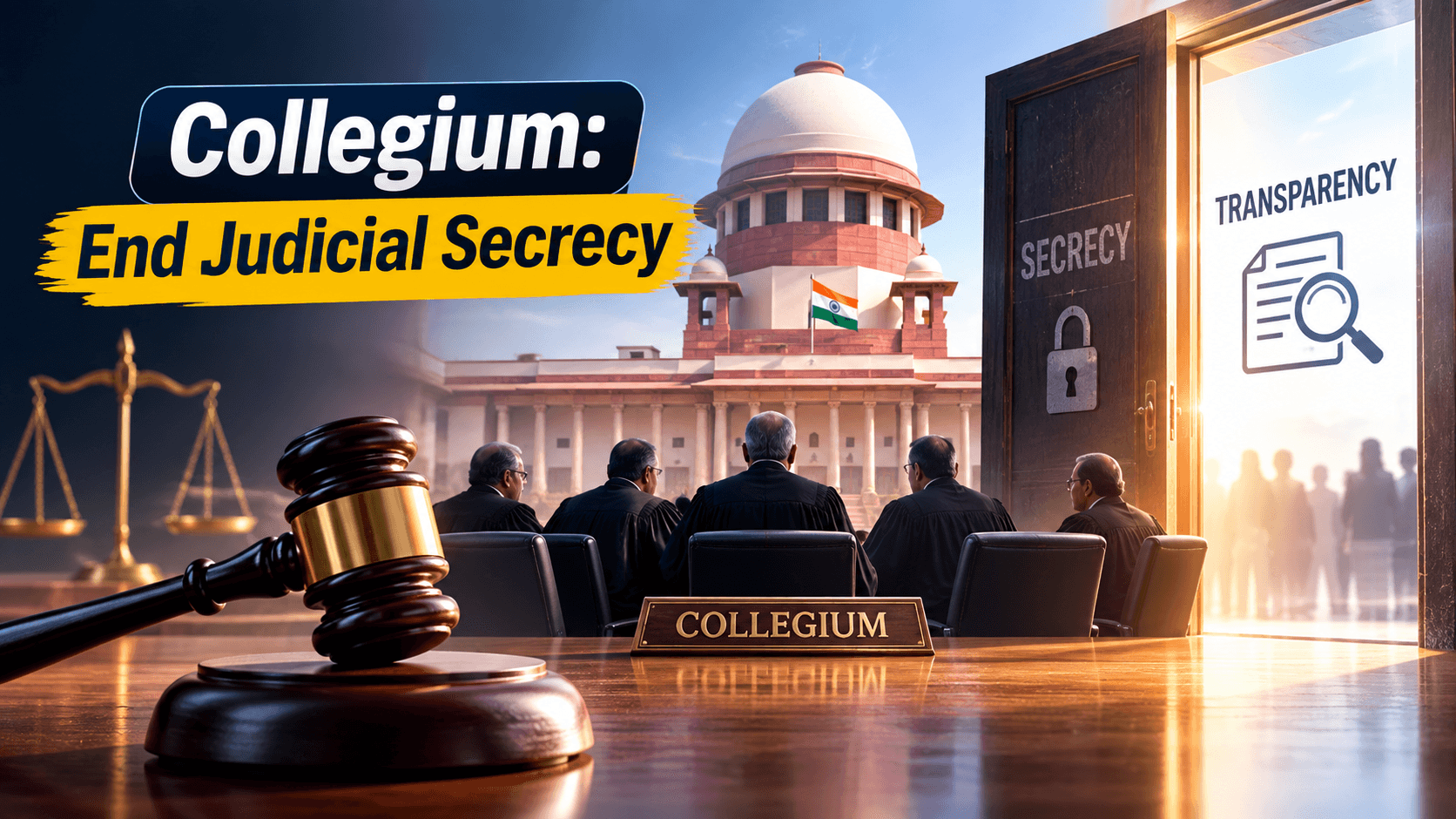
Recently, the debate over transparency in judicial appointments is back in focus after Supreme Court Justice Ujjal Bhuyan recently observed that greater openness in the collegium process would strengthen public trust and ensure that merit remains the guiding principle. Reformers argue that protection from political interference was never meant to become protection from constitutional accountability—a question that has remained unresolved for the last three decades. It is a matter of great concern that a judiciary that demands transparency from every institution of governance cannot itself ask citizens to trust it on blind faith.
What is the Collegium System?
The Collegium System is India's own method for appointing and transferring judges to the Supreme Court and High Courts. It is not written anywhere in the Constitution but has evolved through three landmark judgments of the Supreme Court, known as the Three Judges Cases. Evolution of the System.
| First Judges Case (1981) | The Supreme Court held that the word "consultation" in Articles 124(2) and 217 does not mean "concurrence." This gave primacy to the executive, meaning the government had the final say in judicial appointments. |
| Second Judges Case (1993): | The court overruled its earlier decision. It said "consultation" actually means concurrence, and the CJI's advice would be binding on the President. But before giving such advice, the CJI must consult his two senior-most colleagues. This judgment created the Collegium System and shifted primacy to the judiciary. |
| Third Judges Case (1998): | To make the system more broad-based, the Court expanded the Collegium. It said the CJI should consult four senior-most judges after him, not just two. |
Composition and Role of Government
| SC Collegium: | Consists of the CJI and four senior-most judges of the Supreme Court. |
| HC Collegium: | Consists of the Chief Justice of the High Court and its two senior-most judges. |
| What does the government do? | The government can raise objections and seek clarifications, but if the Collegium reiterates the same name, the government is bound to appoint that person. |
The Constitution lays down the basic framework for appointing judges.
What the Constitution Says:
| Article 217: | High Court judges are appointed by the President after consultation with the CJI, the Governor of the state, and the Chief Justice of that High Court. |
| Article 124: | Judges of the Supreme Court are appointed by the President after consultation with the CJI and other judges as he deems necessary. |
Special Provisions:
| Ad hoc Judges (Article 127): | If there is no quorum in the Supreme Court, the CJI with the President's consent can ask a High Court judge to sit in the Supreme Court. |
| Acting CJI (Article 126): | president |
| Retired Judges (Article 128): | With the President's consent, the CJI can request a retired Supreme Court judge to sit and act as a judge of the Supreme Court for a temporary period. |
How Appointments Actually Happen:
| CJI: | The outgoing CJI recommends his successor, usually on the basis of seniority. |
| SC Judges: | proposal and |
| HC Chief Justices / Judges: | The Chief Justice of a High Court is appointed by the President in consultation with the CJI and the Governor. For other HC judges, the same procedure is followed, with the additional consultation of the Chief Justice of the concerned High Court. |
Arguments For and Against the Collegium System
The Collegium has always been debated—some see it as the guardian of judicial independence, others as an opaque club. Arguments For the Collegium
1. Separation of Powers: It keeps the judiciary independent from the executive and legislature. This is in line with Article 50, allowing judges to work without fear or political pressure.
2. Preservation of Judicial Integrity: Senior judges are best placed to judge a candidate's legal knowledge, integrity, and temperament. The idea of "judges choosing judges" protects the dignity and autonomy of the institution and reduces the risk of corruption or political bargaining in appointments. Arguments Against the Collegium
1. Lack of Transparency: The biggest criticism is secrecy. There is no published procedure, no clear criteria for selection, and no reasoned explanation for rejection. This breeds nepotism and favoritism, often called the "uncle judge syndrome."
2. Misuse of Power: Power gets concentrated in the hands of 5 senior judges. There is no real check on their authority, raising questions of accountability.
3. Inequitable Representation: Data shows a serious skew. Between 2018 and 2022, 79% of High Court judges came from upper-caste backgrounds, while SC/ST/OBC communities remain poorly represented. Women are only 4% of Supreme Court judges. Plus, with 331 High Court vacancies in 2024, the system is also seen as slow and inefficient.
What was the alternative? – NJAC
To fix this, Parliament passed the 99th Constitutional Amendment in 2014 and created the National Judicial Appointments Commission (NJAC). It proposed to include the CJI, two senior judges, the law minister, and two eminent persons to make the process more transparent and merit-based. However, in 2015, in the Fourth Judges Case (SC Advocates-on-Record Association vs Union of India), the Supreme Court struck down the NJAC as unconstitutional, saying it threatened judicial independence by giving too much power to the executive.
Conclusion
The Collegium system was born to protect judicial independence from executive interference, but over three decades it has itself become a symbol of opacity and unaccountability. Justice Bhuyan’s call for openness is a reminder that independence cannot mean isolation. A judiciary that holds every other institution to the standard of transparency must apply the same standard to itself. The solution is not to go back to executive dominance, nor to keep the present secrecy intact. What India needs is a reformed, more transparent collegium—one where criteria are published, reasons are recorded, diversity is consciously promoted, and the process earns public confidence, not just legal validity. Only then will the appointment of judges truly reflect the constitutional values of merit, accountability, and trust.