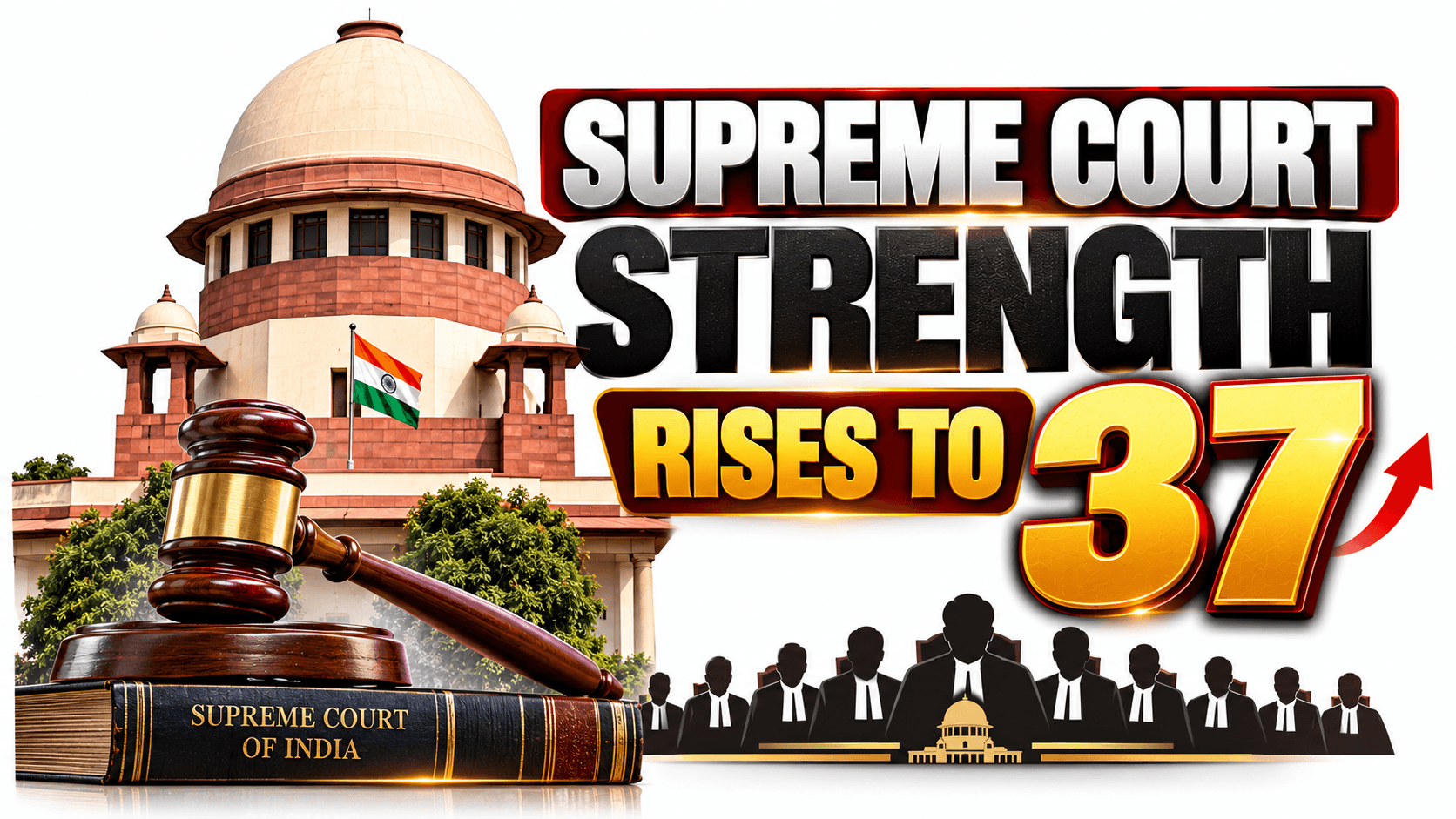
Supreme Court Strength Rises to 37
Why in News?
The Supreme Court has got three new judges, taking its working strength to 37. The appointments come as the court faces a large backlog of cases. Justice S. Muralidhar, Justice Devendra Kumar Upadhyay, and Justice K. R. Shriram have been appointed as Supreme Court judges.
The appointments were recommended by the Supreme Court Collegium and notified by the Centre. With these appointments, the number of judges in the Supreme Court has increased to 37.
Women Judges in Focus
With the appointment of Justice Sunita Agarwal, the number of women judges in the Supreme Court has increased to three. She is the second woman judge recommended by the CJI Surya Kant-led Collegium, after Justice V. Mohana, who was elevated earlier.
This comes after the Supreme Court (Number of Judges) Act, 2026, received presidential assent in August, raising the total strength of Supreme Court judges from 34 to 38, including the CJI. Earlier in June, five new judges were appointed to the court.
Earlier, the Supreme Court had two women judges. Justice B. V. Nagarathna is expected to become the first woman Chief Justice of India in 2027.
Other key points
Justice Muralidhar previously served as Chief Justice of the Orissa High Court. Justice Upadhyay was Chief Justice of the Manipur High Court and earlier headed the Jharkhand High Court. Justice K. R. Shriram was Chief Justice of the Madras High Court.
What is Collegium?
The Collegium System is India's unique mechanism for the appointment and transfer of judges to the Supreme Court and High Courts.
It is not mentioned anywhere in the Constitution. Instead, it has evolved over time through three landmark Supreme Court judgments, collectively known as the Three Judges Cases.