Tribunal Reforms Bill, 2026
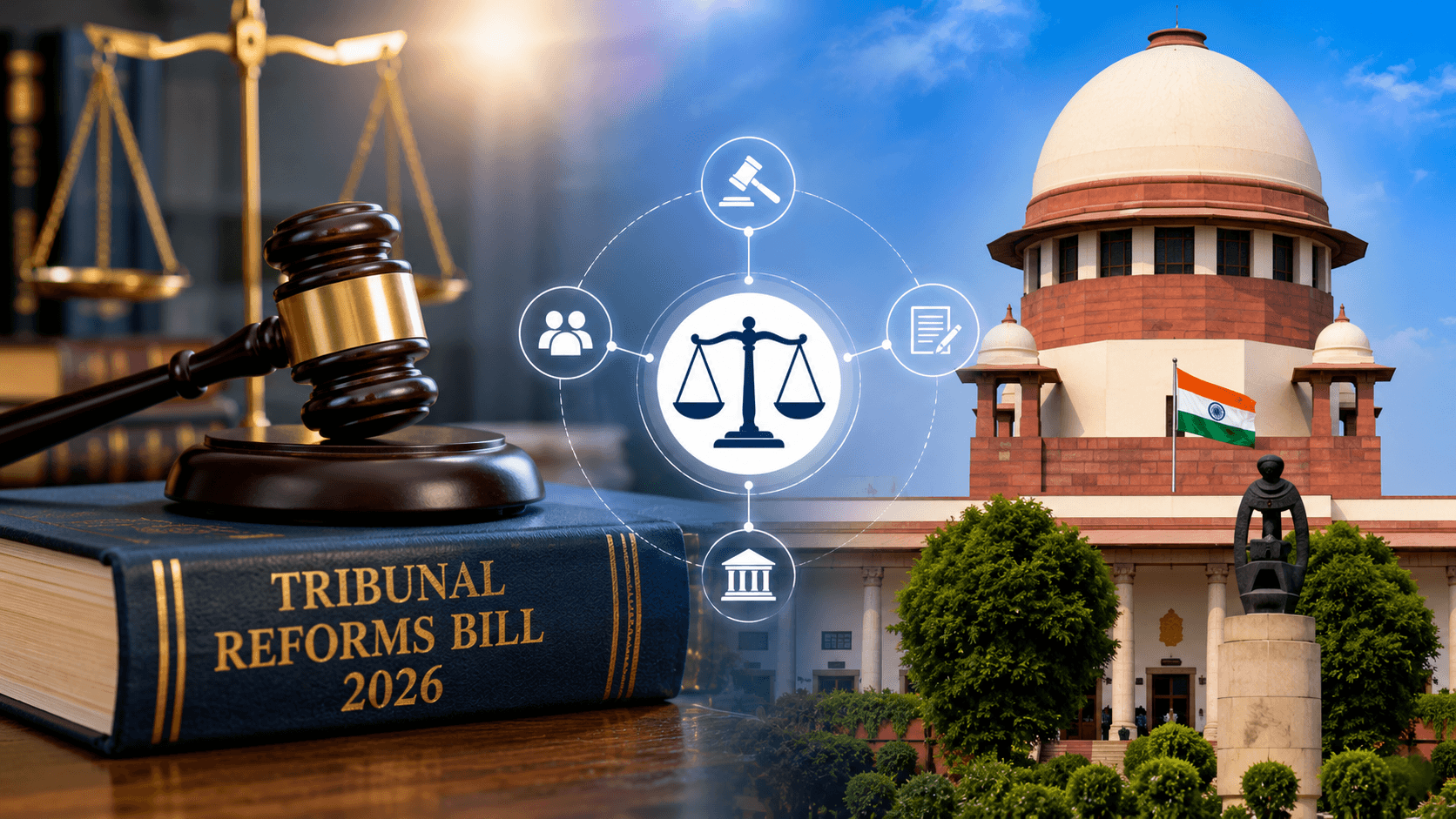
Recently, Parliament passed the Tribunal Reforms Bill, 2026, to fix and streamline India’s tribunal system. The main goal is to make tribunals more efficient, independent of the executive, transparent, and uniform across the country.
This Bill comes after several Supreme Court rulings on tribunal independence. A key one is Madras Bar Association v. Union of India [(2026) 2 SCC 1], where the Court struck down parts of the Tribunals Reforms Act, 2021 and directed the government to set up an independent National Tribunals Commission.
To address this, the 2026 bill proposes to repeal the 2021 Act and bring in a new structure. The idea is to keep tribunals independent from executive interference but at the same time make them accountable to the public they serve.
| What is Tribunal? A tribunal is a quasi-judicial body set up to settle specific disputes quickly, without going through regular courts. It mainly deals with administrative, tax, and service-related matters. Its job includes adjudicating disputes, deciding rights between parties, making administrative decisions, and reviewing existing government decisions. The word 'tribunal' comes from 'tribunes' in ancient Rome. Tribunes were officials whose role was to protect ordinary citizens from unfair actions by powerful magistrates. In simple terms today, any authority or institution that has the power to hear and decide claims or disputes can be called a tribunal, even if the word ‘tribunal’ isn’t in its name. |
| Provisions of the Tribunals Reforms Act, 2021, Struck Down by the Supreme Court The Supreme Court held several parts of the Tribunals Reforms Act, 2021, unconstitutional for violating judicial independence and separation of powers. |
The key provisions struck down were:
| 50-Year Minimum Age: | The Court called this arbitrary. It excluded younger advocates and experts who were otherwise eligible with 10 years of legal practice. |
| Four-Year Tenure: | This was invalidated because a short tenure hurt judicial independence and institutional stability. The Court restored a minimum 5-year tenure. |
| Two Names per Vacancy: | The Court struck this down, as it gave too much discretion to the executive. It directed that the Search-cum-Selection Committee should recommend only one name for each post. |
| Re-enactment of Struck-Down Provisions: | The Court said Parliament cannot just bring back provisions that were earlier held invalid without fixing the defects. It emphasized that judicial review is part of the basic structure. |
Key Provisions of the Tribunals Reforms Bill, 2026
The Tribunals Reforms Bill, 2026, tries to clean up and unify how tribunals in India work. First, it repeals the Tribunals Reforms Act, 2021, and brings appointment and service rules in line with what the Supreme Court has been saying since the Madras Bar Association cases from 2010 to 2025—basically, tribunals should be independent of the executive and respect separation of powers.
To make this happen, the bill sets up a new body called the National Tribunals Commission, or NTC.
The NTC will handle appointments, review how tribunals are performing, investigate complaints against members, and maintain a National Tribunals Data Grid.
Covered Tribunals & Governing Acts
The bill lists all the tribunals, appellate tribunals, and authorities governed by the bill, alongside their corresponding enactments. The changes proposed by the bill shall apply to these tribunals.
About a New National Tribunals Commission
The Tribunals Reforms Bill, 2026, proposes to set up a National Tribunals Commission (NTC) to safeguard the independence of tribunals.
Earlier, under the 2021 Act, the Central Government had the power to make key appointments and decide service conditions.
The new bill shifts that role to the NTC, which will be led mainly by senior members of the judiciary.
Composition of the Commission
The NTC will have:
- Chairperson: A former judge of the Supreme Court or chief justice of a high court
- 4 Members: 2 Judicial Members: Former Chief Justices or Judges of a High Court
- 2 Technical Members: Experts with at least 25 years of experience in public administration, finance, law, accountancy, banking, management, or technology
- The Central Government will formally appoint the Chairperson and Judicial Members, but it must consult the Chief Justice of India before making these appointments.
Functions of the Commission
Under the Tribunals Reforms Bill, 2026, the National Tribunals Commission (NTC) will be the main body managing how tribunals work.
Its key roles are
Conduct selections: The NTC, through Search-cum-Selection Committees, will handle appointments for Chairpersons and Members of tribunals.
Review performance: It will monitor how tribunals are functioning and submit an annual report to the Central Government.
Oversee inquiries: It will supervise complaints and inquiries against tribunal members.
Maintain data: It will build and run the National Tribunals Data Grid—a central portal with case information from all 16 tribunals.
Term of Service
NTC Chairperson & Members: 5 years or till age 70, whichever is earlier
Tribunal Members: 5 years or till age 67, whichever is earlier.
The bill also allows reappointment, with past performance and service being considered during selection.
New Secretariat
The Secretariat serves as the administrative support system for the National Tribunals Commission. The Secretariat will be headed by a Secretary to the Government of India.
Its other officers and employees, including their number and service conditions, will be prescribed by rules. It will function under the general and administrative oversight of the Commission’s Chairperson.
Financial and Administrative Independence
The Tribunals Reforms Bill, 2026, aims to give tribunals more financial and administrative autonomy.
Here’s how it will work:
- Tribunals themselves will assess and send their requirements for funds, staff, and infrastructure.
- The NTC Secretariat will collect these needs, and the Commission will review them using an objective framework to decide the total allocation required.
- The Central Government will still provide the grants, but only after parliamentary approval.
- To ensure transparency, the CAG will audit the accounts of the Commission. The audit report will be sent to the Central Government and then tabled in both houses of Parliament.
Conclusion
The Tribunals Reforms Bill, 2026, aims to bring judicial independence and transparency to the tribunal system. It does this by setting up the National Tribunals Commission—a permanent body to handle appointments, review performance, and oversee discipline. With judiciary-led selection committees and a focus on professional expertise, the process becomes less dependent on the executive. A 5-year tenure also ensures more stability.
At the same time, the Bill keeps the system accountable to Parliament through CAG audits and oversight, so independence doesn’t mean a lack of checks. Overall, the bill moves us away from scattered, executive-driven rules to a structured, professional, and independent framework — in line with the Supreme Court’s Madras Bar Association judgments.
The Tribunals Reforms Bill, 2026 is relevant for BPSC. For Mains GS Paper II, it covers Indian Polity topics like judiciary structure, executive-judiciary relations, and statutory bodies through the proposed National Tribunals Commission. For Prelims, it falls under Indian Political System and Current Affairs, focusing on NTC’s composition, functions, and key changes from the 2021 Act and SC judgments.