UNCCD CoP17: India's First Grassland Guide
Why in News?
The 17th Conference of Parties (CoP17) of the UN Convention to Combat Desertification (UNCCD) was held in Ulaanbaatar, Mongolia, in August 2026. Two major developments from India—a new global approach to drought and the launch of India's first-ever Guide to Grasslands.
What is UNCCD?
UNCCD is one of the three Rio Conventions along with UNFCCC and CBD. It deals with desertification, land degradation and drought. India aims for Land Degradation Neutrality (LDN) by 2030.
Part 1: India's First-Ever Guide to Grasslands
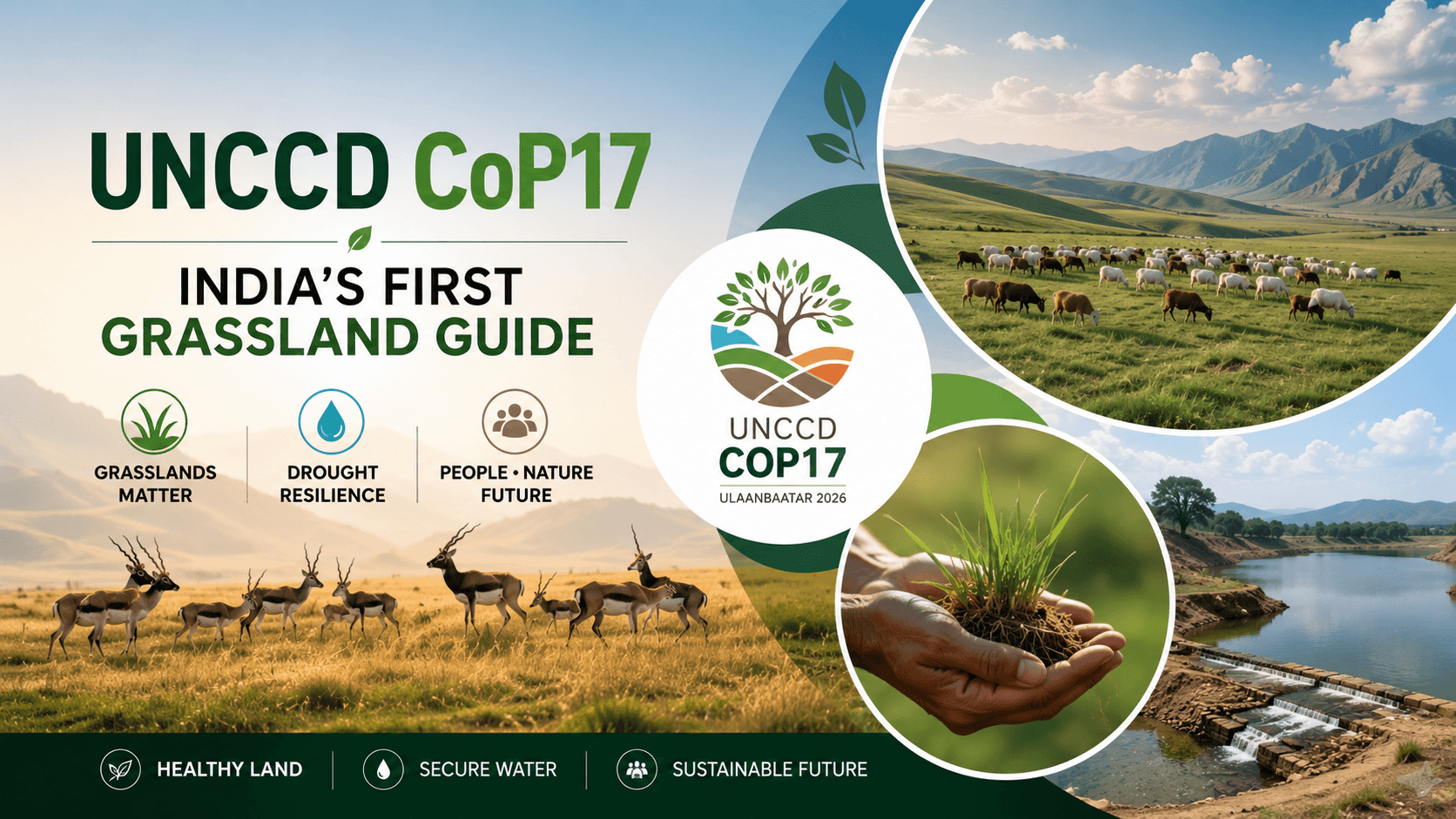
At CoP17, India launched its first Guide to Grasslands and Other Open Natural Ecosystems (ONEs) on 17.08.2026. It was organized by MoEF&CC with ATREE, IUCN, ICFRE, and SAC-ISRO.
Why This Guide Matters
For too long, grasslands, scrublands, and ravines were judged by the absence of trees and called "wasteland." Minister Yadav recalled his childhood in Ajmer, Rajasthan, surrounded by Oran or Gauchar—village-protected grazing lands. Local communities always knew healthy grasslands are indispensable for biodiversity, livelihoods, and climate resilience, and now modern science confirms it.
What Does the Guide Cover?
It brings together information on major ones of India—Himalayan and Terai grasslands, Thar and Banni landscapes, Deccan savannas, rocky plateaus, ravines, scrublands, and coastal and desert ecosystems. It details their geography, ecology, biodiversity, associated tribes, and thematic sections on pastoralism, fire ecology, and carbon sequestration.
These ecosystems shelter species found nowhere else, store huge carbon in soil, support soil-water cycles, and sustain pastoral and livestock-based livelihoods.
This is a paradigm shift. Conservation in India was forest-centric. Now ONEs are brought into the mainstream of land degradation, biodiversity, and climate discourse. The Guide will help achieve Land Degradation Neutrality targets, improve land-degradation assessment, and promote landscape-level, science-informed, and people-centered rangeland governance.
The launch had fireside chats on dryland conservation, climate resilience, and institutional measures for sustainable management of ONEs.
Part 2: India's Call on Drought Resilience
Union Environment Minister Bhupender Yadav addressed Ministerial Dialogue on ‘Accelerating Drought Resilience’ and said drought is no longer an occasional event but a defining development challenge affecting water, food, biodiversity, and the economy.
India's Message: From Relief to Resilience
The minister said drought must be managed as a predictable, preventable risk, not a recurring disaster demanding emergency response. He called for a fundamental shift from reactive relief to proactive, technology-enabled resilience. His mantra—preparedness over response, prevention over crisis, resilience over recovery.
India's 4-Tier Model Explained:
India showcased its multi-institutional approach. First, early warning through rainfall monitoring and satellite-based drought assessment that triggers preparedness at the center and state level. Second, land-water linkage. He gave a powerful line—"Restore the forest, before the flow." It means catchment and riverscape forestry to reduce erosion and improve water retention and recharge groundwater. Plus, river rejuvenation and revival of traditional water bodies.
Third, community-led restoration. In hills—restoration of springs and recharge zones. In the plains—pan-India watershed program on the ridge-to-valley approach for degraded rainfed lands—converged with MGNREGA and community institutions.
Fourth, household and farmer security - Har Ghar Jal for assured drinking water during stress with local quality testing, and PM Fasal Bima Yojana for crop insurance with technology-driven faster claim settlement.
Prevention measures include watershed development, water harvesting, afforestation, groundwater recharge and climate-resilient crops, backed by disaster funds, employment guarantee and fodder support when needed.
India advocated greater global investment in ecosystem restoration and early warning systems and offered to share its knowledge.
Conclusion
CoP17 shows India's two-pronged approach—managing drought proactively and recognizing neglected ecosystems like grasslands. The message is clear—resilience over recovery, and forests alone are not enough; grasslands matter too.