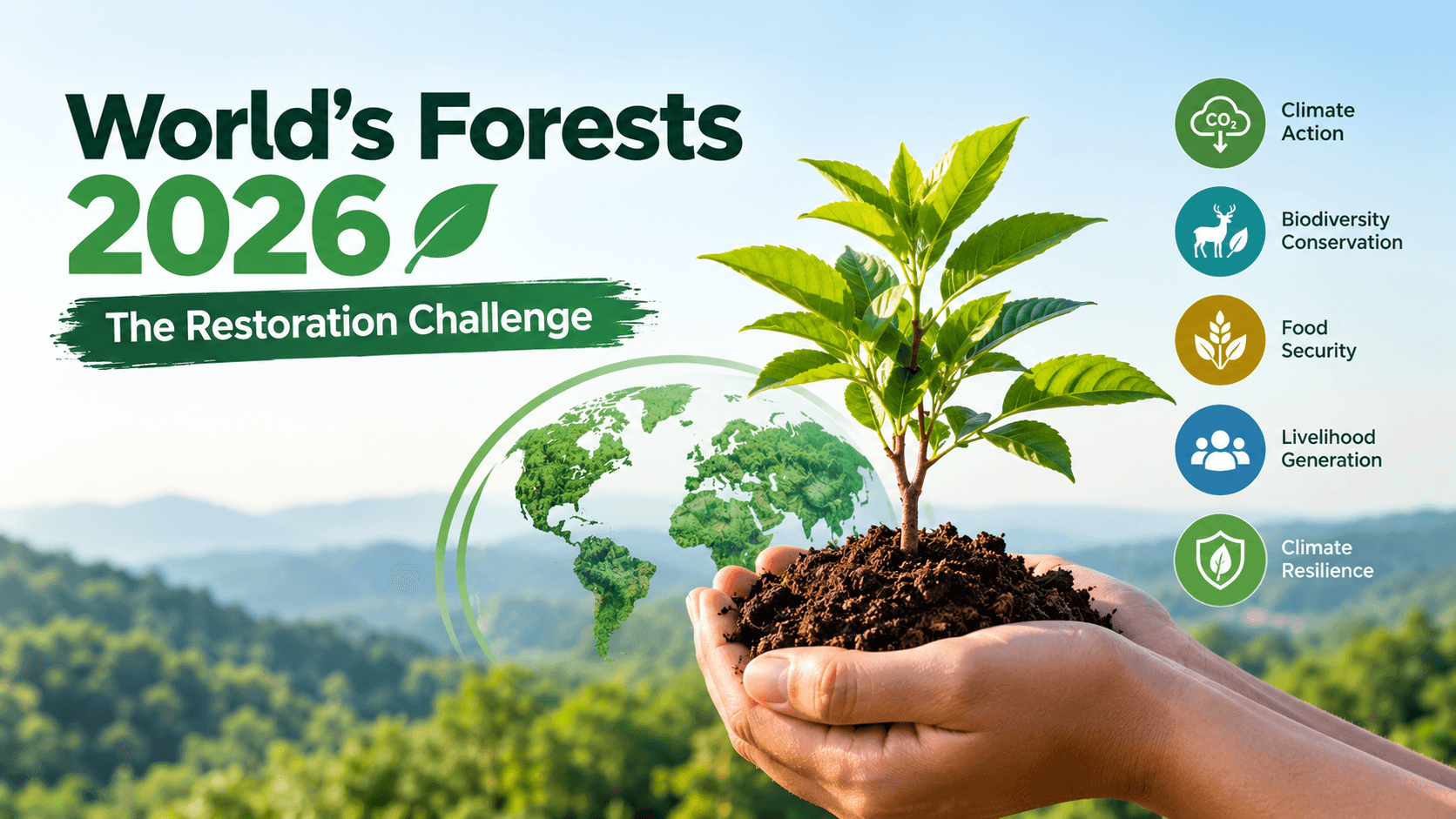
World’s Forests 2026: The Restoration Challenge
Why in the News?
Recently, the Food and Agriculture Organization (FAO) has released the State of the World’s Forests (SOFO) Report 2026, focusing on how forest and landscape restoration can help build a sustainable future.
The report’s theme is “Restoring Forests and Landscapes—The Way Forward for a Sustainable Future.” It highlights the growing problem of land degradation and explains how restoring damaged forests and landscapes can support climate action, biodiversity conservation, food security, and sustainable livelihoods.
The report also highlights India’s contribution to global restoration efforts, placing it among the leading countries in terms of the area under restoration.
Key Highlights of the State of the World’s Forests Report 2026
1. Global Forest and Land Degradation
Land degradation is becoming a major environmental challenge due to population growth, changing land-use patterns, and increasing demand for natural resources.
According to the report:
- More than 460 million hectares of forests and 1.56 billion hectares of land are degraded worldwide.
- Growing demand for forest products, agricultural land, and other resources is putting additional pressure on ecosystems.
- The gap between what nature can sustainably provide and what people consume is increasing.
Forest and landscape restoration is therefore essential to recover damaged ecosystems and maintain the balance between human needs and environmental protection.
2. Region-wise Distribution of Degraded Land
The report highlights significant areas of degraded land across different regions of the world.
| Region | Degraded land (2019) | Share of regional land |
| Asia | 583 million hectares | 19% |
| Africa | 334 million hectares | 12% |
| South America | 245 million hectares | 14% |
Asia has the largest area of degraded land among these three regions, underlining the need for stronger restoration measures.
3. Global Restoration Targets: The 2030 Challenge
Countries are increasingly adopting restoration policies and reporting progress. However, current efforts are not sufficient to achieve global restoration targets.
The Kunming-Montreal Global Biodiversity Framework (GBF), Target 2, calls for at least 30% of degraded terrestrial, inland water, coastal, and marine ecosystems to be under effective restoration by 2030.
According to the report’s estimates:
- An additional 65.6 million hectares per year will need to be restored from 2027.
- This would require restoring an additional 262.5 million hectares by 2030.
Meeting this target will require faster implementation, adequate funding, and coordinated action by governments, businesses, and local communities.
4. India’s Contribution to Global Forest Restoration
India is among the major contributors to global restoration efforts.
Key findings include:
- India ranks second globally, with 18.9 million hectares under restoration, according to the report.
- China leads with 127.4 million hectares under restoration.
- Sudan, Mongolia, and Indonesia are also among the leading countries highlighted in the report.
India’s position reflects the importance of restoration initiatives in addressing land degradation, strengthening ecosystem resilience, and supporting sustainable development.
5. Four Key Pathways to Successful Forest Restoration
The report identifies four major pathways to scale up forest and landscape restoration.
1. Empowering people and strengthening rights
Local communities and Indigenous Peoples should have a meaningful role in decision-making. Recognizing their land rights, traditional knowledge, and interests can improve restoration outcomes.
2. Implementing restoration at the landscape level
Restoration should not focus only on individual trees or small patches of forest. It should consider entire landscapes, including forests, agricultural land, grasslands, and other connected ecosystems.
3. Mobilizing finance and developing business models
Restoration requires long-term investment. Governments, private companies, and financial institutions need to develop funding mechanisms and business models that make restoration economically viable.
4. Creating effective policies and legal frameworks
Clear policies, strong institutions, and coordinated laws are necessary to ensure that restoration projects are implemented effectively and deliver lasting results.
6. Economic and Environmental Benefits of Forest Restoration
Forest and landscape restoration offers benefits beyond increasing tree cover. It can support several environmental and socioeconomic objectives.
- Climate action: Restored forests absorb carbon dioxide and can help reduce the impacts of climate change.
- Biodiversity conservation: Healthy ecosystems provide habitats for wildlife and support ecological balance.
- Food security: Improved land and soil conditions can strengthen agricultural productivity and local food systems.
- Livelihood generation: Restoration can create employment and improve the incomes of rural communities.
- Climate resilience: Healthy landscapes can improve ecosystem resilience to droughts, floods, and other environmental stresses.
The report notes that, under favorable conditions, restoration can generate returns of up to US$30 for every US$1 invested. However, actual returns depend on the location, type of intervention, and time required to realize the benefits.
The report also stresses that the cost of inaction can exceed the cost of restoration, particularly when environmental damage leads to social, economic, and cultural losses.
7. Role of Local Communities and Indigenous Peoples
Successful restoration depends not only on government policies and funding but also on the participation of people who live in and depend on forests.
The report emphasizes that:
- Local communities contribute practical knowledge about ecosystems and sustainable resource management.
- Indigenous Peoples play an important role in biodiversity conservation and the protection of cultural values.
- Restoration programmes should respect community rights and ensure that benefits are shared fairly.
- The principle of Free, Prior, and Informed Consent (FPIC) is important when measures affect Indigenous Peoples and their rights.
Community participation helps make restoration more inclusive, effective, and sustainable over the long term.
8. Challenges in Measuring Restoration Progress
Although many countries report progress in forest restoration, comparing results remains difficult.
The report identifies several challenges:
- Different countries and international frameworks use different definitions and measurement methods.
- Reporting systems are fragmented, making global comparisons difficult.
- Existing data often focus on the area restored rather than the actual ecological and social outcomes.
Therefore, measuring success requires more than counting the number of hectares restored. Monitoring should also assess biodiversity recovery, ecosystem health, carbon storage, and improvements in local livelihoods.
What Is the Food and Agriculture Organization (FAO)?
The Food and Agriculture Organization (FAO) is a specialized agency of the United Nations that leads international efforts to combat hunger and improve food security. Established on 16 October 1945, FAO works to promote sustainable agriculture, forestry, fisheries, and rural development.
Key Facts About FAO
| Established: | 16 October 1945 |
| Headquarters: | Rome, Italy |
| Membership: | 194 members, comprising 193 countries and the European Union, as stated in the provided report material |
| Global presence: | Works in more than 130 countries |
| Main focus: | Food security, nutrition, sustainable agriculture, forestry, and natural resource management |
Three Main Objectives of FAO
1. Eradicate hunger and malnutrition: Improve access to safe, nutritious food and strengthen food security.
2. Reduce poverty: Promote economic and social development, particularly in rural areas.
3. Ensure sustainable natural resource management: Support the responsible use of land, water, air, climate, and genetic resources for present and future generations.
Beyond the News: Global Forest Resources Assessment 2025
The Global Forest Resources Assessment (FRA) is another major FAO initiative that provides comprehensive information on the extent, condition, management, and uses of forests worldwide.
Unlike the State of the World’s Forests report, which examines broader forest-related issues, the FRA provides detailed assessments of global forest resources.
1. Global Forest Cover
According to the Global Forest Resources Assessment 2025:
- The world has approximately 4.14 billion hectares of forest.
- Forests cover around 32% of the world's total land area.
- This is equivalent to approximately 0.50 hectares of forest per person.
- Global deforestation has slowed but remains a major concern, at an estimated 10.9 million hectares annually during 2015–2025.
Slower deforestation is an encouraging development, but the continuing loss of forests highlights the need for stronger conservation and restoration efforts.
2. Top Five Countries by Forest Area
The five countries with the largest forest areas are:
Russia, Brazil, Canada, the United States, China These countries account for a substantial share of the world's forest resources, making their forest management policies important for global climate and biodiversity goals.
3. India’s Position in Global Forest Resources
India has improved its position in terms of total forest area. Key findings from the assessment include: • India ranks ninth globally in total forest area, improving from tenth place in the 2015 assessment. • India retains the third position in annual forest area gain, as reported in the supplied material. • India has approximately 72.74 million hectares of forest area, accounting for around 2% of the world's total forest area. However, increases in forest area do not automatically indicate improvements in natural forest quality. Plantation forests and naturally regenerated forests can differ significantly in biodiversity, ecological value, and resilience. Therefore, forest conservation efforts should focus not only on increasing tree cover but also on protecting natural forests and improving ecosystem health.
4. Countries and Territories Without Forests
The assessment identifies seven countries or territories reporting no forest area:
- Falkland Islands (Malvinas), Gibraltar, Holy See, Monaco, Nauru, Svalbard and Jan Mayen Islands, Tokelau
These examples highlight the geographical differences in forest distribution around the world.
State of the World’s Forests 2026: Key Takeaways for UPSC and BPSC
| Topic | Important Fact |
| Publishing organisation | Food and Agriculture Organization (FAO) |
| Report | State of the World’s Forests 2026 |
| Theme | Restoring Forests and Landscapes—The Way Forward for a Sustainable Future |
| Global forest degradation | More than 460 million hectares |
| Global degraded land | 1.56 billion hectares |
| India’s area under restoration | 18.9 million hectares |
| Global restoration target | At least 30% of degraded ecosystems by 2030 |
| Global Forest Resources Assessment 2025 | 4.14 billion hectares of forests worldwide |
| Global forest cover | Approximately 32% of total land area |
| India’s global forest-area rank | Ninth |
Conclusion
The State of the World’s Forests Report 2026 highlights a critical message: protecting existing forests is important, but restoring degraded landscapes is equally necessary for a sustainable future.
For India, the challenge is to combine restoration with the protection of natural forests, biodiversity conservation and the participation of local communities. Achieving global restoration targets will require long-term financing, effective policies and reliable monitoring systems.
Ultimately, successful forest restoration is not simply about planting more trees; it is about rebuilding healthy ecosystems while improving the lives of the people who depend on them.