Stubble Burning: Smoke Without Solutions?
Stubble burning is a highly relevant, multidisciplinary topic that intersects multiple sections of both the UPSC General Studies Paper I/III (Mains)/Prelims and the BPSC (General Studies Paper II) syllabi. It is primarily covered under environmental ecology, agriculture, and economy. It also seems to be highly yield for specific environmental and agrarian challenges faced by Bihar, including the transition to sustainable farming practices.
Why in news?
Stubble burning in North India, especially in Punjab and Haryana, has once again raised concerns about worsening air quality in Delhi-NCR, underlining the need to look at the economic, technological, and policy reasons behind it.
Stubble burning continues mainly due to the paddy-wheat cycle, groundwater conservation rules, assured procurement of crops, and the high cost of alternative methods to manage stubble.
To reduce it sustainably, we need crop diversification, better incentives for using crop residue, affordable technology, and stronger satellite-based monitoring, rather than relying too much on penalties.
What is stubble burning?
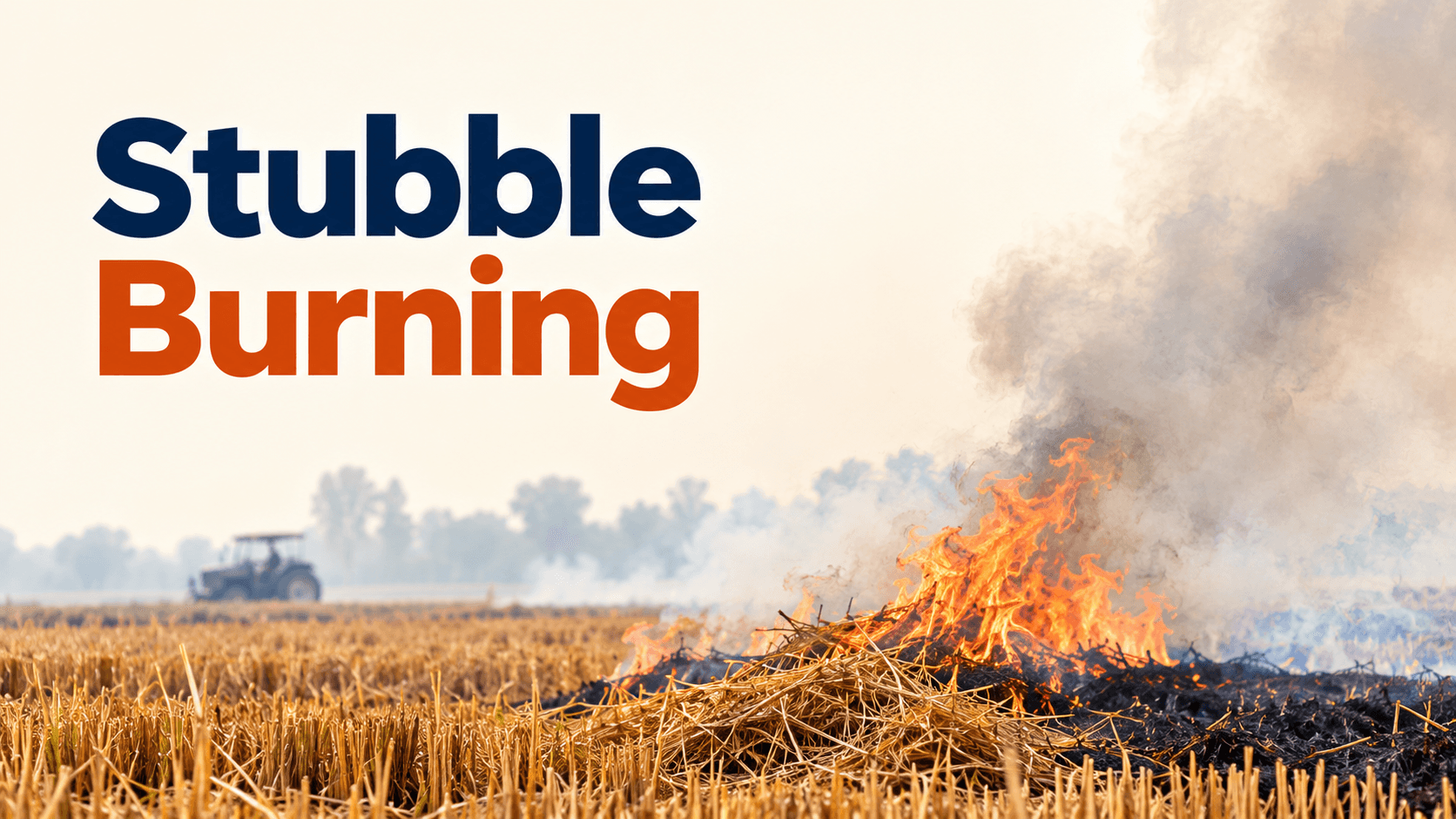
Stubble burning is the practice of setting fire to leftover crop residue, mainly straw and stalks, after harvesting crops like paddy and wheat. It is usually done to clear paddy fields before sowing wheat, between October and November. This practice is most common in Punjab, Haryana, and parts of Uttar Pradesh.
Reasons for Stubble Burning
| MSP-driven rice-wheat cycle: | Assured purchase of rice and wheat at Minimum Support Price (MSP) and subsidized electricity encourage farmers to grow rice and wheat intensively. This discourages crop diversification and creates a large amount of paddy stubble. |
| Short sowing window: | The Punjab Preservation of Sub-Soil Water Act, 2009, restricts early sowing and transplanting of paddy to save groundwater. This has pushed harvesting to late October and early November, leaving farmers with only 10–15 days to prepare fields for wheat. Long-duration varieties like PUSA-44, which take 150–160 days to mature, make this window even tighter. |
| Mechanized harvesting: | The widespread use of combine harvesters leaves behind tall stubble and loose straw, increasing the cost of clearing fields and pushing farmers to burn residue for quick preparation. |
| Cheaper and faster: | Burning is quicker and less expensive than other methods like mixing stubble into the soil or using machines like balers and shredders, which need extra money and labor. |
| Weed control: | Burning can temporarily kill surface weeds, weed seeds, and some pests, though it is not a sustainable solution. |
| Few alternatives: | Limited access to affordable machines, infrastructure, and other options like composting or bioenergy production makes burning the easiest choice for many farmers. |
Impacts
Air pollution: Stubble burning releases pollutants like PM10, PM2.5, nitrogen oxides (NOx), methane (CH₄), carbon monoxide (CO), and volatile organic compounds (VOCs). These emissions create smog and worsen air quality, especially in Delhi-NCR, raising the risk of respiratory problems like asthma, bronchitis, and COPD.
Greenhouse gas emissions: It releases greenhouse gases that add to global warming and climate change. Loss of soil fertility: Burning destroys organic matter and key nutrients in the soil, especially nitrogen and sulfur, and harms beneficial soil microbes. The heat also reduces moisture in the topsoil, degrading soil health and increasing the need for chemical fertilizers.
What are the challenges in controlling stubble burning in India?
Technology and infrastructure gaps: Combine harvesters leave behind a lot of standing stubble and loose straw, which needs special Crop Residue Management (CRM) machines to clear fields quickly. Custom Hiring Centers (CHCs) often fall short during peak harvest season, so farmers don't get machines on time. Paddy straw also has high silica content, making it hard to process industrially, and poor collection, storage, and transport infrastructure limits its commercial use.
Economic and funding issues: Even with government subsidies, machines are expensive, rentals are costly and used only for a short season, making alternatives to burning unattractive, especially for small and marginal farmers. There is also no assured good price for paddy straw, and high collection and transport costs discourage its use in bioenergy and other industries.
Challenges in crop diversification: Assured procurement of rice and wheat at MSP and subsidized electricity discourage farmers from switching to other crops, keeping the rice-wheat cycle and its stubble problem going.
Policy and enforcement challenges: uneven enforcement, fear of penalties, and different incentives across states make it hard to implement sustainable solutions. Relying too much on punishment without giving enough economic support reduces farmer cooperation.
Gaps in monitoring: Satellite monitoring through MODIS and VIIRS has limited observation windows and can miss fires that happen outside those times. So, a drop in reported fire cases may not mean less area is being burnt, making it difficult to judge how well policies are working.
Limited awareness and training: Many farmers, especially small farmers, lack access to practical training, technical guidance, and awareness about in-situ and ex-situ residue management methods, which slows down adoption of sustainable alternatives.
India's Initiatives to Tackle Stubble Burning
Framework by the Commission for Air Quality Management (CAQM):
In-situ crop residue management: Promotes managing residue within the field using Crop Residue Management (CRM) machines, Custom Hiring Centers (CHCs), and bio-decomposers.
Ex-situ utilization: Encourages alternative uses of paddy straw, such as biomass power generation, co-firing in thermal power plants, second-generation (2G) ethanol, compressed biogas (CBG) production, and packaging materials.
Ban and enforcement: Prohibits stubble burning through satellite monitoring, field inspections, and environmental compensation for violations.
Financial support: The Crop Residue Management (CRM) Scheme, running since 2018-19, provides 50% assistance to individual farmers for buying eligible CRM machinery and 80% assistance for eligible Custom Hiring Centre projects, within prescribed limits.
Technological Interventions:
Happy Seeder: A tractor-mounted machine that sows wheat directly in fields with paddy residue, avoiding burning and keeping straw as mulch for the soil.
Pusa Decomposer: A microbial formulation that speeds up decomposition of crop residue into organic matter and improves soil health.
Pelletization: Converts crop residue into biomass pellets for energy, reducing open burning and giving farmers extra income.
Biochar production: Converts residue into biochar through pyrolysis, which can improve soil fertility, water retention, and carbon sequestration.
Crop diversification: Promotes short-duration paddy varieties, Direct Seeding of Rice (DSR), and a shift to less water-intensive crops to reduce residue and ease pressure on the rice-wheat cycle.
Local Initiatives:
Haryana: Provides financial incentives for residue management, direct seeding of rice, and diversification away from paddy. In 2026-27, it raised incentives to Rs 1,200 per acre for residue management, Rs 4,500 per acre for DSR and Rs 8,000 per acre for alternative crops under the Mera Pani-Meri Virasat scheme.
Punjab: Mobile apps like i-Khet and Cooperative Machinery Tracker help farmers access residue management machines.
Chhattisgarh: Gauthans help collect and convert farm residues and cattle dung into organic manure, promoting waste use and rural livelihoods.
Improved satellite monitoring: Combining polar-orbiting satellites (MODIS and VIIRS) with geostationary satellite observations can improve detection of burning beyond limited overpass times and help assess burned areas more accurately.
What Strategies Can India Adopt to Curb Stubble Burning?
Policy and legal reforms: A parliamentary committee has suggested fixing a minimum remunerative price for paddy straw that covers collection, transport, and other costs so that using residue becomes economically viable. There should be a balanced approach that combines incentives, awareness, and fair enforcement, instead of mainly penalizing farmers.
Crop diversification and procurement reforms: MSP and procurement policies should be reformed to encourage farmers to move away from water-intensive paddy to alternatives like pulses, oilseeds, and millets. Short-duration paddy varieties and Direct Seeding of Rice (DSR) should be promoted to widen the short gap between harvesting and sowing and reduce the pressure to burn.
Infrastructure and logistics: There is a need for real-time crop mapping, harvest forecasting, and decentralized biomass collection systems, with temporary storage facilities, local aggregators, and dependable transport networks. Custom Hiring Centers (CHCs) should be strengthened to ensure farmers get CRM machinery on time and at affordable rates during peak season.
Innovative farming technologies: Solutions like Pusa Decomposer, a microbial formulation that decomposes stubble in about 20-25 days, and machines like Happy Seeder and Super Seeder that allow wheat sowing without burning should be promoted. In-situ management through mulching and mixing residue into the soil and ex-situ use for cattle fodder (where suitable), organic manure, paper, packaging, biofuels, and power generation should be encouraged.
Economic incentives and market development: Assured markets and remunerative prices for crop residue should be created so farmers can recover collection, labor, and transport costs. Performance-based incentives for residue management and crop diversification should be expanded, learning from Haryana's incentive-based model.
Community-based post-harvest management: Labor support on the lines of MGNREGA, farmer cooperatives, and village-level collection centers for gathering, composting, and transporting residue should be promoted. Panchayati Raj Institutions (PRIs) should be involved to coordinate residue management and reward villages that show sustained reduction in burning.
Improved monitoring and accountability: Polar-orbiting satellites like MODIS and VIIRS should be combined with geostationary satellite data to detect fires beyond fixed overpass timings. Burned-area assessment, ground verification, and transparent reporting should be used to judge policy success, rather than depending only on satellite fire counts.
Conclusion
Stubble burning is not just an environmental issue but is also linked to economics, technology, and farmer livelihoods. A lasting solution needs more than bans. It requires affordable machines, assured markets for paddy straw, timely support from custom hiring centers, incentives for crop diversification, and better monitoring. With a mix of incentives, awareness, community-based management, and farmer-friendly technology, residue can be turned from waste into wealth. This will help improve air quality, protect soil health, and support sustainable agriculture.
Attempt following question based on the article:
Consider the following:
1. Carbon monoxide
2. Methane
3. Ozone
4. Sulphur dioxide Which of the above are released into atmosphere due to the burning of crop/biomass residue? (a) 1 and 2 only (b) 2, 3 and 4 only (c) 1 and 4 only (d) 1, 2, 3 and 4 (IAS Pre 2019)
Reference: