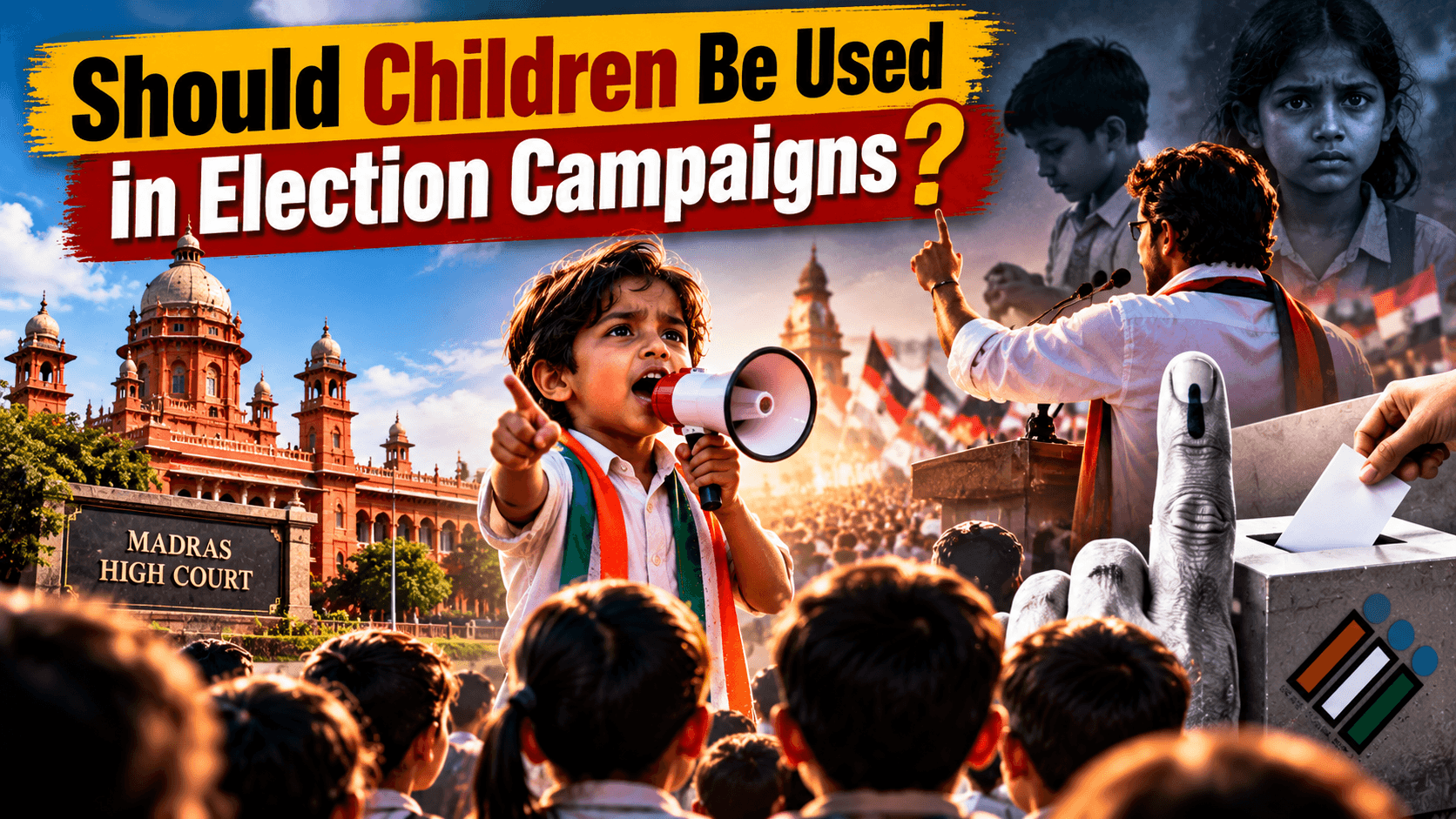
Should Children Be Used in Election Campaigns?
Why in News?
The Madras High Court has recently raised concerns over the growing practice of involving children in political election campaigns. The observation came while the court was hearing an election petition challenging the victory of a Tamilaga Vettri Kazhagam (TVK) candidate in the 2026 Tamil Nadu Assembly elections.
The controversy arose after Tamil Nadu Chief Minister C. Joseph Vijay allegedly appealed to children to persuade their parents and grandparents to vote for his party. Several social media videos subsequently showed children asking their family members to support TVK.
Although the High Court dismissed the election petition, its observations sparked an important national debate:
Should children be allowed to express their political opinions, or should political parties be prohibited from using them as tools for influencing voters?
How Did Children Become Part of Political Campaigning?
The controversy emerged during the 2026 Tamil Nadu Assembly elections, in which the newly formed Tamilaga Vettri Kazhagam (TVK), led by actor-turned-politician Joseph C. Vijay, attracted considerable enthusiasm among young people.
He compared this request to the way children repeatedly ask their parents for their favorite chocolates and other products.
Some family members also reportedly said that they had voted for TVK because their children or grandchildren had asked them to do so. This development raised concerns about the use of children's emotional attachment to influence the political decisions of adult voters.
What Did the Madras High Court Say?
While dismissing the election petition, Justice D. Bharatha Chakravarthy made important observations about the involvement of children in political campaigning. The court criticized the practice of encouraging young children to persuade their family members through social media videos and reels.
Importantly, the judge suggested that Parliament should consider whether involving children in political campaigns should be prohibited or made a legal ground for invalidating an election.
Why Is Using Children in Political Campaigns a Concern?
The debate is not about preventing children from understanding politics or expressing their opinions. Rather, it concerns the possibility of adults and political organizations using children's emotions and family relationships to influence electoral choices. Some important concerns are discussed below.
1. Emotional Pressure on Parents and Family Members
2. Children May Become Tools of Political Propaganda
3. Impact on Independent Thinking
4. Privacy and Digital Footprints of Children
Understanding the Concept of 'Pester Power' in Political Campaigning; The process can be understood through the following sequence: Celebrity Appeal → Children's Emotional Attachment → Repeated Requests to Parents → Possible Influence on Voting Choices This raises serious questions about the ethical boundaries of political advertising and election campaigns.
What Does Indian Election Law Say About Undue Influence?
The controversy also brings attention to Section 123(2) of the Representation of the People Act, 1951. This provision deals with undue influence as a corrupt electoral practice.
In simple terms, voters should be able to decide whom to vote for without being subjected to unlawful pressure or interference.
However, in the present case, the Madras High Court did not consider the alleged emotional appeals made through children sufficient to establish undue influence under this provision.
The court also highlighted the distinction between behavior that may be ethically inappropriate and conduct that legally qualifies as a corrupt electoral practice.
This distinction is important because every objectionable campaign practice does not automatically become a ground for declaring an election invalid.
Children's Political Participation vs. Political Exploitation
A major question in this debate is whether children should have any role in politics at all.
The answer requires a distinction between two different forms of participation.
Meaningful political participation: Children should be encouraged to understand democracy, discuss public issues, express their opinions, and develop independent thinking.
Manipulative political involvement: Children should not be pressured, scripted, or used as messengers to promote a predetermined political agenda or influence the voting decisions of adults.
The United Nations Convention on the Rights of the Child (UNCRC) recognizes children's rights to express their views and participate in matters affecting them. Therefore, completely excluding children from political discussions would also be inappropriate.
Should India Introduce a Law Against Using Children in Political Campaigns?
The issue raises the possibility of introducing a specific legal framework to regulate the involvement of children in election campaigns. Any such law should maintain a balance between children's freedom of expression and their protection from political exploitation. However, such regulations must be carefully drafted so that they do not prevent children from expressing their genuine political opinions or participating in democratic discussions.
Way Forward: Protect Children While Strengthening Democracy
Children are an important part of society and should be encouraged to understand democratic values from an early age. Schools, families, and educational institutions can help them develop political awareness, understand constitutional values, and learn the importance of independent decision-making.
At the same time, political parties must recognize that children are not instruments for gaining electoral support. Parliament and the Election Commission of India should consider developing clearer safeguards against the organized and manipulative use of children in election campaigns.
The objective should not be to silence young voices but to ensure that their opinions remain their own. Ultimately, children should be taught how democracy works, not turned into instruments for making democracy work in favor of a particular political party.
Reference: