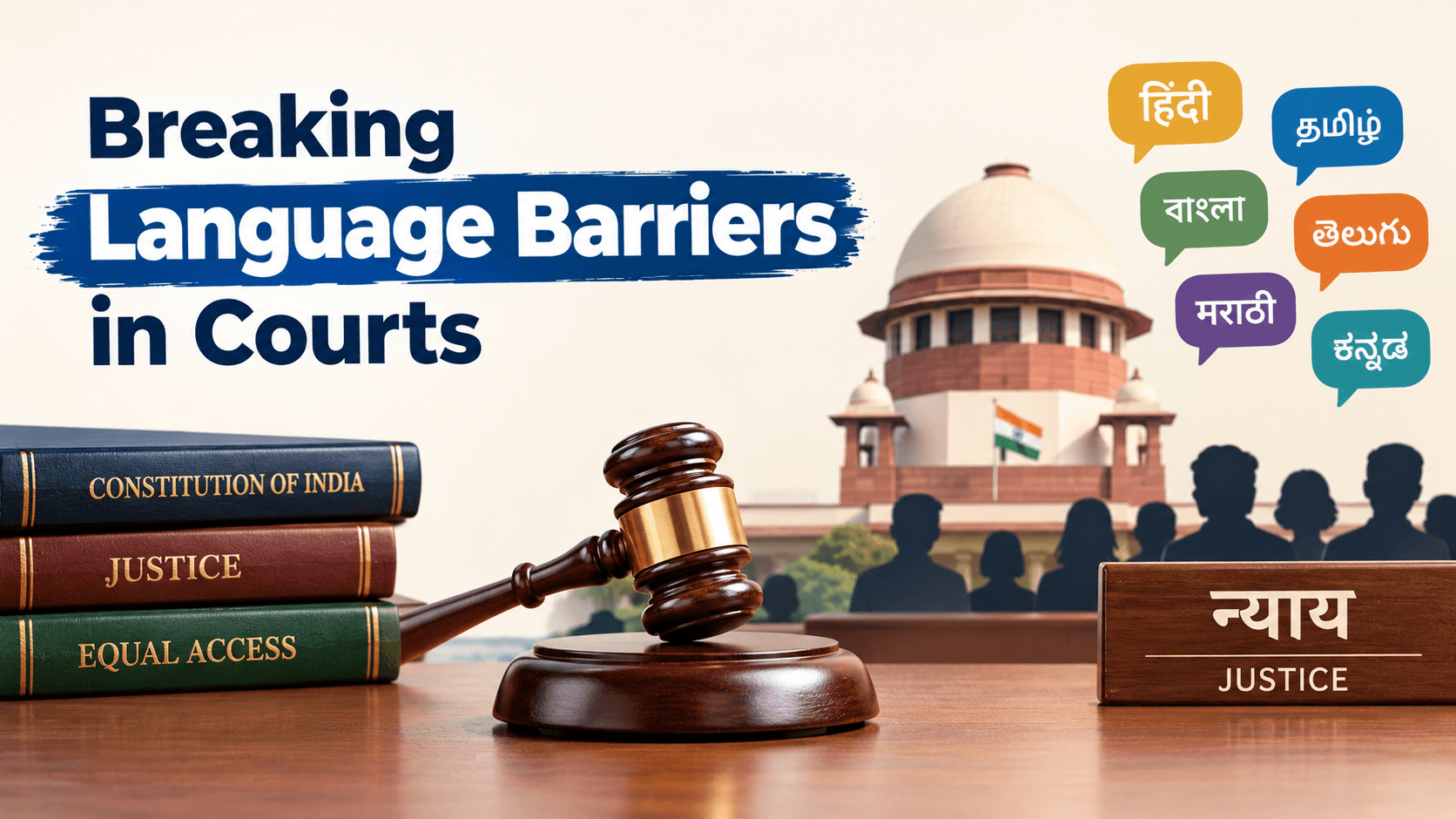
Breaking Language Barriers in Courts
Why in the News?
Recently, the most burning issue related to the language of Indian courts made headlines. The issue came into focus following a petition filed before the Supreme Court of India by the Public Interest Litigation (PIL). The petitioner sought the establishment of a commission to recommend Hindi as the official language of the Supreme Court.
The petition argued that the use of Hindi could make judicial proceedings more accessible to a wider section of the population. However, the issue involves much more than deciding whether Hindi or English should be used in courtrooms. It raises broader questions about constitutional provisions, regional languages, and equal access to justice.
Does Language Decide Who Can Access Justice?
Imagine entering a courtroom where the entire discussion takes place in a language you barely understand. You may know your rights, understand your problems, and have a strong case, but following the legal proceedings becomes difficult simply because of the language being used.
This raises an important question: Should language become a barrier to justice in a country as linguistically diverse as India?
The debate over the language used in Indian courts has once again drawn attention to the relationship between the Constitution, the judiciary, and India's rich linguistic diversity.
At the heart of the issue lies a difficult choice: should India continue to rely on English as the common language of higher judicial proceedings, or should regional languages receive a greater role in making justice accessible to ordinary citizens?
The answer is not as simple as choosing one language over another. It requires balancing constitutional requirements, judicial efficiency, and the linguistic rights of citizens.
Article 348: What Does the Constitution Say About Court Language?
Article 348 of the Indian Constitution provides the principal framework governing the language used in proceedings before the Supreme Court and High Courts.
Under Article 348(1)(a), proceedings in the Supreme Court and every High Court are generally conducted in English, unless Parliament provides otherwise by law.
Article 348(2), however, allows a state governor, with the prior consent of the president, to authorize the use of Hindi or another language used for official purposes in the state for proceedings before that state's High Court.
This provision comes with an important limitation: the use of a regional language does not automatically replace English in all court documents, judgments, decrees, or orders.
The constitutional framework therefore attempts to maintain consistency in higher judicial proceedings while allowing some flexibility for regional languages.
Can Hindi Become the Official Language of the Supreme Court?
Making Hindi the official language of the Supreme Court would require addressing the existing constitutional and legal framework.
Article 348(1)(a) currently provides for the use of English in Supreme Court proceedings. A change would therefore need to be considered within the constitutional framework, including the question of whether a constitutional amendment or another legally appropriate measure would be necessary.
The issue is also connected with the Official Languages Act, 1963, which contains provisions concerning the use of English and other languages in official and judicial contexts.
Any proposal for changing the language of the Supreme Court must consider constitutional requirements, judicial administration, and the practical consequences for litigants from different linguistic backgrounds.
Regional Languages in High Courts: What Is the Current Position?
India's linguistic diversity makes the question of court language particularly important at the state level.
Under Article 348(2), a governor may, with the president's prior consent, authorize the use of Hindi or another official language of the state in high court proceedings.
In addition, Section 7 of the Official Languages Act, 1963, provides a mechanism for using Hindi or another language for official purposes of a state in judgments, decrees, or orders of its High Court, subject to the prescribed conditions and an authoritative English translation.
These provisions reflect an attempt to accommodate regional languages without compromising the consistency and reliability of judicial records.
Why Is English Still Important in the Indian Judiciary?
English continues to play a significant role in India's higher judiciary for several reasons.
- Uniformity in legal interpretation: A common language helps maintain consistency in legal proceedings across different states.
National legal communication: Judgments of the Supreme Court often influence courts throughout the country. A shared language makes these decisions easier to communicate across jurisdictions.
- Legal documentation: English remains important in many established legal documents, precedents, and professional practices.
- Interstate accessibility: Litigants, lawyers, and judges from different linguistic backgrounds may need to understand the same proceedings.
- Administrative efficiency: A common working language can simplify coordination between courts and legal institutions.
However, the continued use of English also creates difficulties for citizens who are unfamiliar with it. This is why the debate is not simply about preserving an established system; it is also about making that system easier for people to understand.
Why Should Regional Languages Have a Greater Role in Courts?
Allowing greater use of regional languages could make the justice system more approachable and inclusive. Here are some important benefits:
| Better understanding for ordinary citizens | People are more likely to understand their legal rights, court procedures, and case developments when information is available in a language they know well. |
| Improved access to justice | Language barriers can make legal proceedings intimidating, especially for people from rural areas and disadvantaged backgrounds. Regional-language support could help reduce these difficulties. |
| Stronger connection between citizens and institutions | When people can understand legal proceedings, they may feel more confident about approaching courts and participating in the justice system. |
| Recognition of India's linguistic diversity | Greater accommodation of regional languages would recognize the importance of India's many linguistic communities. |
| More inclusive legal awareness | Court information, legal aid materials, and explanations of important judgments in regional languages could help spread awareness of constitutional rights and legal remedies. |
What Are the Challenges of Changing the Language of Higher Courts?
Although the use of regional languages offers clear benefits, changing the language of the higher judiciary also presents practical challenges.
- Different language backgrounds: The Supreme Court deals with cases involving people from every part of India. A language familiar to one group may not be understood by another.
- Consistency of legal terminology: Legal concepts must retain their precise meaning when translated into different languages.
- Availability of trained professionals: Judges, lawyers, translators, and court staff would need suitable language skills and training.
- Translation of judgments and precedents: Reliable translations would be essential to prevent misunderstandings and inconsistent interpretations.
- Implementation costs: Developing translation systems, training personnel, and updating court infrastructure would require resources.
These challenges do not mean that regional languages should be excluded. Instead, they show why any reform must be carefully planned and implemented.
Can Technology Help Bridge the Language Gap?
Technology could offer a practical way to improve language accessibility without immediately replacing the existing system.
Artificial intelligence (AI), machine translation, and digital court services can support communication between the judiciary and citizens.
Possible measures include:
- Providing reliable translations of important judgments into Indian languages.
- Making court notices and procedural information available in regional languages.
- Improving multilingual legal aid services.
- Using digital tools to assist lawyers and judges with preliminary translations.
- Developing systems for reviewing translated legal documents to maintain accuracy.
However, legal translation requires a high degree of precision. AI-generated translations should be checked by qualified professionals, particularly when they involve constitutional interpretation, legal rights, or binding judicial decisions. Technology should support legal understanding, not replace professional judgment.
The Way Forward: Accessibility Without Losing Consistency
The real objective should be to make justice understandable to citizens while preserving the reliability of judicial proceedings. A balanced approach could include the following measures:
| Strengthen multilingual legal services: | Provide accessible explanations of court procedures and legal rights in regional languages. |
| Improve translation infrastructure: | Develop accurate, standardized translations of important judgments and legal documents. |
| Train legal professionals: | Encourage language training and develop specialized legal translation expertise. |
| Expand digital accessibility: | Use technology to help citizens follow cases and understand court-related information. |
| Respect constitutional requirements: | Ensure that language reforms comply with the Constitution and applicable laws. |
| Adopt a phased approach: | Evaluate the effectiveness of language-accessibility measures before introducing wider changes to higher-court proceedings. |
Such an approach would allow India to improve access to justice without overlooking the practical and constitutional complexities of its judicial system.
Conclusion
India's language debate is ultimately about a fundamental democratic principle: citizens should be able to understand the institutions that protect their rights. English has an established role in the higher judiciary, but that should not prevent efforts to make legal information more accessible in Hindi and other Indian languages. The solution need not be a simple choice between English and regional languages. A combination of multilingual legal services, reliable translations, technology, and carefully designed legal reforms could help bridge the gap.
Reference: