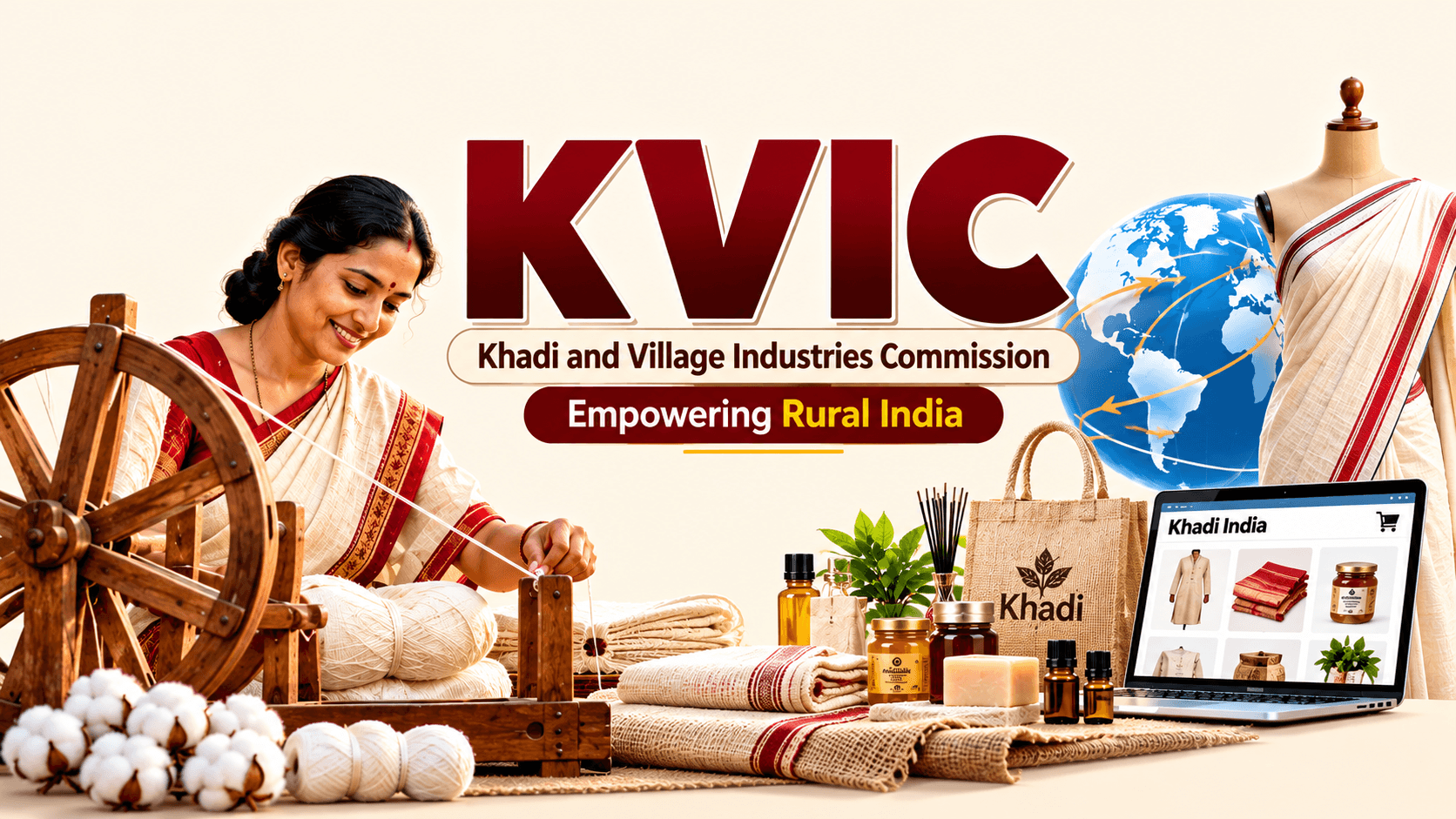
KVIC: Khadi and Village Industries Commission
The Khadi and Village Industries Commission (KVIC) falls under General Studies Paper-II (Governance, Constitution, Polity, Social Justice, and Government Schemes) in the UPSC Civil Services Exam and under General Studies Paper-II (Indian Economy and Geography / Bihar Economy and Government Policies) in the BPSC syllabus.
Why in News?
The Ministry of MSME highlighted the growing role of Khadi and Village Industries in turning traditional skills and local resources into modern rural enterprises by giving access to finance, technology, and training, with KVIC playing the central role in this transformation.
The Khadi Mahotsav, organized every year from 2nd to 31st October, supports these efforts by promoting Khadi and local products, creating awareness among youth, and encouraging public participation in Vocal for Local and Atmanirbhar Bharat initiatives.
Key Facts About Khadi and Village Industries Commission (KVIC)
About: KVIC is a statutory body under the Ministry of Micro, Small and Medium Enterprises (MSME). It was established under the Khadi and Village Industries Commission Act, 1956.
Objective: To promote rural industrialization, generate employment, strengthen village industries, and support artisans by providing financial, technical, and marketing help.
Initiatives for Market Promotion
International Market Linkages: KVIC helps rural enterprises take part in international exhibitions and trade fairs, so they can connect with foreign buyers and increase exports.
Digital Market Access: KVIC runs the Khadi India online store, which sells products like clothing and fabrics, groceries, beauty products, essential oils, perfumes, and incense sticks.
Retail Network: The Khadi marketing network has 8 departmental Khadi India sales outlets, 15 KVIC branches, and 8,035 sales outlets run by Khadi Institutions across the country.
Global Khadi: Khadi is now being showcased on modern fashion platforms like New Zealand Fashion Week 2026 and Lakmé Fashion Week 2025, where traditional craftsmanship is blended with contemporary designs.
Major Achievements of KVIC
Sectoral Growth: In 2025-26, sales of Khadi and Village Industries products touched a record Rs 1.87 lakh crore, while production rose by 380% to Rs 1,25,296 crore compared to 2013-14.
Employment Generation: Employment in the sector grew by 56% to 2.04 crore between 2013-14 and 2025-26, showing its strong role in rural jobs.
Training and Skill Development: KVIC runs 35 departmental and non-departmental training centers that give training in activities like food processing, baking, beekeeping, agarbatti and candle making, and motor repair. In FY 2025-26, 79,682 people were trained, including 47,382 women (about 59%).
Women's Participation: Women make up more than 80% of around five lakh artisans in the Khadi sector, highlighting its importance for women's economic empowerment.
Major Schemes Associated with KVICPMEGP Employment: Since March 2008, the Prime Minister's Employment Generation Programme (PMEGP) through KVIC has provided employment to nearly 97.95 lakh people.
Gramodyog Vikas Yojana (GVY): GVY supports artisans by giving modern machines, toolkits, and equipment. During 2025-26, 37,769 such machines/toolkits were distributed, and more than 3.23 lakh had been distributed till May 2026.
Khadi Vikas Yojana: This scheme supports Khadi institutions through product improvement, value addition, and market development. Its Modified Market Development Assistance (MMDA) component gives flexibility for value addition and market-based pricing. In 2024-25, Rs 245 crore was disbursed to 1,097 Khadi institutions, benefiting 145,484 artisans.
Concessional Credit: Under the Interest Subsidy Eligibility Certificate (ISEC) Scheme, eligible Khadi institutions can get credit at a concessional interest rate of 4% per annum.
Workshed Support: The Workshed Scheme provides better production spaces and improved working conditions for artisans.
Conclusion
The transformation of Khadi and Village Industries into market-oriented rural enterprises shows how traditional skills can be strengthened with modern technology, financial support, and market access. Strengthening this ecosystem can boost inclusive rural development, empower women economically, create sustainable livelihoods, and promote self-reliance in line with the vision of Atmanirbhar Bharat.
Reference: