India Needs a National Media Council
Why in News?
Recently, Rakesh Goswami, a professor of journalism at the Indian Institute of Mass Communication (IIMC), New Delhi, has written an article describing the most burning and long-awaited issues pertaining to the media industry published in The Hindu, where they strongly support the demand of the National Media Council. We will analyze this article and decode the current awaited crisis in the field of media.
A short while ago, the demand for establishing a National Media Council in India gained fresh momentum after the crackdown on freelance journalists and content creators during the October 2026 protests in New Delhi.
During the protests, several freelance and independent journalists, along with digital content creators, were reportedly removed from the protest site and sent to detention centers. Only journalists carrying accreditation issued by the Press Information Bureau (PIB) or the Directorate of Information and Publicity (DIP) were allowed to cover the protests.
The issue has intensified further as the Supreme Court, while hearing a PIL on protection of freelance journalists, questioned who qualifies as a journalist in the digital age and stressed the need for a national protocol and a unified media regulatory framework.
This incident has raised an important question: Who has the authority to recognize someone as a journalist, and should government accreditation determine who can perform journalistic duties?
Who Has the Right to Be Called a Journalist?
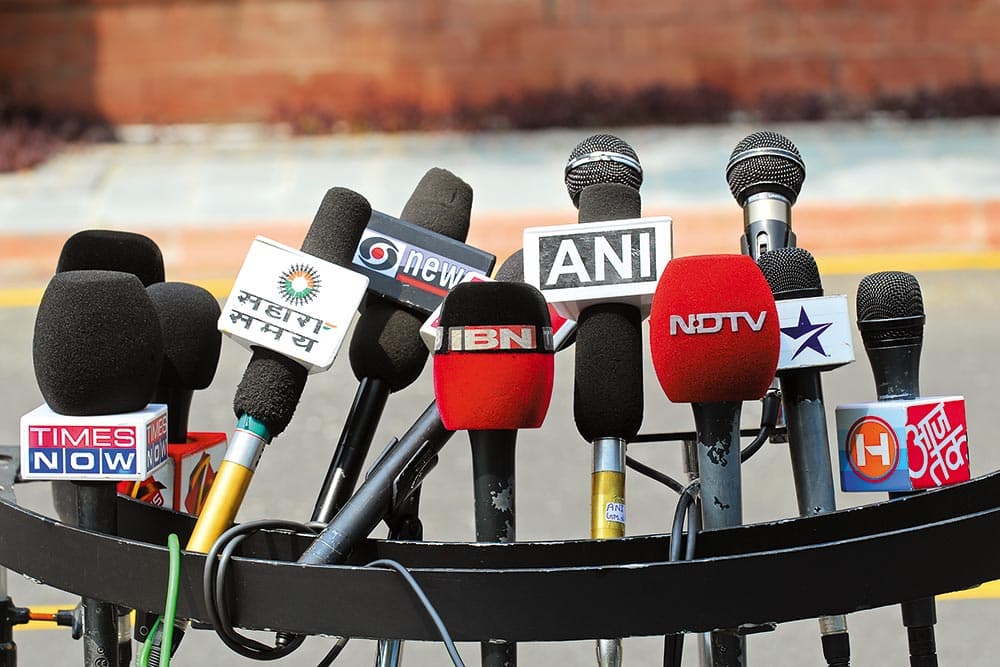
In today's digital age, anyone with a smartphone, camera, and internet connection can report an event, share news, or broadcast a protest live. But does having a camera automatically make someone a journalist? And more importantly, who decides who qualifies as a journalist?
These questions highlight a growing challenge for India's media ecosystem: how to distinguish professional journalism from ordinary digital content creation without restricting freedom of expression.
The debate is no longer limited to traditional newspapers and television channels. Freelancers, independent reporters, and digital journalists are increasingly becoming part of the country's information ecosystem.
Can Every Citizen Become a Journalist? The Supreme Court Debate
The issue also reached the Supreme Court, where a Public Interest Litigation (PIL) sought protection of the freedom of expression of freelance journalists and content creators.
A bench comprising Chief Justice of India Surya Kant and Justice Joymalya Bagchi raised an important question: Does the constitutional freedom of expression give every citizen the right to identify themselves as a journalist?
The Chief Justice expressed concern that if everyone started claiming to be a journalist, it could create difficulties for others.
During the hearing, senior advocate Indira Jaisingh argued for a national protocol that would prevent police from obstructing journalists performing their professional duties, particularly those carrying identity cards issued by their employers.
On the other hand, Solicitor General Tushar Mehta highlighted the growing misuse of the term 'independent journalist.' He pointed out that some individuals use mobile phones to create sensational social media content, sometimes with the intention of gaining popularity and earning money.
This makes it important to examine India's existing journalist recognition system and understand why a National Media Council could become an important institutional reform.
In this context, the 2024 draft of the Media Transparency and Accountability Bill by the Press Club of India, which proposed setting up an NMC, among other reforms, has once again become relevant.
Current Framework for Media Regulation and Recognition
| Who is a journalist? | Under the Occupational Safety, Health, and Working Conditions (OSHWC) Code, 2020, a working journalist is someone whose main profession is journalism in print, electronic, or digital media. Managerial roles are excluded. But there is no single, clear national definition for the digital age. |
| Government Accreditation: | Accreditation is given by PIB at the center and DIP in states. It is based on strict quotas, circulation of newspapers, a subscriber base of an agency, or unique visitors of a portal. Because of this quota system, many genuine freelance and independent journalists fail to get accreditation and thus face problems on the ground. |
Institutional Regulation (Fragmented System):
| Print Media: | Regulated by the Press Council of India (PCI) under the Press Council Act, 1978. It is a quasi-judicial moral watchdog but has no power to punish. |
| TV / Electronic Media: | Mostly self-regulated through the News Broadcasting & Digital Standards Authority (NBDSA) setup by the News Broadcasters & Digital Association (NBDA), legally governed by the Cable TV Networks (Regulation) Act, 1995, and the Program & Advertising Codes. The 2021 amendments brought a three-tier grievance system, a broadcaster, a self-regulatory body, and central government oversight. |
| Digital Media and OTT: | Governed by IT Rules, 2021. It also provides a three-tier grievance mechanism but is criticized for giving too much power to the executive. |
| Films: | Regulated by the Central Board of Film Certification (CBFC) under the Cinematograph Act, 1952. |
| Online Content: | Governed by the IT Act, 2000. Section 69A gives power to the Centre to block content on specific grounds, while Section 79(3)(b) deals with safe harboring for intermediaries. |
The Sahyog portal is used for coordination between government agencies and platforms. In short, India has a scattered and quota-based system; print, TV, digital, and films are regulated by different bodies, with no unified protection for freelancers in the digital era.
Why Do We Need a National Media Council (NMC)?
| Crisis of Definition: | Smartphones have blurred the line between journalist and content creator. As the Solicitor General noted, many claim to be journalists just to make sensational reels for money. An NMC can set clear, professional parameters to separate genuine journalists from bad actors. |
| Need for a Professional Body like the Bar Council: | Lawyers have the Bar Council of India, and CAs have the ICAI, but journalists have no statutory licensing body. An NMC could work on similar lines, recognizing all working journalists, freelancers, and camerapersons uniformly through a professional license, bypassing the govt quota system of PIB accreditation. |
| Tackling Media Convergence: | Today one company runs print, TV, and digital together. But we regulate them in silos: PCI for print, NBDSA for TV, and IT Rules for digital. This creates loopholes. An NMC would be a single, unified statutory authority for the converged media landscape. |
| Empowering the Watchdog: | PCI is called a "toothless tiger"; its power is limited to print only, and it cannot impose fines, suspend licenses, or order primetime apologies for media trials or fake news. An NMC would have real enforcement powers. |
| Failure of Self-Regulation: | Self-regulation in TV has failed to stop toxic debates, sensationalism, and TRP-driven journalism. Ethics are compromised for ratings. Meanwhile, yellow journalism is rampantly ongoing at its peak. |
| Fake News and AI Misinformation: | Digital platforms, coordinated misinformation, and AI deepfakes have grown fast. We need a comprehensive statutory mechanism that covers all mediums, not just print. |
| Cross-Media Ownership and Algorithm Threat: | Growing corporate and political monopoly over media houses hurts editorial diversity. Also, engagement-driven algorithms amplify sensationalism and polarization. An NMC can bring transparency in cross-media ownership and disclosure of conflicts of interest and algorithmic accountability and protect media pluralism. |
Challenges in Establishing an Independent National Media Council (NMC)
1. Appointments and Executive Overreach: If the govt controls appointments, NMC can become a censorship tool instead of a protector. Real independence needs a multi-partisan or judicial collegium system, which governments are reluctant to allow.
2. Financial Autonomy: If NMC depends on the Ministry of Information and Broadcasting (MIB) for funds, its independence is compromised. Alternative models like a corporate media cess face strong resistance from the industry.
3. Government Advertising Leverage: Centre and states use DAVP advertising funds to reward or punish media houses and engineer editorial compliance. Even with an independent NMC, this financial pressure will remain. As the Supreme Court held in Bennett Coleman vs. Union of India (1972), financial strangulation of the press violates Article 19(1)(a). The Court called the free press the "Ark of the Covenant of Democracy."
4. Constitutional Hurdles: Giving NMC punitive powers like fines, suspensions, or mandatory licensing can lead to gatekeeping. It may stifle investigative journalism and clash with freedom of speech under Article 19(1)(a).
5. Corporate Resistance: Big media conglomerates prefer the current self-regulation model like NBDSA. They will lobby hard against an NMC that threatens their TRP-driven business and cross-media monopolies.
6. Digital Complexity: Today the creator economy blurs the line between professional journalist and content creator. Also, digital platforms are borderless, so enforcing NMC orders across jurisdictions is very difficult.
What Measures Are Needed for Effective Journalism?
| National Police Protocol: | As argued in the Supreme Court, there is an urgent need for a standard national protocol; police should not obstruct journalists carrying valid employer ID cards, even if they don't have PIB/DIP accreditation. |
| Independent Co-Regulation Model: | The Parliamentary Standing Committee on IT (27th Report, 2021 on 'Ethical Standards in Media Coverage') stressed balancing regulation with free speech. NMC should work on co-regulation, statutory backing, and self-regulation. Its selection committee must be free from executive control, ideally with the Chief Justice of India, the Leader of the Opposition, and eminent media veterans. |
| Regulating Cross-Media Ownership: | As TRAI recommended in its 2014 report on Media Ownership, strict curbs are needed on cross-media monopolies to protect diversity and prevent concentration of power. |
| Inclusive Standard Setting: | NMC can issue press cards/licenses to recognize freelancers and protect them during protests, but this should be a privilege for access, not a compulsory license to publish. Otherwise it will violate free speech. |
| Anti-SLAPP Law: | Need a law to protect journalists from SLAPP suits, Strategic Lawsuits Against Public Participation, where powerful entities file frivolous defamation cases just to financially drain and silence investigative reporters. |
| Curbing Fake News: | The 2025 Standing Committee on Communications and IT suggested fact-checking mechanisms, internal media ombudsmen, stricter penalties and a clear legal definition of fake news, without curbing free speech. |
| Independent News Ombudsman: | Media houses should appoint independent ombudsmen to look into complaints on accuracy, fairness, bias and ethics. This promotes transparency and public trust. |
| Adopting Global Best Practices: | Australia's News Bargaining Code: Makes Big Tech pay publishers for news content, helping financial sustainability of independent media. EU's Digital Services Act (DSA): Makes large platforms accountable for algorithmic transparency and for curbing fake news, hate speech and election manipulation. |
Conclusion
The question of who is a journalist can no longer be answered with old yardsticks of print circulation or TV channels. In a digital and converged media era, freelancers, independent reporters and content creators are part of the information ecosystem. The debate around National Media Council is not about creating a licence to speak, that right belongs to every citizen under Article 19(1)(a). It is about creating a professional safety net, clear recognition, protection on ground, and accountability.
A co-regulated, independent and financially autonomous NMC, insulated from both government and corporate control, can give real teeth to the watchdog, protect freelancers without gatekeeping free speech, and bring transparency to cross-media ownership and algorithms.
Reference: