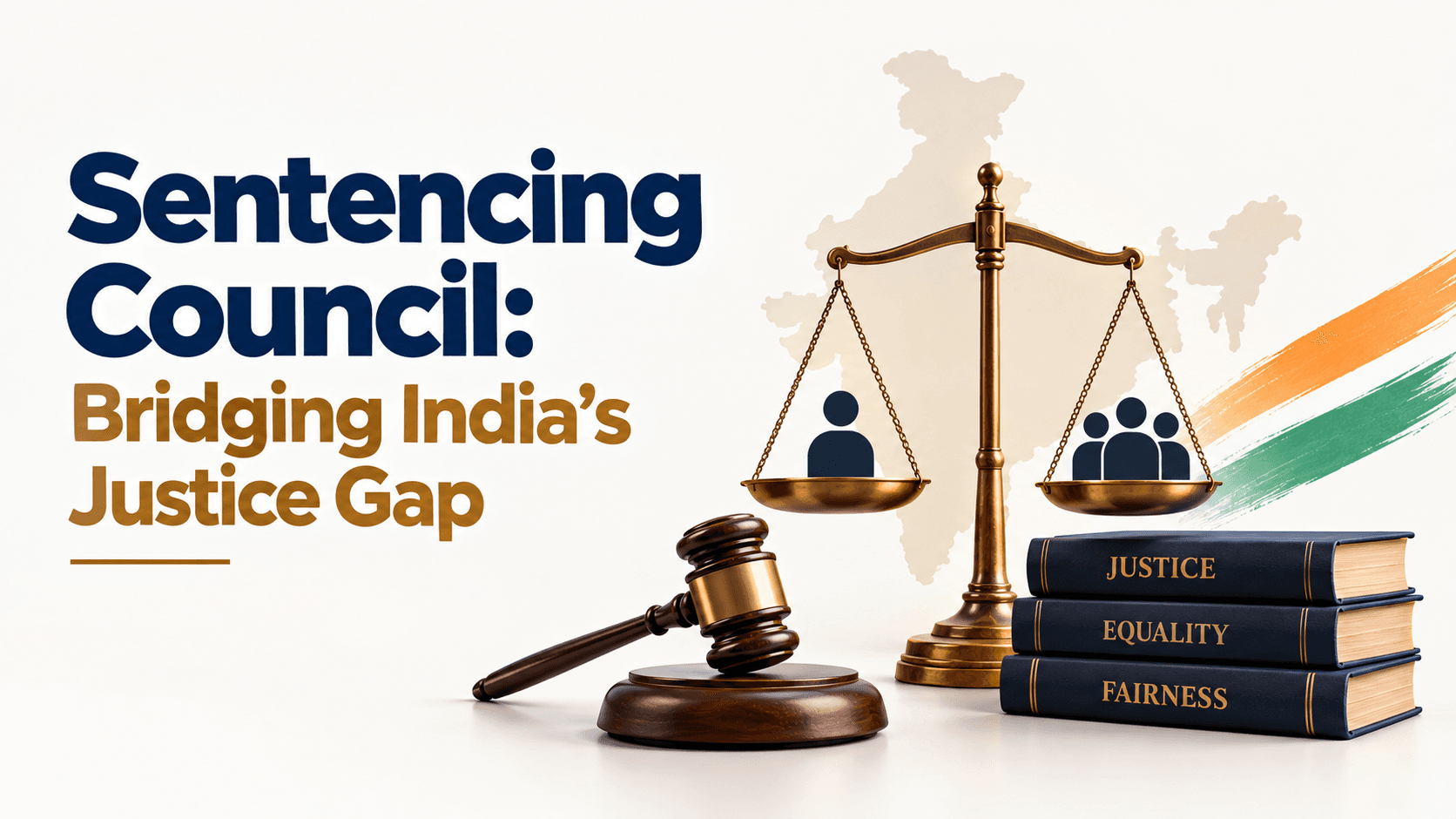
Sentencing Council: Bridging India’s Justice Gap
Why in News?
In a short while, the issue of sentencing disparity in India's criminal justice system has gained attention following the Supreme Court's observations in Sunita Devi vs State of Bihar (2024). The Supreme Court emphasized that sentencing should not be a mere lottery and directed the Central Government to examine the feasibility of a comprehensive National Sentencing Policy, potentially through a Sentencing Commission.
The Centre has assigned the matter to the Law Commission of India for examination. This has renewed the debate on establishing an independent Sentencing Council in India to ensure consistency, fairness, and transparency in the punishment awarded by courts.
What Is Sentencing and Why Does India Need It?
Sentencing refers to the process through which a court determines the appropriate punishment for a person after conviction.
For example, if a law prescribes a maximum punishment of 10 years of imprisonment for an offense, the court must decide whether the convict should receive 2, 5, or 10 years of imprisonment.
In India, this decision largely depends on the discretion of individual judges. Although laws prescribe minimum and maximum punishments for certain offenses, there is no comprehensive national framework specifying how courts should evaluate aggravating and mitigating circumstances.
As a result, two individuals convicted of similar offenses under comparable circumstances may receive significantly different sentences.
Unequal Sentencing: A Challenge to Equality Before Law
Disparities in sentencing are not limited to any category of crime. They reflect a broader structural problem within India's criminal justice system.
For instance, one judge may consider poverty or personal circumstances as grounds for reducing a sentence, while another may not attach the same importance to them.
Such differences raise concerns under two important constitutional provisions:
- Article 14: Guarantees equality before the law and equal protection of the laws.
- Article 21: Protects life and personal liberty and requires any procedure restricting liberty to be fair, just, and reasonable.
Therefore, awarding substantially different punishments to similarly placed offenders without reasonable justification raises serious questions about equality and fairness in the justice system.
Research on rape sentencing by Dr. Mrinal Satish has also highlighted problematic judicial reasoning. In some cases, courts have relied on irrelevant and regressive considerations, such as the complainant's supposed chastity or subsequent marriage, while overlooking psychological harm and breaches of trust.
Supreme Court's Stand: Sentencing Should Not Be a Lottery
In Sunita Devi vs State of Bihar (2024), the Supreme Court highlighted the need for consistency and a structured approach to sentencing.
The court directed the central government to examine the feasibility of introducing a comprehensive national sentencing policy, potentially through a sentencing commission.
The Law Commission of India has been tasked with examining the issue and making recommendations.
Interestingly, the Law Commission had already highlighted the need for a structured sentencing framework in its 47th Report, more than five decades ago. However, India is yet to establish a comprehensive national sentencing framework.
Current Sentencing Framework in India:
India does not have a fixed sentencing grid like the US. It follows a statutory system with wide judicial discretion, which has now been overhauled with the new laws, Bharatiya Nyaya Sanhita (BNS), 2023, and Bharatiya Nagarik Suraksha Sanhita (BNSS).
Types of Punishments (Section 4 of BNS):
| Death Penalty: | Only in "rarest of rare" cases, after weighing aggravating and mitigating factors. |
| Life Imprisonment: | Means imprisonment for the convict's natural life, unless remitted by the state. |
| Imprisonment: | Divided into rigorous (with hard labor) and simple. |
| Community Service: | A new non-custodial punishment for minor offenses to promote reform and reduce jail overcrowding. It is empowered under Section 23 of BNSS. |
| Forfeiture of Property and Fine: | Confiscating assets linked to crime and imposing monetary fines. |
Procedural Mandates under BNSS, 2023:
| Bifurcated Trial: | As per Section 258(2), there is a separate hearing on sentence after conviction. Both sides can argue before the final quantum is decided. |
| Evaluation of Factors: | The court considers age, socio-economic background, prior record, and chances of reform. |
| Unguided Discretion: | Within the legal limits, the exact quantum of punishment is largely left to the individual judge or bench. |
Key Issues Arising from the Sentencing Framework.
Constitutional Violations: Articles 14 and 21 prohibit arbitrary state action and demand fair procedure. If one judge treats social standing as mitigation and another does not, it violates equality before law.
Absence of Standardized Checklist: There is no legally binding checklist to define what is a serious aggravating factor (e.g., weapon use, cruelty), what is genuine mitigation (e.g., age, poverty, remorse), or how to weigh them. This leaves sentencing highly subjective.
Appellate Bottlenecks: Without uniform yardsticks, sentences often seem too harsh or too lenient. This forces high courts and the Supreme Court to correct sentences case by case, increasing pendency.
Underutilization of Alternatives: Despite provisions for non-custodial sentences like probation (Sec 401/402 BNSS, Probation of Offenders Act 1958) and mandatory separate sentencing hearing (Sec 258(2) BNSS), alternatives like community service and probation are rarely used. There is no framework to balance deterrence, reformation, and rehabilitation.
Inconsistent Judicial Reasoning: Studies on sexual offense cases show reliance on irrelevant factors like survivor's chastity or marriage while ignoring psychological harm and breach of trust. This undermines proportionality and equality. As noted in Soman vs State of Kerala (2012), sentencing remains one of the weakest parts of India's criminal justice administration.
Measures to Strengthen India's Sentencing System
| Establish a Statutory Sentencing Council: | India should set up an independent, multidisciplinary sentencing council as recommended by the Malimath Committee (2003). On the lines of the UK Sentencing Council under the Coroners and Justice Act, 2009, it should frame consistent guidelines based on culpability and harm. |
| Formulate a Three-Stage Guideline Framework: | Assess Seriousness: Classify offense by culpability and actual harm caused. Determine Starting Point: Fix an indicative starting point and category range within the statutory limits. Individualize Sentence: Adjust based on clearly defined aggravating factors (e.g., extreme cruelty) and mitigating factors (e.g., age, remorse), as emphasized by the Law Commission’s 47th Report. |
| Presumptive, Not Mandatory Guidelines: | To protect judicial independence, guidelines should be advisory but strongly presumptive. Judges must consider them in every case but can depart by recording written reasons. |
| Build a National Sentencing Database: | Using NJDG infrastructure, create an anonymized national database to track sentencing patterns. This will help monitor disparities and keep policy evidence-based, not driven by penal populism. |
| Victim-Centric and Rehabilitative Sentencing: | Strengthen sentencing through victim impact statements, pre-sentence reports, and rehabilitative alternatives, drawing from New Zealand’s victim participation model and France’s judicial supervision of sentence implementation. |
| Federal Coordination: | Since criminal law is in the Concurrent List (Entry 1) and prisons are in the State List (Entry 4), guidelines must account for state-wise differences in prison capacity and rehabilitation infrastructure. |
| Global Best Practice: | In the US federal system, judges use structured guidelines but can depart with reasoned justification and appellate review. India can adopt a similar balance between consistency and judicial independence. The sentencing framework of England and Wales offers a useful model for India, and its framework follows a structured, step-by-step approach. |
Conclusion
India's sentencing system today gives wide discretion to judges without clear, uniform guidelines. While this allows individualization, it also leads to arbitrariness, inequality, and excessive appellate burden. The shift to BNS and BNSS with community service and separate sentencing hearings is a positive step, but it remains incomplete without structural reform. A Statutory Sentencing Council, with presumptive three-stage guidelines, a national sentencing database, and a victim-centric, rehabilitative approach, can bring consistency without curtailing judicial independence. This will make sentencing fair, transparent, and constitutionally compliant, balancing deterrence with reform.
Reference: