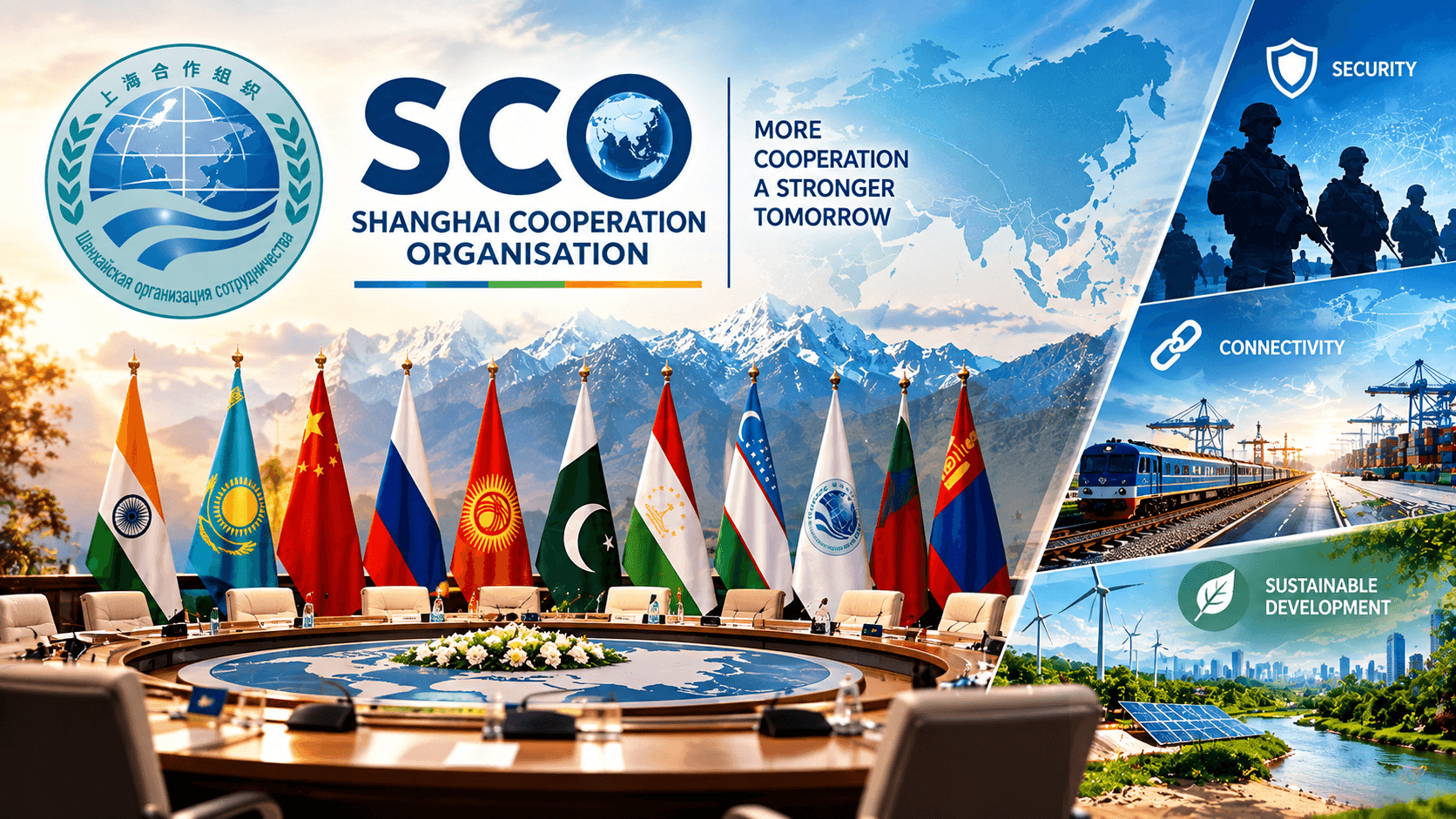
Shanghai Cooperation Organization (SCO)
Why in News?
Recently, the 26th Meeting of the Council of Heads of State (CHS) of the Shanghai Cooperation Organisation (SCO) and the first-ever “SCO Plus” format meeting were held in Bishkek, Kyrgyzstan.
Marking the 25th anniversary of the SCO, the historic summit was chaired by Kyrgyzstan under the theme "25 Years of the SCO: Together for Sustainable Peace, Development, Key Outcomes, and Prosperity."
India had proposed the Shanghai Cooperation Organisation Civilisation Dialogue Forum last year, and its first session will be held in India this year.
What is the "SCO Plus" format?
The "SCO Plus" is an expanded multilateral dialogue mechanism that brings together SCO members, non-member states, and international organizations to deliberate on global challenges and multipolarity.
Theme for 2026: "The UN as a Key Element of a Just World Order: The Contribution of the SCO Plus States to the Formation of a Multipolar World."
What are the key outcomes of the 26th SCO Summit in Kyrgyzstan?
| Bishkek Declaration: | SCO leaders signed the Bishkek Declaration, reaffirming their shared commitment to regional peace, security, and development and charting the future roadmap of the organization. |
| SCO Charter Amendments: | Leaders approved the Protocol on Amendments and Additions to the SCO Charter to modernize its institutional framework. This gives newer members like India a bigger say in shaping the SCO's future legal and structural reforms. |
| Universal Security Centre: | The summit approved regulations to set up the Universal Centre for Countering Challenges and Threats to Security of SCO Member States, a major step to boost intelligence-sharing against terrorism, extremism, and organized crime. |
| SCO Anti-Drug Centre: | Leaders cleared the regulations for the Executive Committee of the SCO Anti-Drug Centre and adopted action programs till 2030 to combat drug addiction and curb the spread of synthetic drugs and their precursors. |
| Economic & Green Corridors: | An action plan (2026–2030) for developing ports and logistics centers across member states was signed, along with a framework for the SCO “Green Technology Corridor” to push sustainable and green connectivity. |
| Global Institutional Partnerships: | The summit approved the SCO–CSTO–CIS Roadmap for trilateral cooperation among the SCO, the Collective Security Treaty Organization (CSTO), and the Commonwealth of Independent States (CIS). It also decided to sign an MoU between the SCO Secretariat and the African Union Commission, expanding SCO's global outreach. |
| International Information Security: | The SCO adopted a Cooperation Plan on Ensuring International Information Security for 2026–2028 to tackle cyber threats and disinformation. |
| Biodiversity: | Leaders adopted a joint initiative and action plan on conservation and sustainable management of biodiversity in SCO member states for 2026–2031. |
| Pakistan's Chairmanship: | The rotating SCO chairmanship for 2026–27 was handed over to Pakistan, which unveiled the theme “Turning Vision into Action: Connectivity, Innovation, and Shared Prosperity." Lahore was also designated as the SCO Tourism and Cultural Capital for 2026–27. |
India at the 26th SCO Summit
The prime minister outlined three core pillars for SCO’s future: security, connectivity, and opportunity.
| Dismantling the Terror Ecosystem: | India gave a strong call for a united fight against terrorism, urging members to dismantle its financing networks and safe havens without any "double standards." On global conflicts, India reiterated its firm stand that battlefields cannot be a solution. Dialogue and diplomacy are the only way forward. |
| Sovereignty in Connectivity: | India stressed that all connectivity projects must respect the sovereignty and territorial integrity of nations, a clear and principled indirect critique of China’s Belt and Road Initiative (BRI) and the China-Pakistan Economic Corridor (CPEC). |
Indian-Led Initiatives:
| Youth and Innovation: | The SCO endorsed India’s initiatives to boost scientific and technical cooperation through the SCO Young Scientists Forum and SCO Young Authors Conference. |
| Civilizational Dialogue: | Member states welcomed India’s proposal to host the first-ever SCO Civilisation Dialogue Forum in Language Reform: During India’s 2022–23 SCO Presidency, India had proposed adding English as an official working language. The 26th Summit formally adopted English alongside Russian and Chinese as an official language of the SCO. |
Why is the SCO significant for India?
Security and Counterterrorism: Through the RATS mechanism, India gets access to intelligence sharing and joint counter-terror exercises, which is crucial for securing its borders and tackling cross-border terrorism emanating from the neighborhood.
Connect Central Asia Policy: The SCO gives India a direct diplomatic and economic gateway to the resource-rich Central Asian Republics (CARs), a region where India lacks direct land connectivity. With CARs like Kazakhstan and Uzbekistan being rich in hydrocarbons and uranium, active engagement through SCO helps India secure its long-term energy needs.
Balancing Strategic Autonomy: By engaging in the SCO (with China and Russia) while also being a core member of the Quad (with the US, Japan, and Australia), India successfully demonstrates its policy of multi-alignment and strategic autonomy in a multipolar world.
What are the key challenges facing the SCO?
| Area | Key Challenge for the SCO |
| Decision-Making | SCO runs on consensus. So, India-Pakistan tensions and India-China border disputes often make common decisions difficult. |
| Geopolitical Balance | The rising clout of China and Russia, plus the entry of Iran and Belarus, creates a perception of the SCO as an anti-West bloc. This clashes with India's strategic autonomy. |
| Terrorism & Security | RATS is good at coordination and intel-sharing but weak in enforcement. Members also have different definitions and double standards on terrorism. |
| Economic Cooperation | China's massive economy gives it an outsized influence, risking trade imbalances and over-dependence of smaller economies on Chinese capital. |
| Connectivity | Eurasian connectivity is split among competing routes, such as China's BRI, India's INSTC, and Trans-Caspian corridors. Different customs rules and geopolitics slow progress. |
WAY FORWARD
Overall, the SCO needs to reform its consensus-based functioning through confidence-building and dispute-management mechanisms, remain a non-bloc and inclusive forum to preserve strategic autonomy, strengthen RATS with real-time intel sharing and action against terror financing, ensure balanced economic cooperation to avoid over-dependence on any one economy, and build interoperable sovereignty, respecting connectivity corridors with harmonized customs norms.
About the Shanghai Cooperation Organization (SCO)
The SCO is a permanent intergovernmental international organization, established in 2001 in Shanghai (China). It was preceded by the Shanghai Five (China, Russia, Kazakhstan, Kyrgyzstan, and Tajikistan) mechanism.
Significance: With 10 members, the SCO covers a vast geopolitical space, accounting for ∼25% of global GDP and over 40% of the world's population.
Member States: China, Russia, Kazakhstan, Kyrgyzstan, Tajikistan, Uzbekistan, India, Pakistan, Iran, and Belarus (newest member). Observer States: Afghanistan and Mongolia.
Dialogue Partners: Azerbaijan, Armenia, Bahrain, Egypt, Cambodia, Qatar, Kuwait, Laos, Maldives, Myanmar, Nepal, UAE, Saudi Arabia, Türkiye, and Sri Lanka.
Secretariat: Beijing, China.
Core Objectives: To strengthen mutual trust, maintain regional peace, security, and stability, and jointly counter new challenges, primarily the "Three Evils" of terrorism, separatism, and extremism.
Structure:
Heads of State Council (HSC): The supreme decision-making body of the SCO.
Regional Anti-Terrorist Structure (RATS): Headquartered in Tashkent (Uzbekistan), RATS is the permanent organ that coordinates member states' efforts against terrorism, separatism, and extremism.
Conclusion
Marking 25 years, the SCO has evolved from a regional security grouping into a key Eurasian platform for peace, connectivity, and development. For India, it remains vital for counterterrorism, energy security, and outreach to Central Asia while balancing its strategic autonomy. If internal rifts are managed and cooperation is made more equitable and action-oriented, the SCO can emerge as a strong voice of the Global South in a multipolar world.