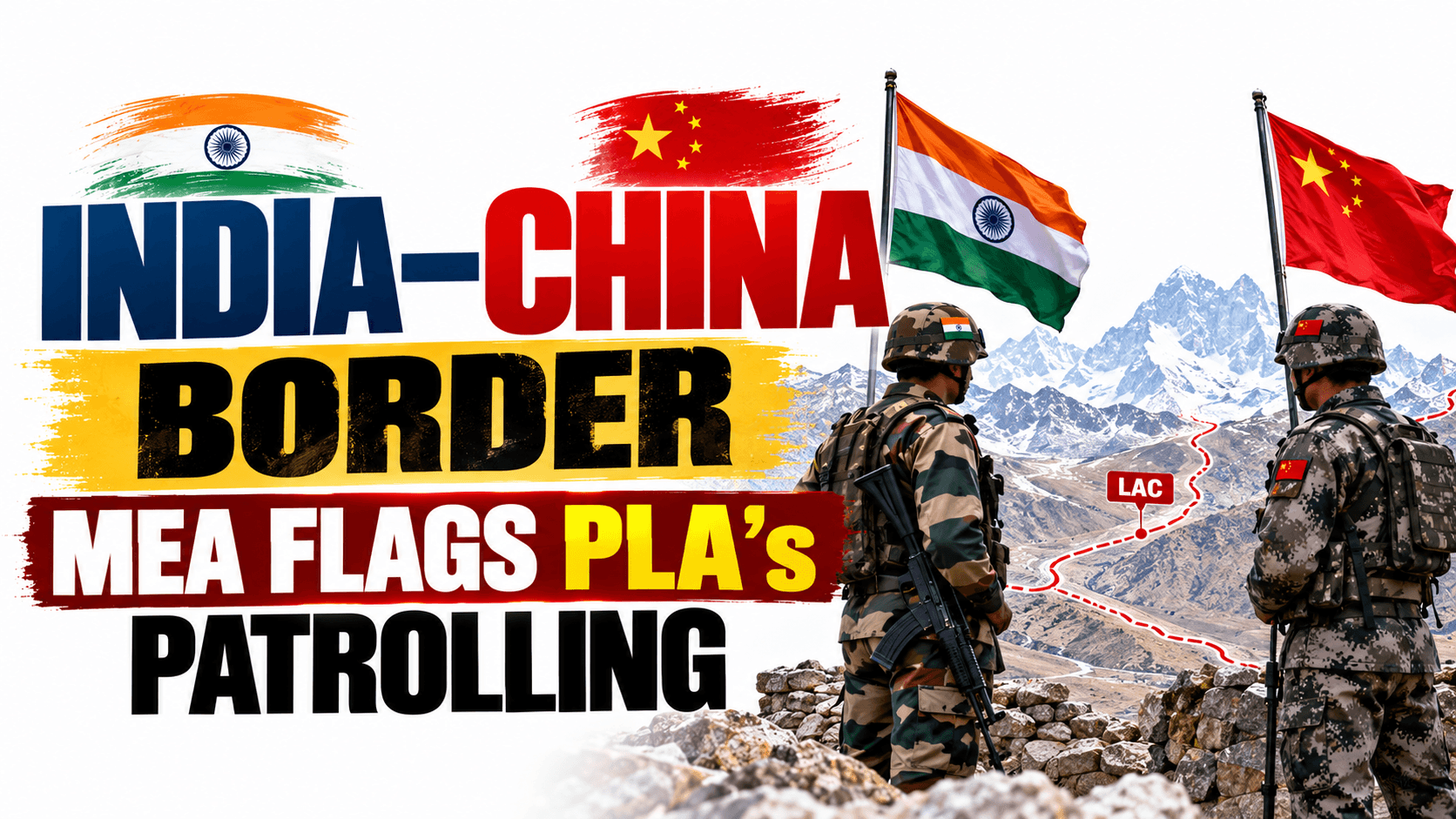
India–China Border: MEA Flags PLA’s Patrolling
Why in News?
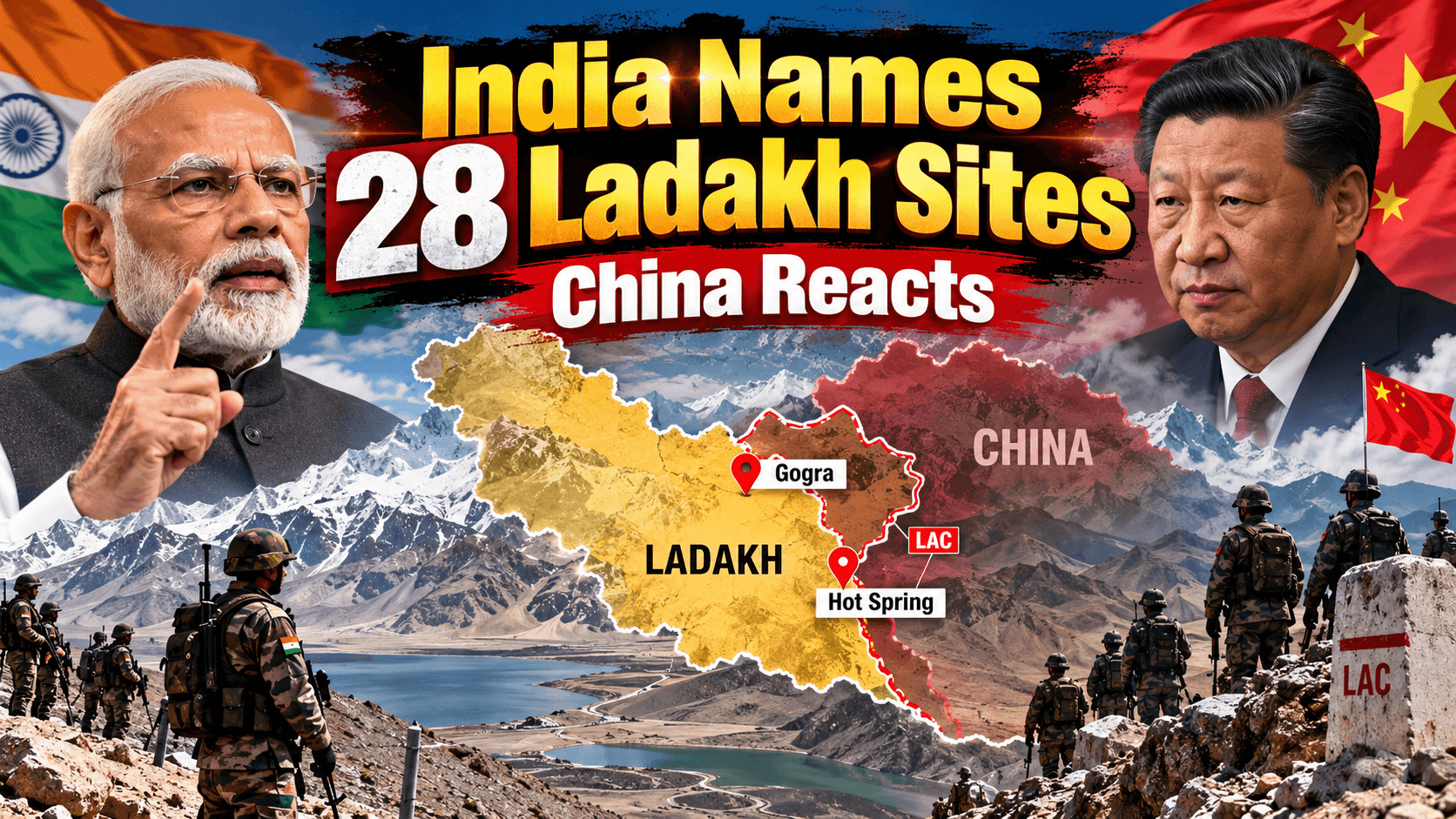
The Ministry of External Affairs (MEA) has acknowledged that the situation along the Line of Actual Control (LAC) between India and China has been disturbed from time to time due to differences in the patrolling behavior of the two countries’ armies.
The statement came after a report in The Hindu highlighted concerns raised by outgoing Indo-Tibetan Border Police (ITBP) Director-General Satrujit Kapur over repeated face-offs between Indian and Chinese troops in Arunachal Pradesh since July 2026.
MEA explained that the situation along the India-China border sometimes becomes tense when Chinese forces deviate from established patrolling patterns, but India and China remain in contact and are working to improve their understanding of the LAC to ensure better border management.
Why Are Face-offs Occurring Along the LAC?
The Line of Actual Control is the de facto boundary separating Indian and Chinese controlled territories. However, the two countries do not have a mutually agreed boundary along several stretches, leading to differences over where the LAC lies.
As a result, Indian and Chinese patrols sometimes enter areas that both sides consider part of their respective territories. Such differences can trigger face-offs, particularly when troops follow different interpretations of established patrolling routes. According to the report, concerns have emerged over repeated face-offs in Arunachal Pradesh since July 2026. These developments have renewed questions about the effectiveness of existing border-management.
India - China strategic Relations
| Diplomatic Foundations: | India and China established ties in 1950, based on the Panchsheel Agreement of 1954. It focused on peaceful coexistence and non-interference and became the base for bilateral relations. |
| Leadership Guidance: | High-level meetings have guided relations during tough phases. On the sidelines of the BRICS Kazan Summit 2024, both sides signaled a renewed push for cooperation. |
| Defense Dialogue: | Corps Commander-level talks and WMCC continue. The 33rd WMCC meeting in March 2025 agreed to prepare for special representatives' talks and improve border management. |
| Connectivity: | India has not joined the BRI due to sovereignty concerns over CPEC passing through PoK. Instead, India promotes IMEC and SAGAR. |
| Border Management: | Both sides carried out disengagement in Galwan, Gogra, and Pangong Tso and made breakthroughs in Depsang and Demchok in 2024 to restore stability. |
Major Challenges in India-China Relations
1. Border Disputes: The 3,488 km LAC is still not clearly defined, leading to frequent incursions and infrastructure buildup. China occupies 38,000 sq km of Aksai Chin and claims 90,000 sq km of Arunachal as South Tibet. Its dual-use villages along the border are seen by India as salami-slicing—gradual encroachment without open conflict. Lack of agreed maps and pending friction points in Depsang and Charding-Ninglung Nala make patrolling difficult.
2. Trust Deficit after Galwan: The 2020 Galwan clash that killed 20 Indian soldiers broke trust. Despite disengagements, normalization remains slow.
3.China-Pakistan Nexus: CPEC passes through PoK, violating India's sovereignty. China's military and nuclear support to Pakistan adds to India's security concerns.
4. Cyber Threats: Groups like ChamelGang have targeted India's power and healthcare networks. India banned 300+ Chinese apps and kept Huawei out of 5G trials for security.
5. Water Security: China's control over Brahmaputra and Sutlej headwaters is a risk. Its mega-dam at Medog and earlier the Zangmu dam were planned without consulting downstream India.
6.Regional Influence: China's presence in Sri Lanka, the Maldives, and Myanmar through the Maritime Silk Road/Stranglehold strategy challenges India's influence in the Indian Ocean.
7. Diplomatic Hurdles: China blocks India's NSG membership and UNSC permanent seat bidshield Pakistan-based terrorists in UN sanctions committees.
Latest Developments in India-China Relations
| Diplomatic Reset in 2025: | India and China marked 75 years of diplomatic ties with events and dialogues. A breakthrough was the agreement on troop withdrawals from Depsang and Demchok in late 2024. |
| Resumption of Dialogue: | The 23rd Special Representatives' meeting and the Vice Minister-Foreign Secretary meeting were held in Beijing in 2025. Both sides reached consensus on border issues and agreed to boost practical cooperation. |
| High-Level Engagements: | PM Modi and President Xi met on the sidelines of the BRICS Kazan summit in October 2024. It was their first formal meeting in five years, signaling intent to reset ties. |
How Can India and China Strengthen Relations?
1. Deepen Strategic Dialogue: Maintain momentum through Special Representatives (SR) talks and WMCC(Working Mechanism for Consultation and Coordination) to resolve remaining friction points. As India has said, 2020-like incidents are not the way forward; full disengagement, de-escalation, and peace on LAC are key. Regular engagement in SCO and BRICS will also build trust.
2. Balance Economic Ties: Diversify supply chains through China+1 strategy while keeping useful FDI. The Economic Survey 2023-24 suggested using Chinese investments to boost Indian exports to the West.
3. Strengthen Border Infrastructure: Speed up strategic roads, ALGs, and surveillance along LAC to match Chinese buildup. Procurement of 31 Predator drones in 2024 was aimed at better mountain reconnaissance.
4. Promote Maritime Deterrence: Increase presence in the Indian Ocean through QUAD and Sagarmala. Deployments in Andaman-Nicobar and coordination with ASEAN help counter China's naval outreach.
5. Lead Regional Development: Push PM-DevINE(Prime Minister's Dev. Initiative for North East Region), BIMSTEC(Bay of Bengal Intitative For Multi Sectoral Technical and Economic Co-op.) , and SASEC(South Asia Subregional Economic Cooperation) to build goodwill in South Asia. New infrastructure in Nepal, Bhutan, and Sri Lanka counters BRI influence.
6. Institutionalize Crisis Management: Set up hotlines between military commands and diplomatic channels to de-escalate quickly. Joint simulations and protocols can help manage LAC crises.
7. Maintain Strategic Autonomy: Balance QUAD and US ties with non-alignment principles. In a multipolar Asia, India should act as a civilizational balancer, not as a proxy of any bloc.
Conclusion
India-China relations are marked by both deep civilizational links and complex strategic challenges. While border disputes, trade imbalance, and regional competition have created a trust deficit since Galwan, economic interdependence and multilateral cooperation in BRICS, SCO, and G20 show that complete decoupling is neither practical nor desirable. The way forward lies in mutual engagement, firm on sovereignty and security at the LAC, but open to dialogue, trade diversification, and crisis management mechanisms.
Reference: