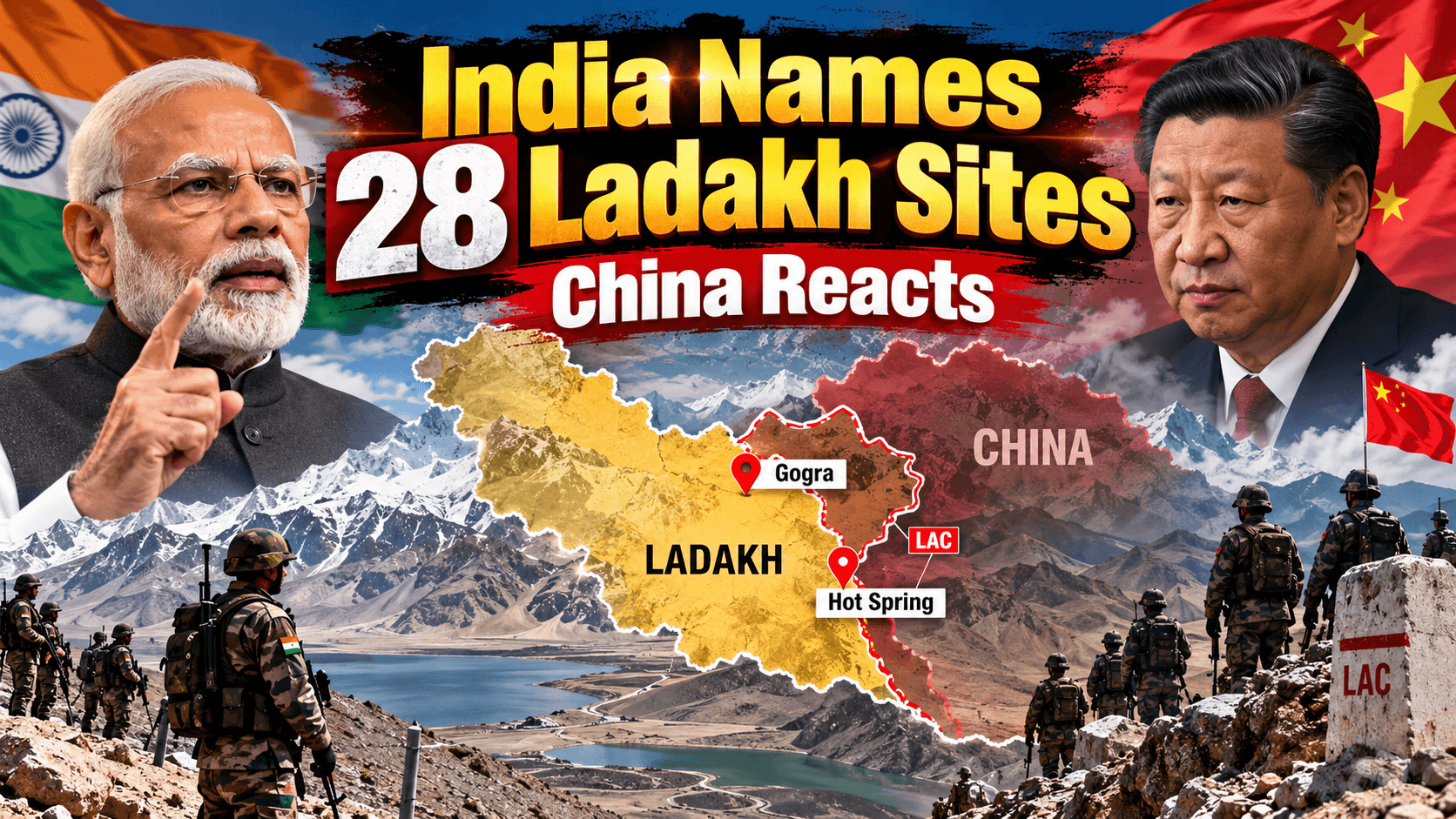
India Names 28 Ladakh Sites: China Reacts
Why in the News?
China has strongly opposed India’s decision to standardize the names of 28 strategic locations and geographical features in Ladakh, claiming that the areas belong to China. The announcement has once again brought the India-China border dispute into focus.
Recently, Chinese Foreign Ministry spokesperson Mao Ning criticized the move, arguing that India’s decision could not change China’s territorial claims. India, meanwhile, maintains its administrative authority over Ladakh and has taken steps to improve the official identification of geographical features in the region.
In recent years, even China had repeated the attempts to rename places in Arunachal Pradesh, but India has consistently rejected China's practice of assigning Chinese names to places in Arunachal Pradesh, describing the exercise as "vain and preposterous."
India has maintained that such actions do not change the "undeniable" fact that the state "was, is, and will" remain an integral part of the country. The changes by India were in direct response to China renaming regions in Arunachal Pradesh in 2023, which it calls 'Zagnan,' or South Tibet.
Several of the newly marked locations hold strategic importance because of their proximity to the Line of Actual Control (LAC) and their role in past India-China military confrontations.
What Happened?
On October 2, 2026, India’s Ministry of Home Affairs formally identified and standardized the names of 28 locations and geographical features in Ladakh. The exercise was carried out in consultation with the Ladakh administration. Its primary objective is to make official maps and geographical records more consistent and accurate.
The locations include high-altitude mountains, glaciers, valleys, rivers, mountain passes, and strategically important areas near the Line of Actual Control (LAC). This move is significant because accurate geographical identification is particularly important in a sensitive border region where India and China have competing territorial claims.
Why Has China Opposed India’s Decision?
China has rejected India’s naming exercise, arguing that the areas concerned belong to it.
Chinese Foreign Ministry spokesperson Mao Ning stated that Beijing does not recognize the creation of the Union Territory of Ladakh and considers India’s announcement of standardized names invalid.
However, renaming or standardizing geographical features does not, by itself, settle a territorial dispute or alter the boundary between two countries. The disagreement reflects the wider differences between India and China over their disputed border.
Gogra and Hot Spring: Why Are These Locations Important?
Among the 28 identified locations, Gogra and Hot Spring are particularly significant because they were major friction points during the India-China military standoff in eastern Ladakh that began in 2020.
These areas are important for several reasons:
- Strategic location: They lie in the sensitive eastern Ladakh border region.
- Military patrolling: The areas are relevant to Indian forces' patrolling activities along the LAC.
- Border tensions: They became prominent during the 2020 confrontation between Indian and Chinese troops.
- Border management: Their precise identification is important for maintaining accurate maps and official geographical records.
The naming exercise therefore carries both administrative and strategic significance.
India-China Border Standoff: A Brief Background
India-China Relations Timeline
India-China relations have seen several ups and downs over the years. The chronology of key events is given below: Year | Event 1950 | Establishment of diplomatic relations between India and China. 1954 | Signing of the Panchsheel Agreement - Five Principles of Peaceful Coexistence. 1962 | Brief border war over disputed territories of Aksai Chin and Arunachal Pradesh. 1976 | Restoration of full diplomatic ties after a gap of 15 years. 1984 | Signing of the Most Favored Nation (MFN) trade agreement. 1986 | China condemns India's move to make Arunachal Pradesh a full-fledged state. 1998 | India conducts nuclear tests, which receive criticism from China. 2005 | Chinese Premier Wen Jiabao extends support for India's bid for a permanent seat in the UN Security Council. 2006 | Reopening of the Nathu La pass for trade after 44 years. 2017-2022 | Series of Chinese incursions and standoffs in Doklam, Galwan Valley, and Tawang.
The eastern Ladakh border standoff began on May 5, 2020, following a violent confrontation between Indian and Chinese troops in the Pangong Lake area. The tensions led to a prolonged military deployment along the disputed border. Both countries subsequently held diplomatic and military-level talks to resolve the situation.
The disengagement process began in 2022 at certain friction points, although the broader boundary dispute has remained a major challenge in bilateral relations. The LAC serves as the de facto line separating areas controlled by India and China, but the two countries do not have a common understanding of its alignment at every point.
India-China Border Disputes
India-China relations have witnessed several border disputes, mainly over Aksai Chin and Arunachal Pradesh. The dispute stems from unclear boundary demarcations during British colonial rule and the McMahon Line agreement, which China does not recognize.
Major border disputes are discussed below:
Boundary Line Dispute: India considers the McMahon Line as the legal boundary and the basis for the Line of Actual Control (LAC), while China does not recognize it.
1962 Sino-Indian War: The war broke out over competing claims on Aksai Chin and Arunachal Pradesh.
Nathu La Clashes (1967): The PLA attacked Indian posts in Sikkim. India retaliated decisively, driving back Chinese forces and destroying their fortifications.
Doklam Standoff (2017): A 73-day standoff occurred when Chinese troops started constructing a road in the disputed Doklam region, claimed by Bhutan. It began on June 16, 2017, prompting India to launch Operation Juniper on June 18 in support of Bhutan. Both sides withdrew troops on August 28, 2017.
Galwan Clashes (2020): Chinese troops intruded into Indian territory in the Galwan Valley objecting to Indian road construction. It was the first fatal clash between the two sides since 1975.
Yangtse Clash (2022): The clash took place in Arunachal Pradesh when around 300 Chinese troops advanced towards Indian outposts near Chumi Gyatse Falls. It led to an hour-long hand-to-hand combat with serious injuries on both sides.
Why Is the Naming of Ladakh’s Geographical Features Significant?
1. Improves Official Mapping: Standardized names help maintain consistency across government maps, records, and administrative documents.
2. Strengthens Geographical Identification: Clear identification of mountains, passes, valleys, and other features can improve communication about specific locations in a remote border region.
3. Highlights India’s Territorial Position: The exercise reflects India’s position regarding its territorial claims and administrative jurisdiction in Ladakh. However, naming alone does not establish international legal title over disputed territory.
4. Adds to India-China Border Tensions: China’s strong reaction highlights how geographical names and maps can become politically sensitive in areas where territorial claims overlap.
What Is the Line of Actual Control (LAC)?
The Line of Actual Control (LAC) is the line that separates the areas controlled by India and China. It is not a mutually agreed, fully demarcated international boundary. The two countries have different perceptions of the LAC in several areas, which has contributed to recurring border tensions. Eastern Ladakh remains strategically important because of its difficult terrain, high-altitude environment, and proximity to disputed border areas.
India-China Relations: What Lies Ahead?
China’s opposition to the naming exercise highlights the continuing challenges in resolving the India-China boundary dispute.
For India, standardizing geographical names is an administrative exercise that improves the consistency of official records. For China, the issue is linked to its competing territorial claims.
Going forward, sustained diplomatic engagement, military communication, and mechanisms to manage border tensions will remain important for maintaining peace and stability along the LAC.
Conclusion
India’s decision to standardize the names of 28 strategic locations in Ladakh has triggered a fresh diplomatic exchange with China. The inclusion of sensitive areas such as Gogra and Hot Spring gives the development added strategic importance. For competitive examinations, the issue connects India-China relations, the Line of Actual Control, border management, Ladakh’s geography, and territorial disputes—making it relevant for both UPSC and BPSC current affairs.
Reference: