Cruise Missile Showdown: India vs Pakistan
This article is useful for BPSC and UPSC aspirants, as it connects current defense-related developments with important static concepts. It helps in UPSC Prelims and GS Paper III (Internal Security and Science & Technology) by explaining cruise missiles, ballistic missiles, missile speed, range, and DRDO’s role in indigenous defense development. It also supports GS Paper II (India–Pakistan Relations) by providing insights into regional security and defense preparedness. For BPSC, the article is relevant to general studies, general science, and defense-related current affairs. It can also help aspirants prepare for Mains answers on India’s defense modernization, strategic autonomy, and indigenous defense technology.
Why in News?
Pakistan’s latest test of the Fatah-4 cruise missile has renewed attention on the military capabilities of India and Pakistan. The test has drawn attention because of the missile’s reported ability to fly at low altitudes and its potential to strike targets at considerable distances. However, Pakistan has not publicly disclosed the maximum range achieved by the extended-range version.
The key question is how the Pakistani missile compares with India’s Nirbhay and BrahMos missiles.
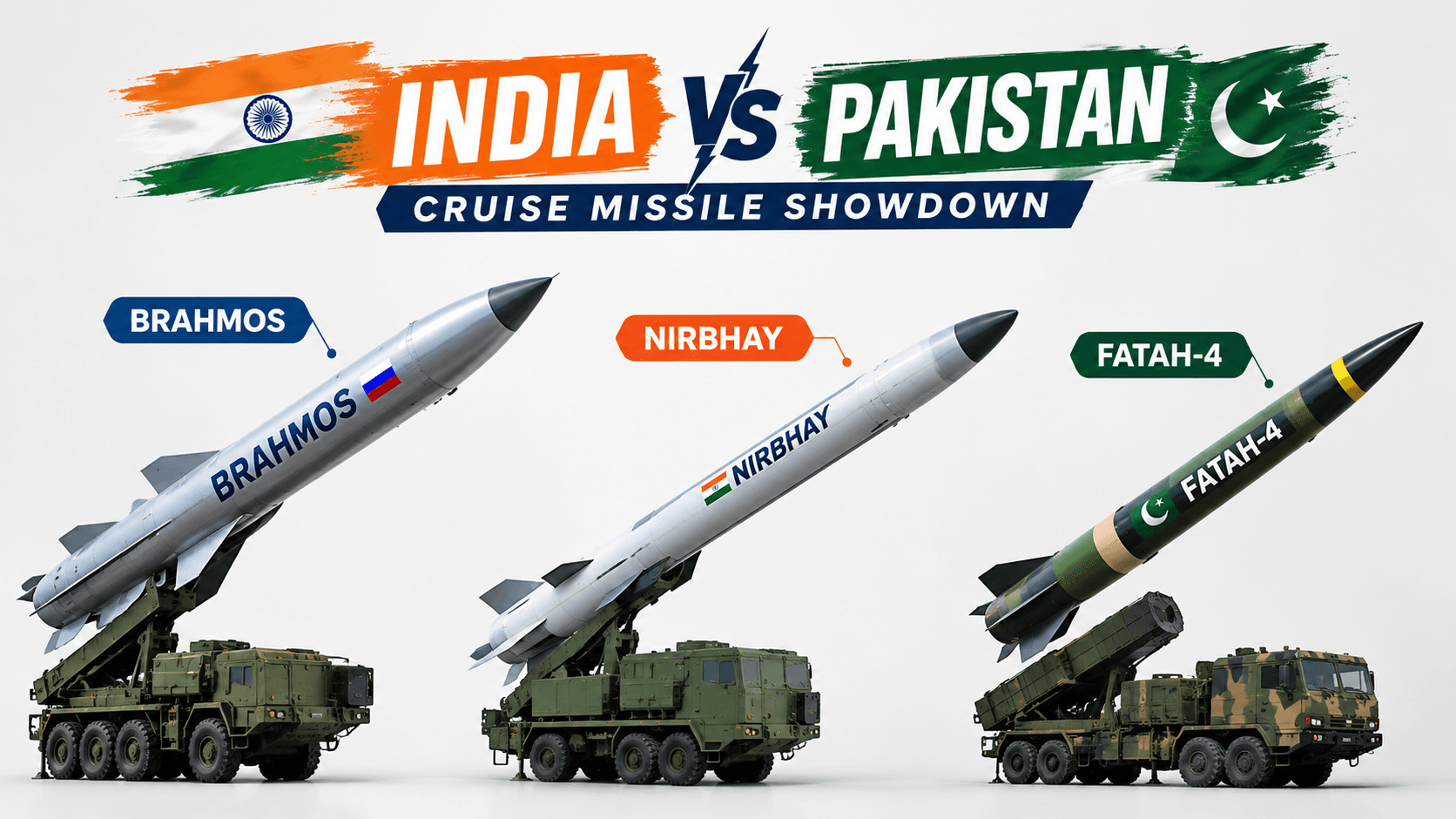
Although all three are designed to strike targets with precision, they differ significantly in range, speed, flight profile, and operational role. Nirbhay focuses on long-range subsonic strikes, while BrahMos relies on supersonic speed. Fatah-4, meanwhile, is Pakistan’s ground-launched cruise missile designed for conventional precision attacks.
What Is a Cruise Missile?
A cruise missile is a guided weapon that flies through the atmosphere towards a designated target, typically using an onboard propulsion system and navigation equipment throughout much of its flight.
Unlike ballistic missiles, which travel along a high-arcing trajectory for much of their flight, cruise missiles can fly at relatively low altitudes and adjust their routes.
Key features of cruise missiles
- Precision: Designed to strike specific targets using guidance and navigation systems.
- Low-altitude flight: Some cruise missiles fly close to the ground or sea surface, potentially reducing radar detection opportunities.
- Route flexibility: They can follow planned routes and, depending on the system, maneuver during flight.
- Different speeds: Cruise missiles may be subsonic, supersonic, or, in some cases, hypersonic.
Low-altitude flight can make detection more difficult, but it does not make a missile invisible or impossible to intercept. Radar networks, airborne sensors, and modern air-defense systems can still detect and engage such threats.
Key points about Fatah-4:
| Type: | Ground-launched cruise missile. |
| Reported baseline range: | Approximately 750 km. |
| Speed: | Reportedly subsonic. |
| Flight profile: | Designed for low-altitude flight. |
| Guidance: | Pakistan has highlighted advanced avionics and navigation systems. |
| Latest development: | Testing of an extended-range version, with its maximum range undisclosed. |
The significance of the latest test lies in Pakistan’s effort to strengthen its conventional long-range strike capability. However, the test announcement alone does not establish the missile’s operational effectiveness against modern air-defense systems.
What Is India’s Nirbhay Missile?
India’s Nirbhay is a long-range, subsonic cruise missile developed by the Defence Research and Development Organisation (DRDO).
It was designed to provide India with a long-range precision-strike capability against high-value targets. Its emphasis on range, endurance, and flexible flight profiles distinguishes it from faster, supersonic systems such as BrahMos.
Key features of Nirbhay:
- Developer: DRDO.
- Type: Long-range, subsonic cruise missile.
- Reported range: Approximately 800–1,000 km in commonly cited specifications, with some DRDO-published material reporting figures extending to 1,500 km.
- Flight profile: Capable of low-level flight.
- Primary role: Precision strikes against selected targets.
- Main strength: Long-range reach combined with a flexible flight path.
The Nirbhay program has also contributed to India’s broader efforts to develop indigenous cruise-missile technologies, including propulsion, guidance, and navigation.
Its reported range is greater than the approximately 750 km baseline figure associated with Fatah-4. However, a direct comparison remains incomplete because the maximum range of Pakistan’s newly tested extended-range version has not been publicly established.
What Makes BrahMos Different?
BrahMos is a supersonic cruise missile jointly developed by India’s DRDO and Russia’s NPO Mashinostroyenia. It belongs to a different category from the subsonic Nirbhay and the reportedly subsonic Fatah-4.
Rather than relying primarily on long endurance and subsonic flight, BrahMos combines high speed with precision-strike capability.
Key features include:
- Developers: India and Russia.
- Type: Supersonic cruise missile.
- Speed: Approximately Mach 2.8.
- Publicly cited range: Up to around 290 km for the original configuration; later variants have different range capabilities.
- Launch platforms: Land, ships, and aircraft, depending on the variant.
- Primary roles: Land-attack and anti-ship missions.
- Main strength: High speed and reduced flight time.
BrahMos’ supersonic speed gives defenders less time to respond after detection than they would generally have against a comparable subsonic missile. However, speed alone does not determine effectiveness; detection, maneuverability, guidance, launch conditions, and the target’s defenses also matter.
What Are the Different Types of Missiles?
Missiles can be classified according to their flight path, speed, launch platform, and intended target. Understanding these categories is useful for defense-related current affairs and competitive examinations.
1. Cruise missiles
These are powered, guided missiles that fly through the atmosphere towards their targets. Some follow low-altitude flight paths to reduce detection opportunities. Examples: Nirbhay, BrahMos, and Fatah-4.
2. Ballistic missiles
These missiles receive thrust during the powered phase and then follow a largely ballistic trajectory, although some can maneuver. They are commonly associated with high-speed, long-range strikes. Examples: the Agni series and Prithvi series of Indian ballistic missiles.
3. Hypersonic weapons
These travel at speeds of at least Mach 5. The category includes hypersonic glide vehicles and hypersonic cruise missiles, which use different flight and propulsion approaches. Key point: Not every missile that reaches Mach 5 is a hypersonic cruise missile.
4. Surface-to-air missiles (SAMs)
These are designed to intercept aerial threats such as aircraft, helicopters, and, depending on the system, incoming missiles. Examples: Akash and the Barak-8 family of air-defense missiles.
5. Anti-tank guided missiles (ATGMs)
These are designed to destroy armoured vehicles, including tanks. They may be launched by infantry, vehicles, or aircraft. Examples: Nag and HELINA.
6. Air-to-air and air-to-surface missiles
Air-to-air missiles target enemy aircraft, while air-to-surface missiles are launched from aircraft against targets on land or at sea. Examples: Astra (air-to-air) and Rudram-series anti-radiation missiles.
DRDO: The Backbone of India’s Indigenous Missile Development
The Defence Research and Development Organization (DRDO) is India's principal defence research agency under the Ministry of Defence. It develops technologies and systems to strengthen the country's defense preparedness and reduce dependence on foreign suppliers.
Its missile programs cover multiple roles, from strategic deterrence to battlefield operations and air defense.
Major contributions of DRDO
- Agni series: Development of strategic ballistic missile capabilities.
- Prithvi series: Shorter-range ballistic missile systems.
- BrahMos: Joint development with Russia of a family of supersonic cruise missiles.
- Akash: Development of surface-to-air missile capabilities.
- Astra: Development of indigenous air-to-air missiles.
- Nag: Anti-tank guided missile development.
- Nirbhay program: Development of long-range subsonic cruise-missile technology.
Beyond individual missile systems, indigenous research into propulsion, seekers, guidance, navigation, and control systems supports India's broader defense-industrial ecosystem.
Why Does This Comparison Matter for India’s Defense Preparedness?
The Fatah-4 test highlights the continuing importance of precision-strike capabilities in South Asia. However, the number of kilometers a missile can travel is only one measure of its military value.
Three factors are particularly important:
- Range and endurance: Longer-range missiles can potentially threaten targets farther from their launch locations.
- Speed and flight profile: Subsonic missiles can benefit from low-altitude flight and route flexibility, while supersonic missiles offer shorter flight times.
- Detection and interception: A missile's real-world effectiveness depends on its navigation, reliability, survivability, and the capabilities of the opposing air-defense network.
For India, continued investment in indigenous missile development, surveillance, early-warning systems, and integrated air defense remains important. The comparison also demonstrates why cruise missiles with different speeds and ranges are complementary rather than directly interchangeable.
Conclusion
Pakistan's Fatah-4 and India's Nirbhay occupy broadly similar territory as reported subsonic cruise-missile systems, although important details of Fatah-4's extended-range version remain undisclosed. BrahMos is different: its defining feature is supersonic speed rather than the longer-range, subsonic approach associated with Nirbhay.
The key takeaway is that missile capability cannot be judged by range alone. Speed, accuracy, guidance, reliability, and the ability to penetrate air defenses all influence operational effectiveness. Through DRDO-led research and programs such as BrahMos and Nirbhay, India continues to strengthen its indigenous precision-strike capabilities.
Previous year's question
Q. Consider the following statements:
1. Ballistic missiles are jet-propelled at subsonic speeds throughout their flights, while cruise missiles are rocket-powered only in the initial phase of flight.
2. Agni-V is a medium-range supersonic cruise missile, while BrahMos is a solid-fuelled intercontinental ballistic missile. Which of the statements given above is/are correct? (a) 1 only (b) 2 only (c) Both 1 and 2 (d) Neither 1 nor 2
(IAS Pre-2023)
ANS: The correct option is (d) neither 1 nor 2. Detailed Breakdown Statement 1 is incorrect: The definitions are inverted. Ballistic missiles are powered by rockets initially and then follow a free-falling, unpowered ballistic trajectory, reaching supersonic or hypersonic speeds. Cruise missiles are essentially unmanned jet-propelled aircraft that fly at subsonic or supersonic speeds throughout their entire flight. Statement 2 is incorrect: The missile classifications are reversed. Agni-V is a solid-fuelled Intercontinental Ballistic Missile (ICBM), while BrahMVs is a supersonic cruise missile.
Reference: