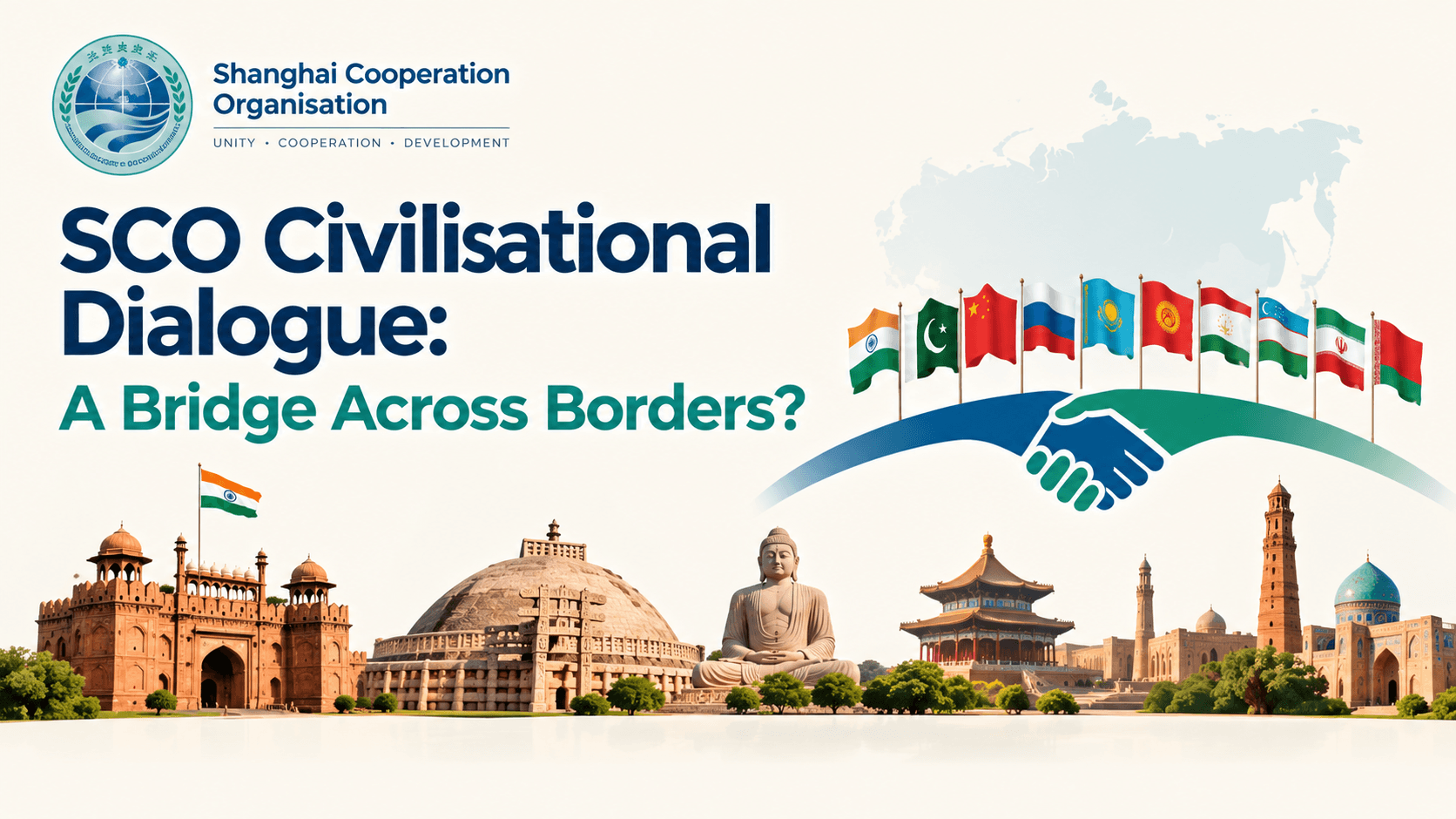
SCO Civilisational Dialogue: A Bridge Across Borders?
Why in News?
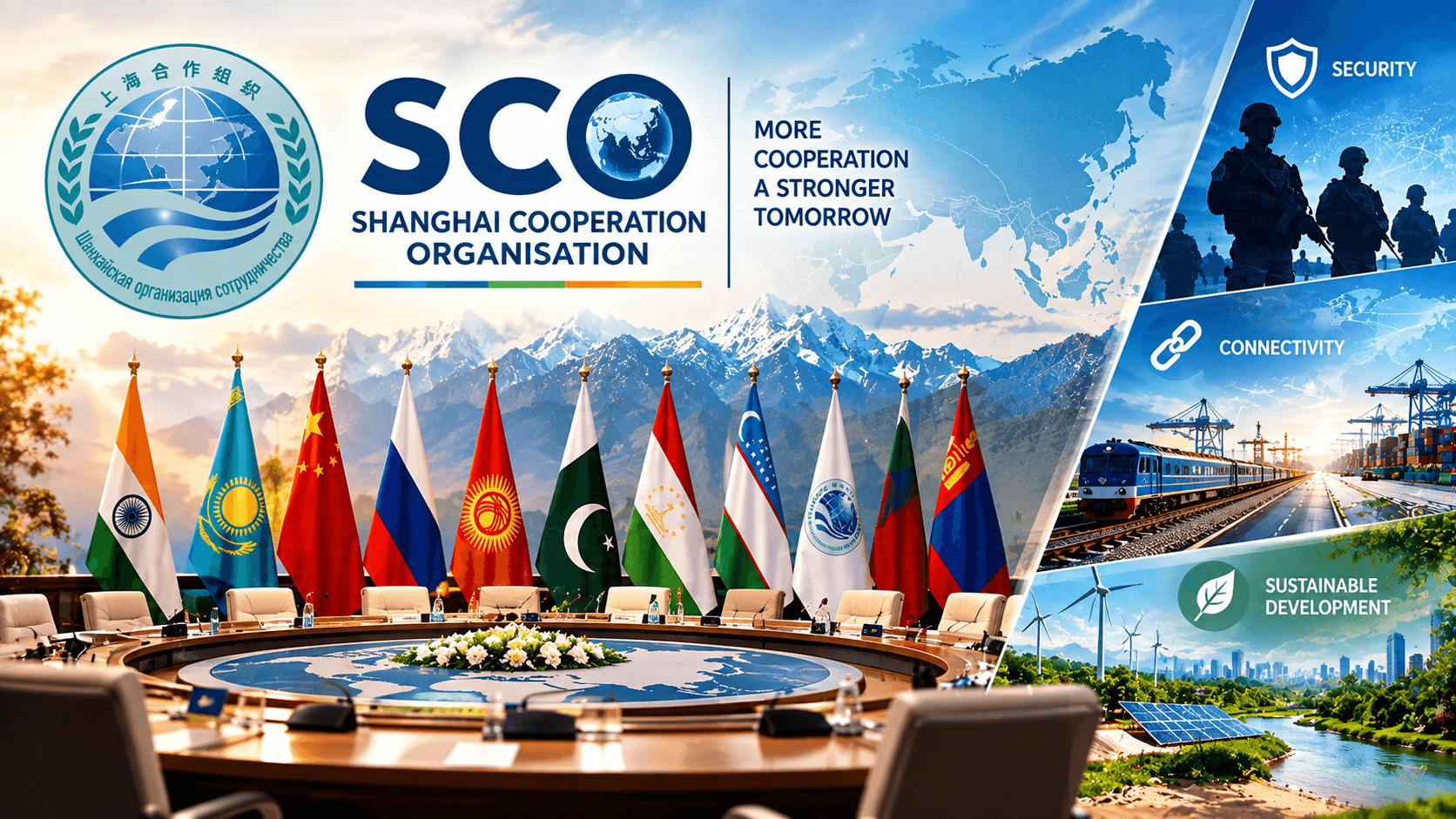
In a short while, India has invited Pakistan to attend the first-ever SCO Civilisational Dialogue Forum, scheduled to be held in New Delhi from November 20 to 22, 2026. It is noteworthy that India will hold the first "Civilizational Dialogue Forum" of the 10-nation Shanghai Cooperation Organisation (SCO) grouping, which also includes Pakistan.
The invitation is significant because it comes amid strained India-Pakistan relations, particularly following the military conflict between the two countries in May 2025.
What Is the SCO Civilizational Dialogue Forum?
The Civilizational Dialogue Forum is a new initiative under the Shanghai Cooperation Organization (SCO). Its primary objective is to bring member countries together through cultural exchange, shared heritage, and civilizational connections.
The initiative was proposed by Prime Minister Narendra Modi during the SCO leaders' summit in Tianjin last year and was subsequently adopted by the SCO Council.
Unlike traditional diplomatic meetings that mainly focus on politics, security, and economic cooperation, this forum aims to highlight the historical and cultural connections among participating nations.
About the Shanghai Cooperation Organization (SCO)
The SCO is a permanent intergovernmental international organization, established in 2001 in Shanghai (China). It was preceded by the Shanghai Five (China, Russia, Kazakhstan, Kyrgyzstan, and Tajikistan) mechanism. India and Pakistan had officially joined SCO in 2017 as full members.
Significance: With 10 members, the SCO covers a vast geopolitical space, accounting for ∼25% of global GDP and over 40% of the world's population.
Member States: China, Russia, Kazakhstan, Kyrgyzstan, Tajikistan, Uzbekistan, India, Pakistan, Iran, and Belarus (newest member). Observer States: Afghanistan and Mongolia.
Dialogue Partners: Azerbaijan, Armenia, Bahrain, Egypt, Cambodia, Qatar, Kuwait, Laos, Maldives, Myanmar, Nepal, UAE, Saudi Arabia, Türkiye, and Sri Lanka.
Secretariat: Beijing, China.
Core Objectives: To strengthen mutual trust, maintain regional peace, security, and stability, and jointly counter new challenges, primarily the "Three Evils" of terrorism, separatism, and extremism.
Structure:
Heads of State Council (HSC): The supreme decision-making body of the SCO.
Regional Anti-Terrorist Structure (RATS): Headquartered in Tashkent (Uzbekistan), RATS is the permanent organ that coordinates member states' efforts against terrorism, separatism, and extremism
Why Is Purana Qila the Venue?
The three-day event will be inaugurated by Prime Minister Narendra Modi at Purana Qila (Old Fort), New Delhi. Notably, Purana Qila served as a point of attraction for the delegates of the G20 summit also in September 2023.
Purana Qila, identified as the ancient city of Indraprastha, has been a subject of archaeological interest for several decades.
The excavation has unearthed significant findings, providing insights into Delhi's continuous history spanning over 2500 years. More than 136 coins and 35 seals and sealings have been discovered from a small, excavated area, indicating the site's pivotal role as a center for trade activities.
The excavation had yielded a remarkable collection of artifacts. Notable findings include a stone image of Vaikuntha Vishnu, a terracotta plaque of Gaja Laxmi, a stone image of Ganesha, seals and sealings, coins, terracotta figurines of humans and animals, beads of various stones, and a bone needle. These artifacts, along with pottery and other antiquities, offer valuable insights into the ancient civilization and trade activities at the site.
About Gaja Laxmi
In NCERT Class 12 History (Themes in Indian History Part 1, Chapter: Kings, Farmers, and Towns / Thinkers, Beliefs and Buildings), the sculpture of Gaja Lakshmi is discussed in the context of early Indian art, iconography, and its presence at early Buddhist monuments like the Sanchi Stupa, where it symbolizes prosperity and shows how popular folk deities were incorporated into Buddhist art.These depictions at Sanchi and Bharhut date between 2nd century BCE and 1st century CE, making Gaja Lakshmi one of the earliest and most enduring goddess forms in South Asian art. Elephants here symbolise prosperity, rain-bearing clouds and royal power, elements that were vital for both agrarian life and ancient kingship.
These archaeological findings reflect different historical periods, including the pre-Mauryan period, Mauryan period, Shunga period, Kushana period, Gupta and post-Gupta periods, Rajput period, and Sultanate and Mughal periods.
Hosting the dialogue at this historic site reflects India's intention to connect contemporary diplomacy with its rich cultural and civilizational heritage.
India's Participation in the SCO and Regional Diplomacy
Although India has stayed away from SAARC meetings in Islamabad since 2016 due to differences with Pakistan, it continues to participate in SCO activities.
India has also remained involved in regional security cooperation through the SCO's Regional Anti-Terrorist Structure (RATS). In September, India sent SCO National Coordinator Alok Dimri to Islamabad for the first coordination meeting related to Pakistan's SCO presidency.
Pakistan is scheduled to host the SCO Heads of State Summit in August 2027. Earlier, in November 2024, External Affairs Minister S. Jaishankar represented India at the SCO Heads of Government Meeting.
Why Has Pakistan Been Invited?
If the Pakistani minister of National Heritage and Culture, Aurangzeb Khan Khichi, attends, it will mark an important moment in India-Pakistan engagement. It would be the first visit by a Pakistani minister to India since former Foreign Minister Bilawal Bhutto Zardari attended the SCO Foreign Ministers' Meeting in Goa in May 2023. It would also be the first such visit since the four-day military conflict between India and Pakistan in May 2025.
Conclusion: Can Culture Strengthen Regional Relations?
The SCO Civilizational Dialogue Forum represents an effort to use culture, history, and shared heritage as instruments of regional cooperation. India's invitation to Pakistan is particularly noteworthy given the current state of bilateral relations. However, the invitation itself should not be interpreted as a major diplomatic breakthrough.
The real significance of the event lies in its attempt to create a platform where countries can explore their historical connections and cultural similarities, even when political differences continue to exist. For India, the forum is also an opportunity to showcase its ancient civilization and strengthen its cultural engagement with the wider SCO region.
Reference: