Sagarmanthan 2026: India–EU’s Green Shipping Push
Why in News?
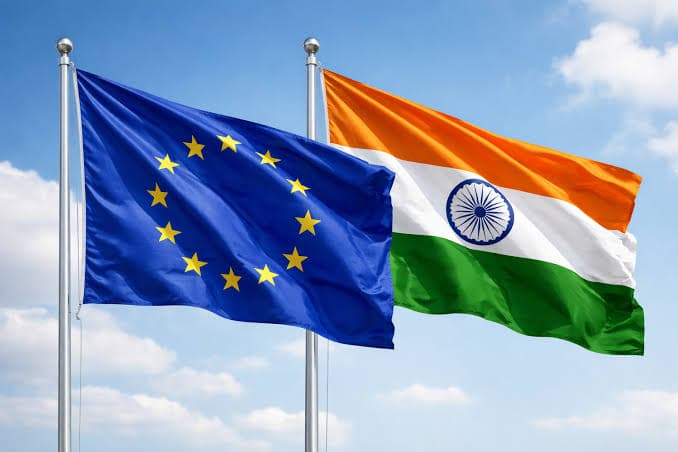
India and the EU have officially teamed up to make shipping greener. At the 3rd edition of Sagar Manthan: The Great Oceans Dialogue (2026), both sides launched an industry coalition for the India-EU Green Shipping Corridor.
What will this coalition do?
Push the use of low-emission fuels like green methanol, ammonia, and hydrogen in ships.
Bring in private investment for green port infrastructure.
Make green shipping routes commercially viable, not just experimental
The event was organized by the Ministry of Ports, Shipping and Waterways (MoPSW) in partnership with the Observer Research Foundation (ORF).
Key Highlights of the India-EU Green Shipping Corridor Initiative
1. Green Fuel Trade
The corridor aims to link India's production strength with Europe's demand. India will produce and export green ammonia and methanol, which will be used as clean fuel for ships. This will directly help in decarbonizing the maritime sector.
2. Implementation Roadmap
The plan is moving step-by-step. First, a pre-feasibility study was completed in 2025 to check technical and economic viability. Now in 2026, an industry coalition has been formed. Its job is to mobilize private investment, build strong government-industry partnerships, and make the green corridor commercially viable.
3. Renewable Energy at Ports
Under the Harit Sagar Green Port Guidelines 2023, India has set clear targets. The share of renewable energy in major ports will be increased to over 60% by 2030 and over 90% by 2047, reducing the carbon footprint of port operations.
4. Green Maritime Transition
Major changes are happening on the ground. Diesel-powered harbour tugs are being replaced with green-powered vessels. Three ports—Deendayal Port in Gujarat, Paradip Port in Odisha, and V.O. Chidambaranar Port in Tamil Nadu—have been identified as green hydrogen hubs for production, storage, and bunkering of cleaner fuels. The strategy also includes shore-to-ship electricity and electrification of port equipment.
5. Maritime Resilience
The initiative is not just about emissions. It also aims to make maritime supply chains more resilient to geopolitical disruptions and climate risks while ensuring a just and inclusive green transition.
6. Port Capacity Expansion
Under Maritime Amrit Kaal Vision 2047, India plans to expand its port handling capacity to 10 billion tonnes annually by 2047. Major ports already handled over 915 million tonnes in FY 2025-26, up from 581 million tonnes in FY 2014-15.
7. National Waterways
Cargo movement on national waterways has seen massive growth—from 18 million tonnes in FY 2013-14 to 218 million tonnes in FY 2025-26. This shows inland waterways are becoming a key part of India's multimodal and greener transport system.
India-EU Free Trade Agreement (FTA)
The long-awaited India-EU Free Trade Agreement has finally crossed the finish line. Negotiations that lasted almost 20 years were concluded on January 27, 2026, at the 16th India-EU Summit in New Delhi. Leaders called it the "mother of all deals."
The deal is not officially signed yet. After conclusion, the text went for legal scrubbing and approval by the European Council. It is now scheduled to be officially signed on December 16, 2026, in Brussels in the presence of PM Modi. Once signed, it will go to the European Parliament for passage in 1-2 months, and rollout is expected in early 2027.
Key Highlights of the India-EU Trade Agreement
1. Scale & Scope
This agreement is huge in size. It creates a combined free trade market of 2 billion people, which accounts for nearly 25% of the world's GDP and handles over €180 billion in trade every year. It is one of the largest trade deals signed by both sides.
2. Tariff Eliminations
The core of the deal is large-scale tariff removal. The EU has agreed to eliminate or reduce tariffs on 99.5% of Indian export value, meaning 93% to 99% of Indian products will get duty-free or preferential access to the European market. On the other hand, India will eliminate or reduce tariffs on 96.6% of EU goods exports, but this will be done in phases over several years.
3. Automobiles & Wine
This is the most sensitive and headline-making part of the deal. India will significantly lower tariffs on European cars to just 10% for a limited quota of up to 250,000 vehicles. Similarly, tariffs on European wines and spirits will be reduced to 20-30% within quotas, and tariffs on olive oil will be brought down to 0%, making these European products more affordable in India.
4. Services & Mobility
The agreement goes beyond goods and covers high-value services. It includes strong commitments in IT, professional, financial, and maritime transport services. It also introduces a mobility framework that will make it easier for skilled professionals, intra-company transferees, and students to move and work between India and the EU.
Conclusion
The India-EU Green Shipping Corridor is more than just a clean-fuel project—it is a strategic partnership for the future. For India, it brings investment, technology, and a global market for its green hydrogen. For the EU, it ensures a reliable supply of clean fuels to meet its climate targets. And for the world, it means cleaner oceans, stronger supply chains, and a practical model of green transition. With growing port capacity, booming waterways, and clear targets under Harit Sagar and Maritime Amrit Kaal Vision 2047, India is showing that economic growth and environmental responsibility can sail together.