Public Accounts Committees (PACs)
Why in News?
In a little while, the Lok Sabha Speaker, Om Birla, inaugurated the two-day All India Conference of Chairpersons and Members of Public Accounts Committees (PACs) in Thiruvananthapuram, Kerala. The conference brought together PAC members from Parliament and the State/UT Legislatures to discuss how public money is spent and how accountability can be strengthened.
The central theme for 2026 was “Audit, Accountability, and Good Governance: The Evolving Role of PAC," which focused on how audits and PACs must adapt to ensure more transparent, responsible, and effective governance in changing times.
Key Highlights of the PAC Conference
PAC is not just about checking accounts: The speaker made it clear: PAC's job is not just to read CAG reports and tick boxes. It must ask a bigger question: Did the money spent change people's lives on the ground? Scrutiny must be outcome-driven, not just paper-driven.
Fiscal discipline is the backbone of democracy: every rupee from the public exchequer is people's money. It must be accounted for and used only for the purpose it was sanctioned for. Fiscal discipline is not optional; it is non-negotiable for a healthy democracy.
One common digital platform for audits: A proposal was made to create a common digital audit monitoring platform for all state legislatures, on the lines of Parliament. This will help track audits on time and follow up on corrective actions faster.
Keralam Resolution (2026)
The conference adopted the Keralam Resolution, calling for:
Greater cooperation among all PACs
Fixed timelines for Action Taken Notes
Capacity-building to make financial oversight stronger
Public Accounts Committee (PAC)
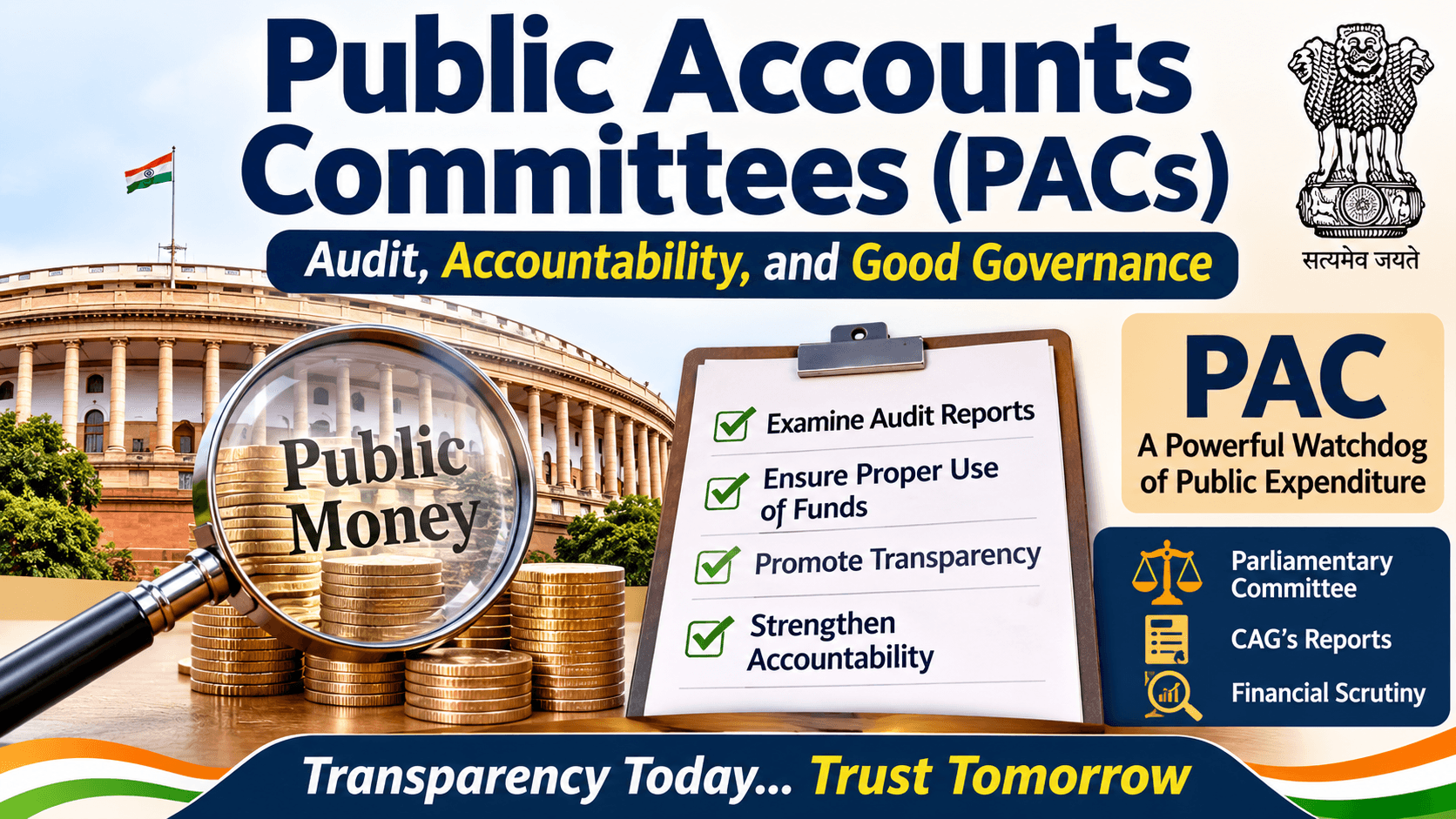
The Public Accounts Committee is one of the most powerful financial committees of Parliament. Its job is simple but crucial: to check how the government spent the public's money and to hold the executive accountable to the legislature.
It works closely with the CAG and is one of the three Financial Parliamentary Committees, along with the Estimates Committee and the Committee on Public Undertakings (CoPU).
PAC is not a constitutional or statutory body. It is constituted annually under Rule 308 of the Rules of Procedure and Conduct of Business in Lok Sabha. Articles 105 and 118 provide the broader constitutional framework for parliamentary committees.
Historical Background
PAC was first established in 1921 after the Montague-Chelmsford Reforms. In the beginning, the Finance Member/Finance Minister himself was the Chairman, which made free criticism of the government difficult. After the Constitution came in 1950, PAC became a full-fledged parliamentary committee under the speaker, and the finance minister was barred from membership.
Membership: Total 22 members, 15 from Lok Sabha and 7 from Rajya Sabha. Rajya Sabha members were added in 1954-55. Members are elected annually by proportional representation through a single transferable vote. No minister can be a member. If a member becomes a minister, he/she automatically leaves the committee.
Since 1967, by convention, the Chairperson is from the Opposition and is appointed by the Lok Sabha Speaker. This is a parliamentary convention, not a constitutional requirement. Tenure is a maximum of 1 year.
Functions and Scope: PAC mainly examines the Appropriation Accounts (expenditure) and Annual Finance Accounts (receipts) of the Government of India.
It extensively examines the reports of the CAG. That is why CAG is called the "friend, philosopher, and guide" of PAC.
It checks whether the money was legally available, used for the intended purpose, followed the rules, and whether re-appropriations were proper.
It also examines autonomous bodies, state corporations, and trading/manufacturing schemes audited by CAG.
Its scrutiny is not just about numbers. It checks the "wisdom, faithfulness, and economy" of expenditure and pulls up the government for losses, wasteful expenditure, and financial irregularities.
It examines excess grants, which must be regularized by Parliament under Article 115. It also criticizes unnecessary savings, as they lead to waste and extravagance.
PAC can also take up subjects on its own (Suo motu) under Rule 276, even without a CAG para.
Action Taken Accountability: The government must reply to PAC recommendations within 6 months to form an Action Taken Report. Action Taken Notes on all CAG paras must be submitted within 4 months through the Audit Para Monitoring System (APMS) Portal to achieve zero pendency.
Limitations: PAC conducts only post-expenditure audits—it checks spending after it has already happened. Its recommendations are non-binding. It has no authority over government policy or executive decisions.
Conclusion
PAC is not just a committee that counts rupees; it is the guardian of the people's money. If every rupee is spent honestly, tracked digitally, and questioned fearlessly, good governance will not be a slogan; it will be a reality. The Keralam Resolution has shown the way. Now, it is time for every PAC, from Parliament to the smallest state legislature, to turn audit into accountability and accountability into development. Because when public money is protected, public trust is protected.
Reference: