Medical Devices Rules, 2017
Why in News?
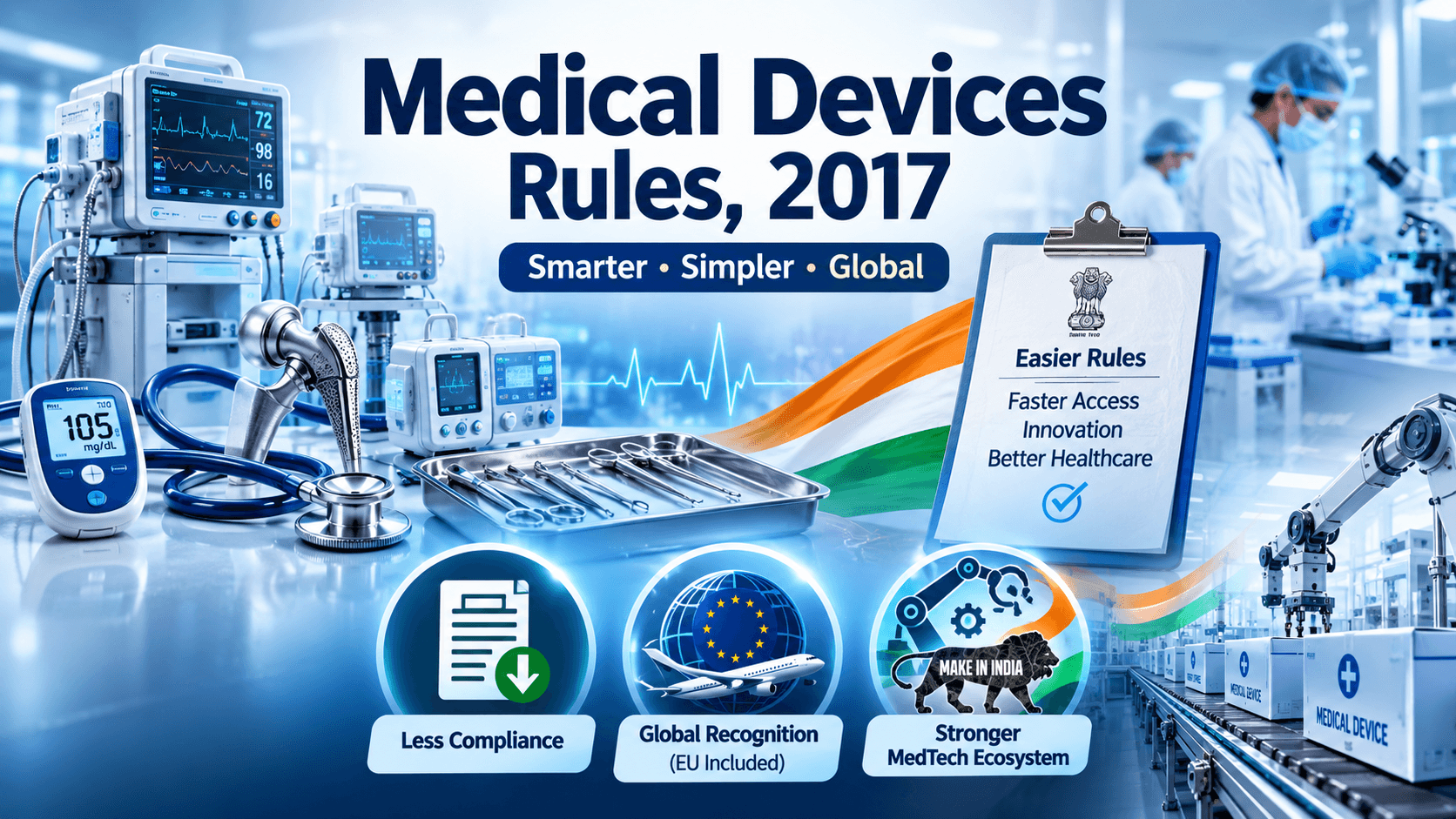
Recently, the Central Government has amended the Medical Devices Rules, 2017, to promote Ease of Doing Business (EoDB) in the medical device sector. The reforms aim to reduce compliance burden, bring transparency, and ensure faster access to advanced medical technologies in India.
What are the 3 major reforms?
The government has amended the rules in three key areas:
1. Simplification of Outsourced Sterilization—Amendment in Rule 44 and Rule 25 Earlier, if a manufacturer did not have its own sterilization facility, it had to take a separate loan license under Rule 25 for getting sterilization done from outside.
Now after amendment: The manufacturer will not need a separate loan license, provided the outsourced sterilization facility already holds a valid license under Medical Devices Rules, 2017.
Benefit:
| 1. | Cuts down on paperwork, approval time, and cost |
| 2 | Encourages utilization of specialized high-quality sterilization centers |
| 3 | Helps MSME manufacturers who cannot afford to set up sterilization units |
| 4 | MedTech makes in India get a boost |
2. Uniform Testing Fees—New Ninth Schedule Inserted
Earlier, different medical device testing laboratories were charging different fees, creating confusion and disputes.
Now: A Ninth Schedule has been added prescribing uniform and standardized fees for testing of medical devices across all labs.
3. Inclusion of the European Union for Clinical Investigation Waiver—Amendment in Rule 63
This is the most important reform for international convergence.
What is Rule 63?
For medical devices without a predicate device (i.e., completely new innovative devices), clinical investigation in India is required. But if the device is already approved by a stringent foreign regulator, India can waive local clinical trials.
Earlier, recognized jurisdictions were the USA, the UK, Australia, Canada, and Japan (5 countries).
Now: The European Union (EU) is also included as the 6th recognized jurisdiction.
Benefit:
- Devices already approved in the EU can enter India faster without repeating clinical trials
- Reduces regulatory duplication and time
- Indian patients get faster access to advanced EU-approved devices
- shows India's move towards global regulatory harmonization
Why These Reforms Matter
For Governance & Economy: Strengthens India's medical device ecosystem, which is still import dependent (approx. 70-80% imports). Reduces compliance burden and promotes EoDB.
Aligns with Atmanirbhar Bharat, Make in India, and the National Medical Devices Policy 2023.
For Public Health:
Faster availability of safe, quality, and innovative devices.
While ensuring highest standards of quality, safety and performance are maintained
A transparent fee structure builds trust among stakeholders
Conclusion
The amendment to Medical Devices Rules, 2017, is a balanced step—it simplifies business without compromising safety. By recognizing the EU, rationalizing testing fees, and easing loan license norms, India is moving towards a more transparent, predictable, and globally convergent regulatory system for MedTech, which is crucial for achieving affordable healthcare for all.