Living Planet Report, 2026 Released.
Why in News ?
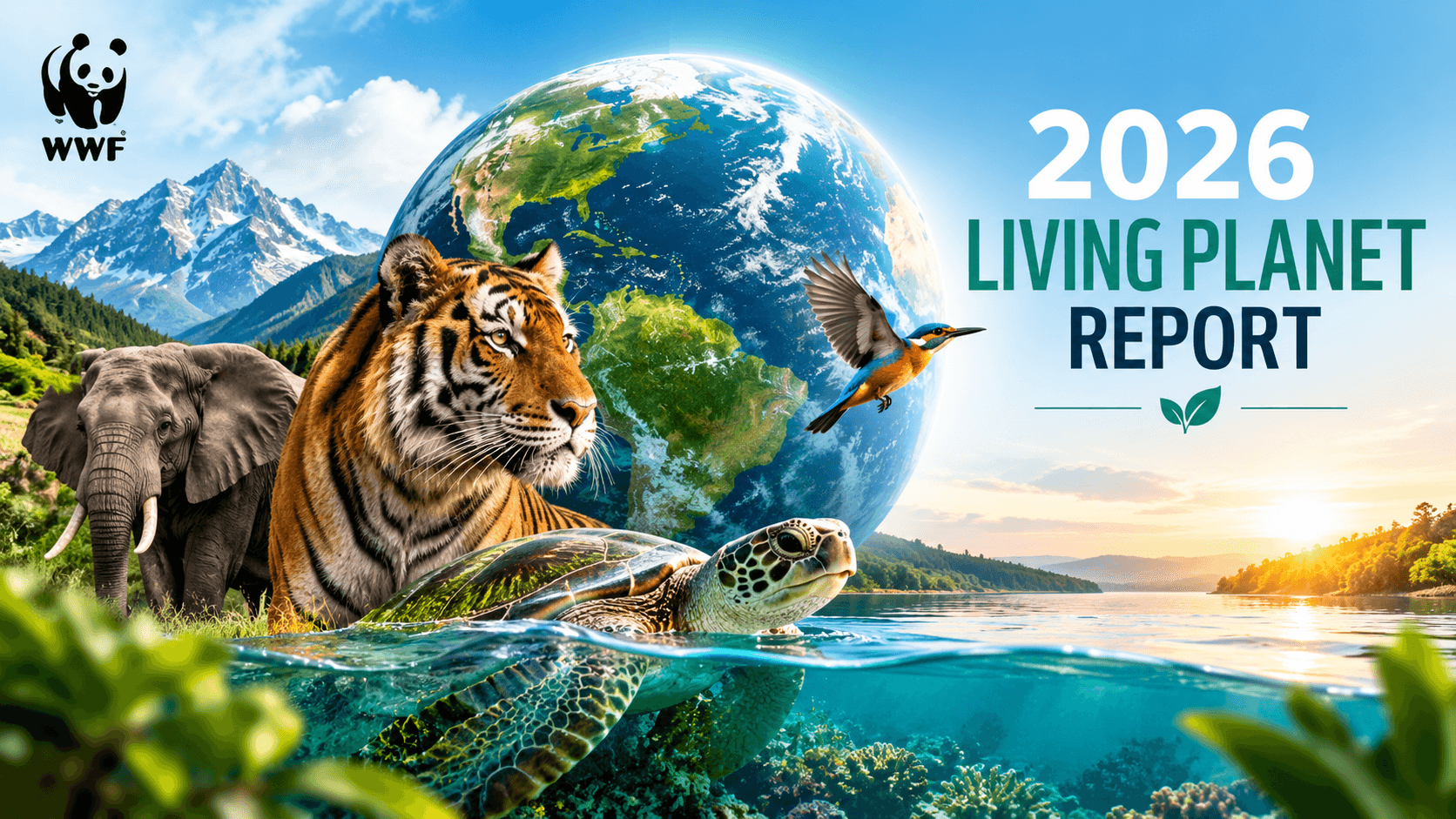
Recently, the World Wide Fund for Nature (WWF) biennial Living Planet Report, 2026, has been released. This is the 16th edition of the report.
Living Planet Index(LPI) is the parameter to track average trends in wildlife populations. It measures the state of the world’s biological diversity based on population trends of vertebrate species from terrestrial, freshwater and marine habitats. These species include mammals, birds, fish, reptiles and amphibians. Developed in 1998, LPI measures the changes.
Key Findings
- According to the report, the average size of monitored vertebrate populations declined 73% over 52 years between 1970 and 2022. This means that the average size of the wildlife populations included in the study has declined by 73%. For example if a monitored population of deer in a forest was 1,000 in 1970 and dropped to 300 by 2022. That represents a 70% decline in the population.
Similarly, the LPI is calculated by aggregating the trends of numerous monitored populations.
- The decline across the three major ecosystems was as follows:
Freshwater → 85% ↓
Terrestrial → 69% ↓
Marine → 59% ↓
Therefore, the freshwater ecosystem is the most severely affected ecosystem.
- According to the report, the way the world produces and consumes food is the biggest driver of biodiversity loss. This can be understood through the following equation:
Rising food demand → Expansion of agriculture → Conversion of forests/habitats → Loss of biodiversity
- Furthermore, intensive agriculture entails issues such as:
excessive water use, pesticides, fertilizers, soil degradation, greenhouse gas emissions.
- Therefore, establishing national parks alone is not enough for biodiversity conservation; food systems must also be made sustainable.
- The Living Planet Report 2026 puts forward a significant concept: positive tipping points. According to the report, major transformations in energy, food, and finance systems are essential for nature recovery.
What is a positive tipping point?
In simple terms: When a beneficial change begins to spread so rapidly that it becomes self-sustaining and gains its own momentum, it can be termed a positive tipping point. For Example: Solar energy. Initially, solar energy was expensive and limited → technology improved → costs dropped → adoption increased → investment grew → solar expanded even faster. Similarly, sustainable agriculture and nature-positive finance can also be rapidly mainstreamed.
Can biodiversity loss be reversed?
Yes.
This is the most positive message of the Living Planet Report 2026. The report highlights examples of recovery for certain species:
- Tiger
- Green sea turtle
- Bluefin tuna
- Southern African elephants
These examples demonstrate that wildlife populations can recover through a combination of targeted conservation, political will, community participation, and international cooperation.
The global wild tiger population has reached approximately:
2010 → 3,200
2026 → around 5,700
This is a significant example of the success of targeted conservation.
In India as well, recovery has been observed in some key species due to conservation efforts. According to the 2022 All India Tiger Estimation, 3,682 tigers were recorded in India.
Are Living Planet Report and Convention on Biodiversity(CBD) linked?
Yes. The CBD needs indicators and scientific data to determine whether global biodiversity goals are being achieved.
The Living Planet Index is one of the indicators used within the monitoring framework of the Kunming-Montreal Global Biodiversity Framework. It is listed as a component indicator.
The Kunming-Montreal Global Biodiversity Framework was adopted under the CBD in 2022 and contains 4 long-term goals for 2050 and 23 targets for 2030 .
It is called the Kunming–Montreal Global Biodiversity Framework (KMGBF) because the framework’s development and adoption were closely associated with two cities: Kunming, China and Montreal, Canada.
Why two names?
It belongs to two-stage process:
1. Kunming, China – 2021 The first part of CBD COP15 was held in Kunming in October 2021. Countries adopted the Kunming Declaration and continued negotiations toward a new global biodiversity framework.
2. Montreal, Canada – 2022 The negotiations were resumed and the final Kunming–Montreal Global Biodiversity Framework was adopted in Montreal in December 2022 at CBD COP15.
What is the WWF?
WWF stands for World Wide Fund for Nature. The WWF is an international conservation organization whose primary objective is to protect nature, wildlife, and biodiversity.
The WWF's work broadly involves:
- Preserving biodiversity
- Promoting the sustainable use of natural resources
- Reducing pollution and wasteful consumption
- Conserving wildlife and ecosystems
- Collaborating with governments, communities, and other organizations on conservation efforts
What is ZSL ?
ZSL stands for Zoological Society of London. It is a scientific and conservation organization. ZSL was established in 1826. Its mission is to contribute to the conservation of wildlife and ecosystems through science and research. Most importantly, ZSL manages the Living Planet Index (LPI).