Legislative Council: Relevant but Needs Reform
Why in News?
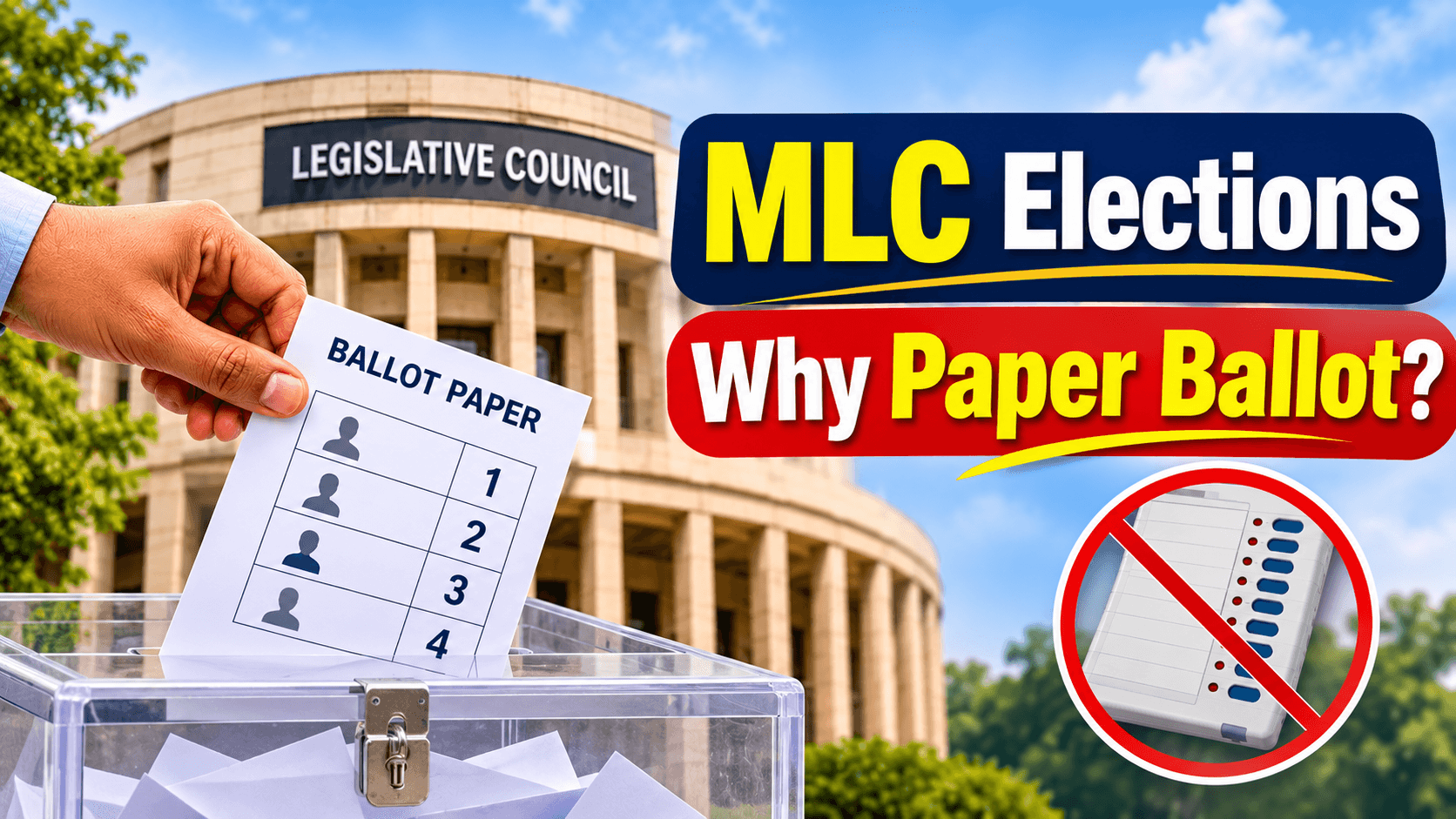
Members of Legislative Council (MLC) elections in several states have again put the spotlight on the bicameral system in states. This has raised questions on why only a few states have a Legislative Council (Vidhan Parishad) and what role it plays in our democracy.
What is a legislative council?
India has a bicameral system at the center, such as the Lok Sabha and the Rajya Sabha. Bicameralism at the Centre was introduced by the Montagu-Chelmsford Reforms, 1919, while the Government of India Act, 1935, provided for bicameral legislatures in some provinces. The Legislative Council first started functioning in Bengal in 1937. The Constitution allows states to have either one house or two houses.
For states with two houses, the legislature has:
Lower House (Vidhan Sabha): Directly elected by the people, it is the main law-making body.
Upper House (Vidhan Parishad): It is the revising chamber. It is a permanent body and is never dissolved.
Tenure: Like the Rajya Sabha, the Legislative Council is a permanent House and is never dissolved. Members serve a 6-year term, with one-third retiring every 2 years.
Eligibility: To become an MLC, a person must be at least 30 years old, while for an MLA, the minimum age is 25 years.
Bicameral States: At present, only 6 states have a Legislative Council, such as Andhra Pradesh, Telangana, Uttar Pradesh, Bihar, Maharashtra, and Karnataka.
Note: Jammu & Kashmir had a council till it was abolished under the J&K Reorganisation Act, 2019.
Constitutional Provisions:
– :
| Article 168 | Structure of State Legislature | It lays down whether a state will have only a Vidhan Sabha (unicameral) or both Vidhan Sabha and Vidhan Parishad (bicameral). |
| Article 169 | Creation and Abolition | Parliament can create or abolish a Legislative Council by simple majority if the concerned State Assembly passes a resolution for it. The Assembly resolution must be passed by special majority, majority of total membership, and at least two-thirds of members present and voting. |
| Article 171 | Composition | The maximum strength of the Council is one-third of the Assembly strength, and the minimum is 40. So, its size depends on the size of the assembly. |
How MLCs are elected:
Unlike MLAs, MLCs are chosen through indirect election by proportional representation with a single transferable vote:
| 1/3rd | Elected by local bodies like municipalities, Gram Panchayats, Panchayat Samitis, and Zila Parishads. |
| 1/3rd | Elected by MLAs from among non-assembly members. |
| 1/12th | Elected by graduates residing in the state with at least 3 years standing. |
| 1/12th | Elected by teachers who have taught for at least 3 years in secondary schools or above in the state. |
| 1/6th | Nominated by the governor for persons having special knowledge in literature, science, art, cooperative movement, and social service. |
Utility of Legislative Councils
| Check on Hasty Laws: | It works as a revising chamber that rechecks bills passed hurriedly or under populist pressure in the Assembly. |
| Voice to Diverse Groups: | It gives direct representation to teachers, graduates, and local bodies in lawmaking. |
| Space for Experts: | The governor's nomination route allows eminent persons and subject experts who do not want to contest direct elections to contribute. |
| Shares Workload: | By introducing non-money bills, the Council helps reduce the heavy legislative burden of the Assembly. |
Why Do Only Some States Have Legislative Councils?
Financial Burden: Running a second house costs a lot on salaries, allowances, and infrastructure, which is heavy for smaller states.
"Parking Lot" for Politicians: Often criticized for accommodating leaders who lost elections or to please coalition partners, rather than bringing in experts and intellectuals.
Very Limited Powers: Under Article 197, the Council cannot veto a bill passed by the Assembly. It can only delay an ordinary bill for a max of 4 months, 3 months the first time and 1 month after reconsideration. It cannot introduce or reject money bills. It can only suggest changes within 14 days, which the Assembly may accept or reject. Unlike Parliament, there is no provision for a joint sitting to resolve deadlock between two houses at the state level.
Seen as a Delaying Body: Critics say it only delays important bills without adding much value.
No Federal Need: The Rajya Sabha is needed to represent states at the Centre for federalism. At the state level, the council does not serve such a federal purpose; it only represents functional groups and local bodies.
Issues in Working:
| Politicized Nominations: | The governor's quota meant for eminent persons is often filled with political loyalists, defeating the purpose of bringing independent experts. |
| Narrow Representation: | Separate seats for graduates and teachers made sense after independence when they were rare and respected, but today with mass education, giving privilege to only these two groups looks outdated. |
| Political Creation/Abolition: | Article 169 is called an "experimental provision"; councils are created or abolished at the whims of new governments. |
| Obstruction & Duplication: | When opposition controls the council, it can delay government bills for politics. When the same party controls both houses, it becomes a "ditto chamber" that just repeats Assembly debates without real scrutiny. |
Conclusion:
The Legislative Council can be useful as a revising chamber that checks hasty laws and brings in teachers, graduates, and experts, but it has weak powers and is often misused for political adjustment. Its relevance depends on reforms and honest use, otherwise it remains costly and dispensable.
Reference: