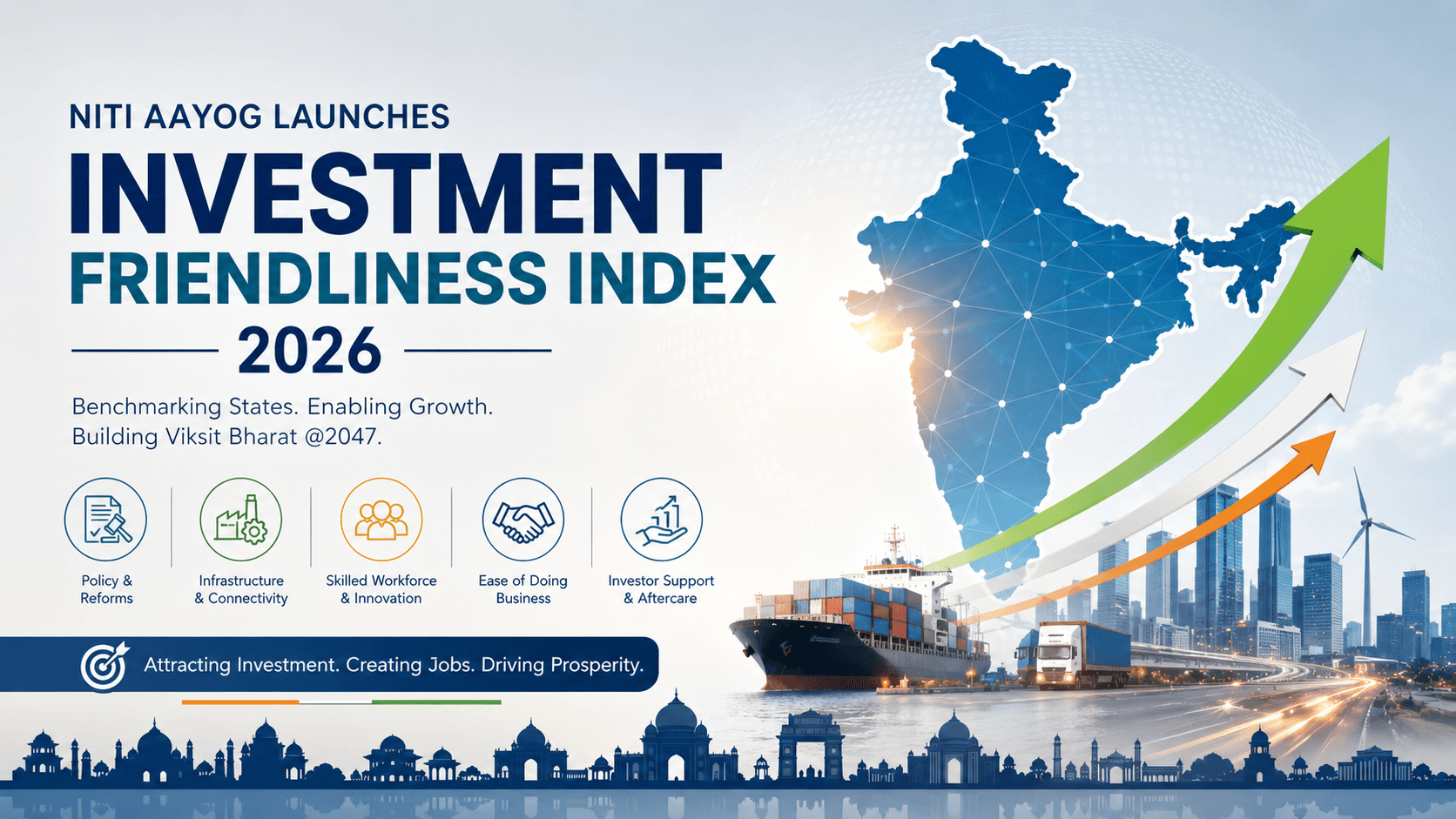
NITI Aayog has unveiled the first-ever Investment Friendliness Index (IFI) 2026 to evaluate and rank the preparedness of Indian States and Union Territories in attracting, enabling, and retaining domestic as well as foreign investments.
The Investment Friendliness Index seeks to foster competitive and cooperative federalism by encouraging States and Union Territories to adopt best practices and undertake continuous reforms in pursuit of the vision of Viksit Bharat @2047.
Actually, during the 9th Governing Council Meeting of NITI Aayog held in July 2024, NITI Aayog was assigned with preparing an Investment-Friendly Charter comprising key policies, programmes, and processes required to attract investments. Subsequently, The Union Budget 2025–26 announced the development of an Investment Friendliness Index to strengthen the spirit of competitive and cooperative federalism.
About IFI 2026
IFI 2026 is a benchmarking tool designed to assess how investment-ready States and UTs are across policy, infrastructure, governance, and ease of doing business.
The index aims to create healthy competition among States and guide investors toward locations with the strongest enabling environment.
It aligns with India’s broader goal of becoming a global manufacturing and investment hub by strengthening sub-national competitiveness.
Key Objectives of IFI 2026
Benchmarking: Measure State and UT performance on parameters that directly impact investment decisions.
Facilitation: Identify gaps in regulatory processes, infrastructure, and investor support systems.
Sustaining Investments: Evaluate aftercare, grievance redressal, and policy stability to ensure long-term investor confidence.
Data-Driven Policy: Provide States with actionable insights to reform and improve their investment climate.
The Index evaluates key policy, institutional, regulatory, and infrastructure-related parameters that influence investment decisions and provides a comparative assessment of the investment ecosystem across States and Union Territories.
The report underscores that while national-level reforms provide the overarching policy direction for economic growth, State Governments play a pivotal role in shaping the investment climate through robust infrastructure, efficient regulatory frameworks, effective institutions, and predictable policy regimes.
What IFI 2026 Assesses
The index looks at multiple dimensions including:
Policy & Regulatory Framework: Clarity, stability, and investor-friendly reforms
Infrastructure: Industrial land, power, logistics, and connectivity
Ease of Doing Business: Single-window clearances, digitization, and compliance burden
Skilled Workforce & Innovation Ecosystem: Availability of talent and R&D support
Investor Support & Aftercare: Handholding, incentives, and dispute resolution mechanisms
Why the Investment Friendliness Index Matters
Competitive Federalism: Encourages States to compete on reforms rather than just incentives, improving the overall investment climate.
Capital Mobilization: Helps channel both domestic and FDI into States with better governance and infrastructure.
Job Creation & Growth: Improved investment readiness translates into more industries, MSMEs, and employment at the State level.
Transparency for Investors: Gives domestic and global investors a credible, comparable view of where to invest in India.
India has witnessed sustained economic growth over the past three decades and is now on the path towards becoming a developed nation under the vision of Viksit Bharat @2047.
Framework and Methodology
The Investment Friendliness Index covers all 28 states and 8 Union Territories and evaluates investment attractiveness across the following eight pillars:
- Infrastructure
- Business climate
- Resources
- Government policy
- Regulatory Ease
- Institutional Environment
- Financial Health; and
- Environmental Resilience
The Investment Friendliness Index (IFI) framework has been developed through a rigorous and consultative process involving an extensive review of global and domestic investment benchmarking methodologies.
The framework comprises 84 indicators, incorporating both secondary data and perception-based measures derived from a primary survey of investors.
Key Results and State Categorisation
Based on overall scores, States and Union Territories have been classified into four performance categories:
● Top Performers (scores above 50) ● Frontrunners (45–50) ● Emerging Performers (≥40 – <45) ● Aspiring States (below 40)
Based on the overall assessment, Gujarat, Maharashtra, Tamil Nadu, Goa, and Odisha have emerged as the Top Performers in the Investment Friendliness Index. In addition, 15 States have been classified as Frontrunners, while eight States/UTs have been placed in each Emerging Performers and Aspiring States categories.
Recognizing the diversity in India's federal landscape, States and Union Territories have also been assessed within three peer groups - Large States, Hilly and North-Eastern States, and Union Territories and City States. This peer-group approach accounts for differences in geography, economic scale, and administrative context, enabling more meaningful and equitable comparisons.
Among the Large States, Gujarat secured the first rank, followed by Maharashtra and Tamil Nadu, which are also the top three performers in the overall Index. In the Hilly and North-Eastern States category, Uttarakhand emerged as the highest-ranked State, followed by Assam and Himachal Pradesh. Among the City States and Union Territories, Goa secured the top position, followed by Delhi and Chandigarh.
(This topic is relevant for UPSC GS Paper-2 & GS Paper-3 and BPSC Mains GS Paper 2 under Government Policies and Economic Development)
What is the Investment Friendliness Index (IFI) 2026?
It is NITI Aayog's first ever index that evaluates and ranks Indian States and Union Territories on their preparedness to attract, enable, and retain domestic and foreign investments.
When was NITI Aayog tasked with developing an Investment-Friendly Charter?
During the 9th Governing Council Meeting of NITI Aayog held in July 2024, NITI Aayog was assigned to prepare an Investment-Friendly Charter of key policies, programmes and processes to attract investment.
Which Union Budget announced the development of the Investment Friendliness Index?
The Union Budget 2025-26 announced the development of the Investment Friendliness Index to strengthen competitive and cooperative federalism.
How many states and union territories does the IFI 2026 cover, and across how many pillars?
The IFI 2026 covers all 28 states and 8 Union Territories, evaluating them across eight pillars: Infrastructure, Business Climate, Resources, Government Policy, Regulatory Ease, Institutional Environment, Financial Health, and Environmental Resilience.
How many indicators make up the IFI 2026 framework?
The framework comprises 84 indicators, combining secondary data with perception-based measures from a primary survey of investors.
How are states categorised under the IFI 2026?
States are classified into four categories based on scores: Top Performers (above 50), Frontrunners (45-50), Emerging Performers (40 to under 45), and Aspiring States (below 40).
Which states ranked as Top Performers in the overall IFI 2026?
Gujarat, Maharashtra, Tamil Nadu, Goa, and Odisha emerged as the Top Performers in the Investment Friendliness Index.
How were states grouped for a fairer comparison in the IFI 2026?
States and UTs were assessed within three peer groups, Large States, Hilly and North-Eastern States, and Union Territories and City States, to account for differences in geography, economic scale and administration.
Which state topped the Hilly and North-Eastern States category?
Uttarakhand emerged as the highest ranked state in this category, followed by Assam and Himachal Pradesh.
Is the Investment Friendliness Index part of the BPSC/UPSC syllabus?
Yes, this topic is relevant for UPSC GS Paper 2 and GS Paper 3, and for BPSC Mains GS Paper 2 under Government Policies and Economic Development.