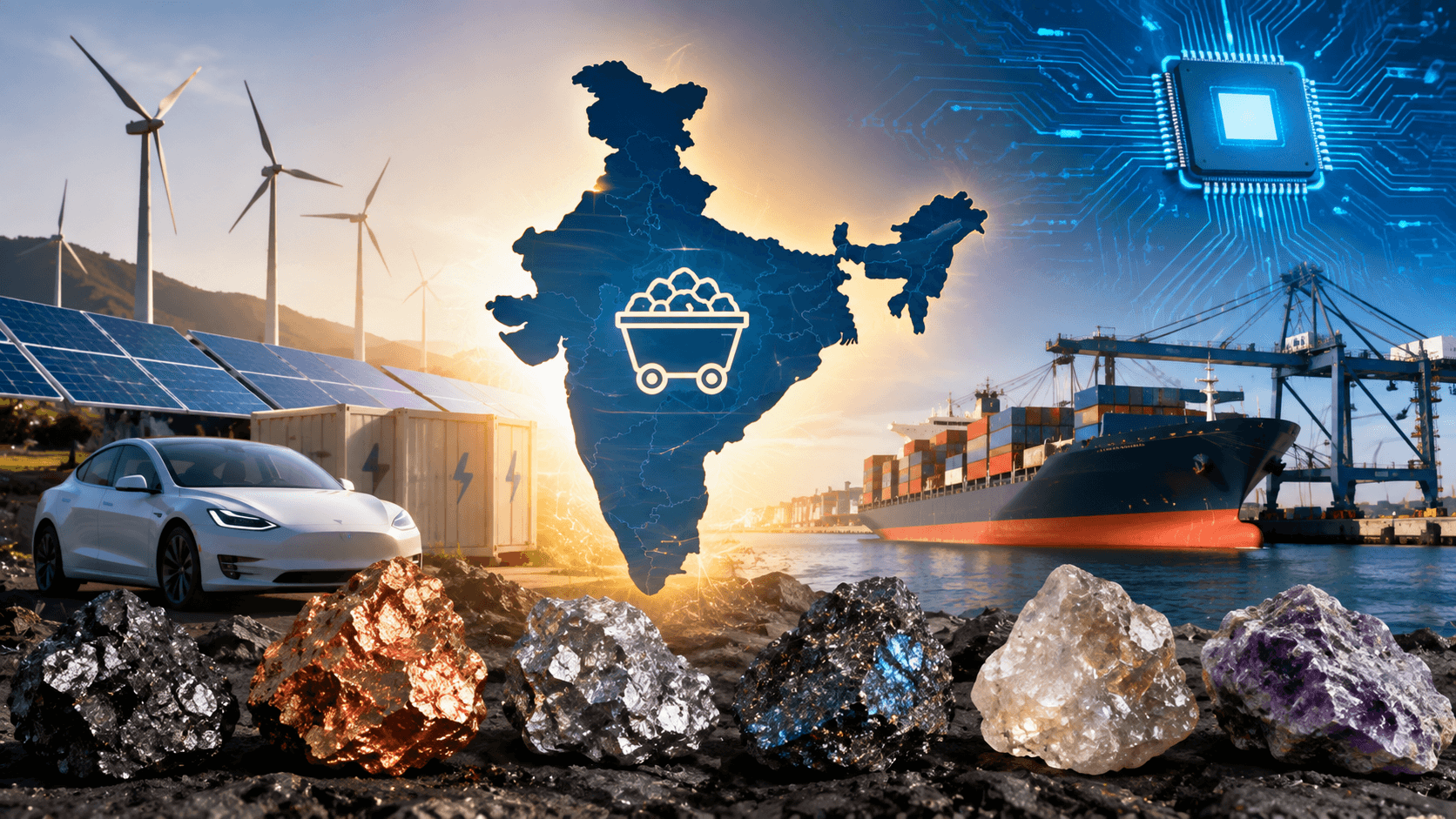
Critical Minerals: The Foundation of Strategic Power
This editorial is based on 'Critical minerals, the foundation of strategic power' published in The Hindu on 04/08/2026. The article talks about the growing importance of critical minerals in defining India’s strategic power and its strategic autonomy as well. Critical minerals have become a key determinant of strategic and economic power, as the world moves to green energy and digitalization. With this important editorial some data have been extracted from PIB.
Why in News?
Critical minerals have become central to India's economic growth, energy transition, national security, and strategic autonomy. India has accelerated exploration, overseas acquisitions, and policy reforms through the National Critical Mineral Mission.
What are Critical Minerals
Critical minerals are those minerals that are essential for economic development and national security. They are indispensable for clean energy technologies, high-tech electronics, transport, telecommunications and defence.
They are vital to power the global transition to a low carbon emissions economy. These are also minerals fraught with supply chain vulnerabilities, hence the necessity for governments to secure their supply chains for such minerals.
The major Critical minerals
Countries identify minerals critical for them based on their national priorities. In 2023, the Ministry of Mines, released a list of 30 critical minerals for India.
These minerals are Antimony, Beryllium, Bismuth, Cobalt, Copper, Gallium, Germanium, Graphite, Hafnium, Indium, Lithium, Molybdenum, Niobium, Nickel, PGE, Phosphorous, Potash, REE, Rhenium, Silicon, Strontium, Tantalum, Tellurium, Tin, Titanium, Tungsten, Vanadium, Zirconium, Selenium and Cadmium.
Why are Critical Minerals the New Currency of Progress?
As the world pivots to clean energy and advanced technologies, control over critical minerals has become the new frontier of geopolitics.
It is not merely a mining programme, but a strategic blueprint to secure energy security, drive industrial growth, and cement technological independence. From the lithium that powers electric vehicles to the rare earths vital for defence systems, the National Critical Minerals Mission casts its net wide.
As a matter of fact Critical minerals form the backbone of the modern economy because they are necessary for manufacturing electric vehicles, renewable energy equipment, semiconductors, batteries, aerospace technologies, and advanced defence systems.
As countries strive to achieve net-zero emissions and technological self-reliance, demand for these minerals is increasing rapidly. Consequently, securing reliable supplies of critical minerals has become an important aspect of national security and economic competitiveness.
Why Critical Minerals Matter for India’s Clean Energy Future
Critical minerals sit at the heart of India’s energy transition, powering technologies from solar panels to electric vehicles. Their role cuts across key sectors. As demand surges, these resources are emerging as the foundation of a stronger strategic future.
Solar Energy:- Photovoltaic cells, the heart of solar panels, depend on elements like silicon, tellurium, indium, and gallium to turn sunlight into electricity. India’s solar power capacity, now at 64 GW, leans heavily on these critical minerals, driving the nation’s solar dreams.
Wind Power:-Wind turbines are powered by neodymium and dysprosium. These elements drive the high-performance magnets that make turbines spin efficiently. With India aiming to expand its wind power from 42 GW to 140 GW by 2030, demand for these critical minerals will soar, making them essential for the clean energy revolution.
Electric Vehicles (EVs):- At the heart of every electric car lies a battery fueled by lithium, nickel, and cobalt. These minerals make clean mobility possible, storing energy that powers EVs on the road. With the government pushing for 30% EV penetration by 2030, the hunger for these resources is set to multiply.
Energy Storage: Lithium-ion systems are vital for renewable integration, depending once again on lithium, cobalt, and nickel. These minerals make it possible to store surplus power and provide backup when demand peaks.
Global Scenario:
The global demand for critical minerals has increased sharply because of the rapid expansion of renewable energy, electric mobility, and digital technologies. However, the production and processing of these minerals are concentrated in a few countries, especially China, creating geopolitical risks.
Export restrictions and supply chain disruptions have encouraged countries such as the United States, the European Union, Japan, and India to diversify their sources and invest in overseas mining projects.
The major points are crucial :
- Demand expected to increase significantly by 2070.
- China dominates mineral processing.
- Supply chains are highly concentrated.
- Resource nationalism is increasing.
- Countries are investing in overseas mining assets.
India's Position
India possesses considerable geological potential for minerals such as copper, graphite, rare earth elements, and newly discovered lithium reserves. Despite this, the country depends heavily on imports for lithium, cobalt, and nickel because domestic exploration, mining, and refining capacities remain inadequate. This dependence exposes India to geopolitical uncertainties and supply chain vulnerabilities.
Strengths
- Significant geological potential.
- Large domestic market for clean technologies.
- Growing policy support.
- Strategic partnerships with mineral-rich countries.
Weaknesses
- Heavy import dependence.
- Limited exploration.
- Poor refining capacity.
- Technology constraints.
- Slow project approvals.
Geopolitical Importance
Critical minerals are increasingly viewed as the "new oil" because they determine a country's ability to manufacture advanced technologies and maintain strategic autonomy. Nations are using mineral diplomacy, export controls, and overseas investments to secure long-term supplies. China's dominance in processing critical minerals has highlighted the strategic importance of diversified and resilient supply chains.
Challenges Faced by India
India faces multiple challenges in developing a secure critical mineral ecosystem. These include inadequate exploration, lack of processing and refining facilities, dependence on imports, technological limitations, environmental concerns, and lengthy regulatory approvals. Addressing these constraints is essential for achieving self-reliance in critical minerals.
The major challenges are :
| 🎯 Challenges | 📖 Description |
|---|---|
| 📦 Import Dependence | Heavy reliance on foreign suppliers increases supply-chain risks. |
| 🗺️ Limited Exploration | Underexplored mineral reserves reduce domestic availability. |
| 🏭 Weak Refining | Lack of refining capacity limits value addition. |
| ⚙️ Technology Gaps | Need for advanced extraction and recycling technologies. |
| 🌱 Environmental Issues | Sustainable mining practices remain a major challenge. |
| 💸 High Investment | Mining projects require significant capital and long gestation periods. |
| 📑 Regulatory Delays | Slow approvals impact project execution and investor confidence. |
| 🌐 China's Dominance | Dependence on China's processing ecosystem creates strategic vulnerabilities. |
Government Initiatives
Recognizing the strategic importance of critical minerals, the Government of India has launched several initiatives to strengthen domestic exploration, encourage private investment, secure overseas mining assets, and improve processing capabilities. These measures aim to reduce import dependence and build resilient supply chains.
The National Critical Mineral Mission (NCMM)
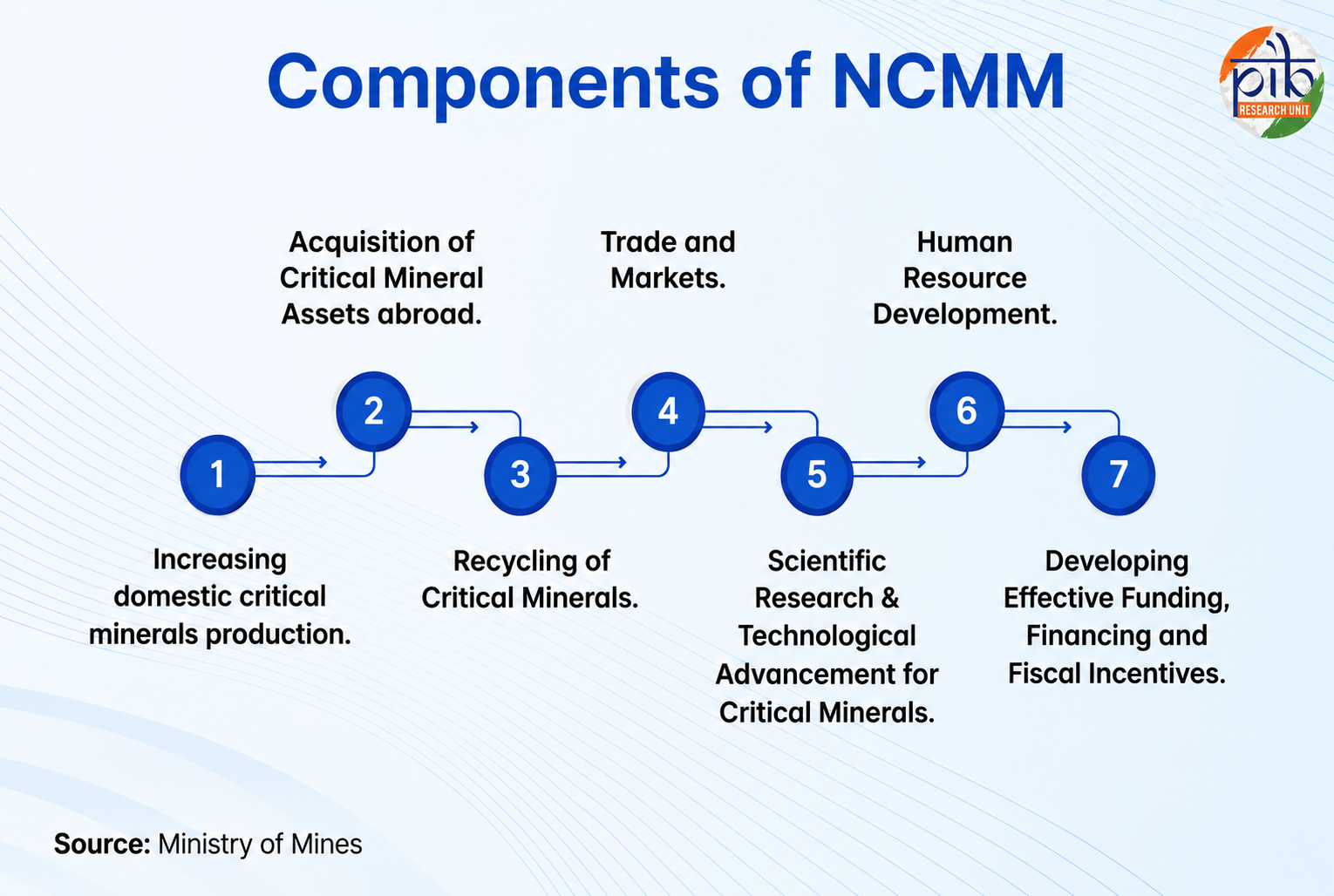
The National Critical Mineral Mission (NCMM), launched in 2025, is India’s blueprint to secure domestic and global supply chains of critical minerals. NCMM targets 1,000 patents by 2030, with the creation of 7 Centres of Excellence to drive breakthroughs in exploration and extraction. Under the NCMM, a ₹1,500 crore incentive scheme has been approved to boost recycling capacity for critical minerals.
KABIL (Khanij Bidesh India Limited)- Acquire overseas mineral assets. Ensure long-term mineral security.
Auction of Critical Mineral Blocks- Encourage private participation. Increase domestic mining.
International Cooperation-Partnerships with Australia, Argentina, Chile and African nations.
Recycling and Circular Economy-Battery recycling. Urban mining. E-waste management.
Way Forward
India must adopt a comprehensive strategy that combines domestic exploration, processing, technological innovation, recycling, and international cooperation.
| 🚀 Initiative | 🌟 Impact |
|---|---|
| 🔎 Explore More | Discover new domestic mineral reserves |
| 🏭 Process in India | Increase value addition and self-reliance |
| ♻️ Recycle Resources | Reduce imports and support sustainability |
| 🛡️ Strategic Reserves | Improve supply-chain resilience |
| 🤝 Public-Private Partnerships | Accelerate investment and infrastructure |
| 🌍 Global Partnerships | Secure stable mineral supply chains |
| 💡 Innovation & R&D | Develop advanced mining technologies |
| 📋 Ease Regulations | Speed up project implementation |
| 👨🏭 Skill Development | Build a future-ready workforce |
| 🌐 Diversified Imports | Minimize geopolitical and market risks |
Conclusion
Critical minerals are becoming as strategically significant in the 21st century as oil was in the 20th century. They are indispensable for energy security, economic growth, technological leadership, and national defence. For India, securing reliable and sustainable supplies of critical minerals is essential to achieving the goals of Viksit Bharat 2047, Atmanirbhar Bharat, and the green energy transition.
As a matter of fact, India has set major climate milestones like cutting the emissions intensity of its GDP by 45% by 2030 (from 2005 levels), sourcing half of its power capacity from non-fossil fuels by the same year and achieving net-zero emissions by 2070. A balanced approach that integrates domestic capacity building, international partnerships, recycling, and technological innovation will ensure long-term strategic resilience.
Critical minerals and their geopolitical impact fall under Current Affairs, Economy, and Science & Technology in the BPSC syllabus. They are primarily covered in General Studies (GS) Paper II of the Mains exam and in the Prelims.
Reference:
- https://www.thehindu.com/opinion/op-ed/critical-minerals-the-foundation-of-strategic-power/article71302082.ece
- https://www.pib.gov.in/PressNoteDetails.aspx?ModuleId=3&NoteId=155158®=3&lang=2
What are critical minerals?
Critical minerals are minerals essential for economic development and national security, indispensable for clean energy technologies, high-tech electronics, transport, telecommunications, and defence.
How many critical minerals has India identified, and when?
In 2023, India's Ministry of Mines released a list of 30 critical minerals considered essential for the country, including lithium, cobalt, graphite, and rare earth elements.
Why do critical minerals matter for solar and wind energy in India?
Solar photovoltaic cells depend on silicon, tellurium, indium, and gallium, while wind turbine magnets rely on neodymium and dysprosium. India's solar capacity currently stands at 64 GW, and wind power is targeted to expand from 42 GW to 140 GW by 2030.
Why do critical minerals matter for electric vehicles?
EV batteries depend on lithium, nickel, and cobalt, and demand for these minerals is set to rise as the government pushes for 30% EV penetration by 2030.
What is the National Critical Mineral Mission (NCMM)?
Launched in 2025, the NCMM is India's blueprint to secure domestic and global critical mineral supply chains. It targets 1,000 patents by 2030 and the creation of 7 Centres of Excellence.
What role does KABIL play in India's critical mineral strategy?
KABIL, or Khanij Bidesh India Limited, works to acquire overseas mineral assets to help ensure India's long-term mineral security.
What is India's main weakness in the critical minerals sector?
Despite significant geological potential for minerals like copper, graphite, and rare earth elements, India depends heavily on imports for lithium, cobalt, and nickel because domestic exploration, mining, and refining capacities remain inadequate.
Why is China's dominance significant in the global critical minerals market?
Production and processing of critical minerals is concentrated in a few countries, especially China, creating geopolitical risks that have encouraged countries like the United States, the European Union, Japan, and India to diversify their sources.
What incentive has been approved for recycling critical minerals?
Under the NCMM, a 1,500 crore rupee incentive scheme has been approved to boost recycling capacity for critical minerals.
Is the critical minerals topic part of the BPSC syllabus?
Yes, as an Economy-related topic covering resource security and strategic autonomy, critical minerals are relevant to GS Paper-3 in the BPSC syllabus.