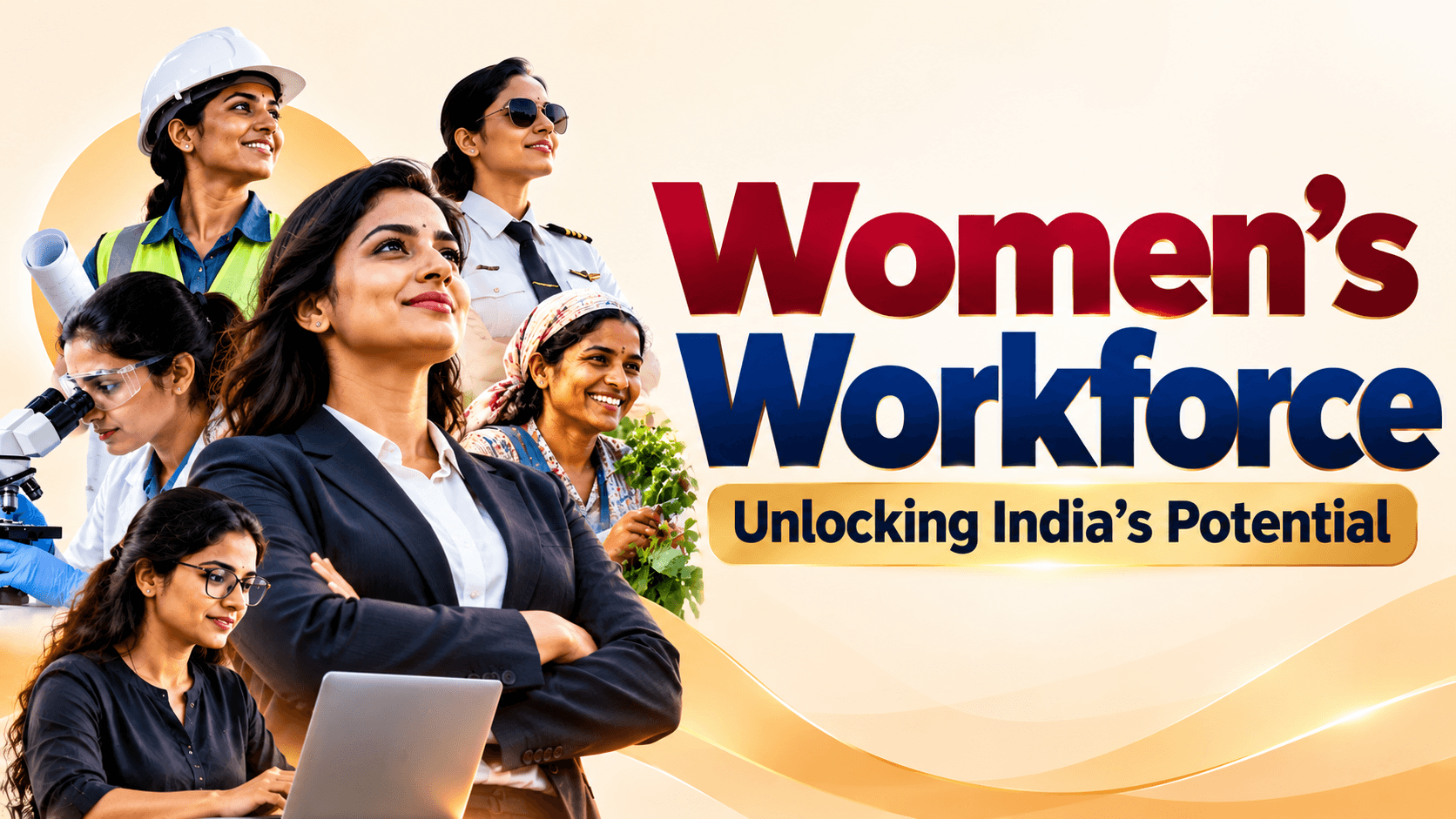
Women’s Workforce: Unlocking India’s Potential
Topics related to "Women’s Workforce: Unlocking India’s Potential" and the Female Labour Force Participation Rate (FLFPR) span multiple papers in both the UPSC (Union Public Service Commission) and BPSC (Bihar Public Service Commission) civil services examination syllabi. Because it bridges social issues and economic growth, questions can appear under several specific sections.
Why in News?
The rise in female labor force participation in India has brought focus to improving the quality of women's employment, with more emphasis on job security, social protection, safer workplaces, financial independence, and economic empowerment.
What are the key trends about women's employment in India?
Rising labor force participation: According to the Periodic Labour Force Survey (PLFS), female LFPR for women aged 15 years and above rose from 23.3% in 2017-18 to 40% in 2025.
The Labor Force Participation Rate (LFPR) measures the proportion of the population that is either working or seeking or available for work.
Increasing employment: The Female Worker Population Ratio (WPR) rose from 22% in 2017-18 to 38.8% in 2025, showing a rise in the share of women employed.
The WPR measures the proportion of employed persons in the total population.
Large employment base: An estimated 20 crore women aged 15 years and above were employed in India during the shift towards quality employment. Women's economic empowerment now increasingly depends on access to adequate income, job security, social protection, formalization, financial opportunities, and greater control over economic decisions.
How Are Women Contributing to Entrepreneurship and Emerging Sectors?
Women's entrepreneurship: More women are taking up entrepreneurship, which is strengthening financial independence, asset creation, and access to economic opportunities.
Women-owned MSMEs: As of October 2026, around 3.69 crore registered MSMEs were women-owned, making up 38% of total MSME registrations.
Women in startups: By March 2026, over 1.07 lakh recognized startups (48%) had at least one woman director or partner.
Electronics manufacturing: As of July 2026, women made up nearly 70% of the direct workforce in mobile phone manufacturing and about 30% of the workforce created in the broader electronics manufacturing sector over the last decade.
Semiconductor industry: As of March 2025, women accounted for about 25% of the semiconductor workforce, including nearly one-fourth of India's chip design and engineering workforce.
Civil aviation: As of June 2025, women made up 15% of pilots, one of the highest shares globally, along with 15% of air traffic controllers, 11% of flight dispatchers, and 33% of Flight Operations Inspectors in the Directorate General of Civil Aviation (DGCA).
STEM research: As per Research & Development Statistics 2025-26, women's participation in STEM research careers rose from 13% in 2000-01 to 18.6% in 2020-21 and 29% in 2023-24, showing their growing role in research and innovation.
How is the government supporting women-led enterprises through formalization?
1. Swavalambini Scheme (2025):
Launched in Feb 2025 as a pilot in 6 colleges/universities in Assam, Meghalaya, Mizoram, UP, and Telangana. The idea is to help young women go from just having a business idea to starting a business.
It gives them entrepreneurship training, help with finance and market linkage, legal support, and 21 weeks of mentorship.
The pilot did better than its target; 1,276 women were trained under the Awareness Programme (target was 1,200) and 602 under the Development Programme (target was 600).
2. Yashasvini Campaign (2024):
This campaign pushes for more women entrepreneurs to register on the Udyam Portal and aims for gender parity by 2029. It creates awareness, offers handholding support, builds capacity, and pushes the government’s 3% procurement target for women-owned MSEs.
Result so far: It helped register over 22 lakh women-owned MSMEs by July 2026. And, in FY 2025-26, the government purchase from women-owned MSEs surpassed the target by 3.8%.
How are Credit Schemes Improving Women's Access to Finance?
Financial Support for Women-Led MSMEs
1. Pradhan Mantri MUDRA Yojana (PMMY), 2015:
Gives collateral-free loans up to ₹20 lakh to small, non-farm businesses to help them start and grow.
By April 2026, over 57.79 crore in loans had been given since it started, and nearly two-thirds of them went to women.
2. Credit Guarantee Scheme for Micro and Small Enterprises (CGTMSE):
Helps MSEs get loans from banks without collateral. For women-led businesses, it gives 90% guarantee coverage and a 10% discount on the guarantee fee. As of Feb 2026, about 30.75 lakh guarantees worth ₹2.07 lakh crore had been approved for women-owned MSEs.
3. Prime Minister's Employment Generation Programme (PMEGP):
A credit-linked subsidy scheme to start new non-farm micro-enterprises. Women get a higher subsidy, 25% in urban areas and 35% in rural areas.
By May 2026, women made up nearly 40% of the micro-enterprises supported under it and received about 45% of the total subsidy given.
Financial Support for Women-Led Startups
1. Fund of Funds for Startups (FFS), 2016:
The government puts money into SEBI-registered Alternative Investment Funds (AIFs), and these AIFs then invest in startups through equity. From 2025 onwards till Jan 2026, AIFs supported under FFS had invested about ₹2,995 crore in women-led startups.
2. Startup India Seed Fund Scheme (SISFS), 2021:
Gives early-stage money to startups through approved incubators for proof of concept, prototype making, product trials, and market entry. As of Jan 2026, incubators under this scheme had approved about ₹294 crore for women-led startups.
3. Credit Guarantee Scheme for Startups (CGSS), 2023:
Helps startups get collateral-free loans from banks, NBFCs, and AIFs by giving a credit guarantee on the loan. As of Jan 2026, loans worth about ₹39 crore had been guaranteed for women-led startups under this scheme.
How Are Government Initiatives Expanding Market Access for Women Entrepreneurs?
1. Womaniya Initiative—on GeM Portal:
Launched on Government e-Marketplace (GeM) to help women-owned MSEs and SHGs directly sell to government buyers.
Women can register and sell products like handloom, jute, coir, home décor, etc. through a dedicated window.
By July 2026, over 2.17 lakh women-owned MSEs were registered on GeM. In FY 2025-26, they did business worth over ₹28,000 crore—a 27.6% growth in a year. They got 5.6% of total order value on GeM, which is more than the 3% target.
2. Procurement and Marketing Support (PMS) Scheme:
Helps MSEs reach markets through trade fairs, exhibitions, vendor-development programs, e-commerce, and packaging support. For women-owned MSEs, it gives a 100% subsidy on stall rent for participating in trade fairs.
3. MSME TEAM Initiative (2024-27):
Launched under the RAMP Programme, it helps MSEs sell on digital platforms through ONDC (Open Network for Digital Commerce). Till FY 2025-26, about 1,700 women-owned MSEs had registered under it.
Why it matters:
These schemes connect three things, formal registration, easy credit, and market access. This helps women-led businesses find more customers, earn more, and grow sustainably.
How are Skill Development Initiatives Preparing Women for Emerging Sectors?
Pradhan Mantri Kaushal Vikas Yojana 4.0 (PMKVY 4.0): This is the main skilling scheme that is now focused on future-ready skills. Instead of only traditional trades, it is training women in areas like AI, semiconductors, and green energy. Between 2021-22 and 2025-26, it trained 20,393 women in artificial intelligence, 5,927 in semiconductors, and 76,671 in renewable energy.
National Apprenticeship Promotion Scheme (NAPS): This scheme gives women a chance to learn while earning through paid apprenticeships in real workplaces. During 2021-22 to 2025-26, 1,534 women were trained in artificial intelligence and 19,899 in renewable energy under this.
Craftsman Training Scheme (CTS): Run through ITIs across the country, it provides long-term vocational and technical training. Between 2021-22 and 2025-26, it trained 512 women in AI, 31 in semiconductors, and 5,753 in renewable energy, helping them enter core technical roles.
NAVYA Initiative: Launched in 2025, its full form is Nurturing Aspirations through Vocational Training for Young Adolescent Girls. The aim is to prepare young girls for jobs that are non-traditional and future-oriented. Under PMKVY 4.0, it targets skilling 3,850 adolescent girls.
AI Careers for Women: Started in 2025, this program is building 30 Centres of Excellence in women's colleges across six states, with 150 spoke centers in Tier-II and Tier-III towns. It aims to give 20,000 learners hands-on AI training, along with certifications, internships, and career guidance.
WISE-KIRAN: The Women in Science and Engineering–Knowledge Involvement in Research Advancement through Nurturing scheme is for women in science and technology research. During 2025-26, 180 women pursued PhDs, 606 women scientists got postdoctoral or translational research support, 26 senior scientists got R&D support, and 29,443 schoolgirls received STEM support.
How Are Labor Reforms Promoting Safer Employment Opportunities for Women?
Four labor codes implemented in November 2025: The government merged 29 old and overlapping labor laws into four simple codes to make jobs safer, more secure, and more inclusive for women. These are the Code on Wages, 2019; Industrial Relations Code, 2020; Code on Social Security, 2020; and Occupational Safety, Health, and Working Conditions Code, 2020.
Key Provisions for Women Workers
Grievance Redressal: Grievance Redressal Committees will now have proportionate representation of women. This means women will have a stronger voice when workplace disputes are resolved.
Maternity Benefits: Eligible women employees can get up to 26 weeks of paid maternity leave. Adoptive and commissioning mothers are eligible for 12 weeks of paid leave.
Medical Bonus: If the employer does not provide free prenatal and postnatal care, women are entitled to a medical bonus of ₹3,500. Nursing Breaks: Women can take two nursing breaks during work hours till the child is 15 months old.
Crèche Facilities: Any establishment with 50 or more employees must have a crèche. Women are allowed four visits to the crèche daily, including rest breaks.
Work-from-Home Provision: After maternity leave, women can opt to work from home if the nature of work allows it, based on mutual agreement with the employer.
Expanded Employment Opportunities: Women are now allowed to work in all establishments and sectors, including night shifts, provided they give consent and the employer ensures prescribed safety measures.
Prohibition of Gender Discrimination: The Code on Wages, 2019 bans discrimination based on gender in recruitment, wages and service conditions for same or similar work. It pushes for equal pay for equal work.
Representation in Policymaking: Women must make up at least one-third of members in Central and State Advisory Boards. These boards advise on minimum wages and steps to improve women's employment.
Significance: These reforms are aimed at making workplaces more equal, secure and inclusive - with better maternity protection, job security, equal pay, and greater participation of women across all sectors.
Conclusion
India is now moving beyond just increasing the number of women in the workforce to ensuring they get quality jobs. This marks a shift towards truly inclusive growth. By improving access to skills, finance, markets, social security and safe workplaces, women will get more economic independence and better opportunities to become entrepreneurs. This will strengthen women-led development and help achieve the vision of Viksit Bharat 2047.
Reference: