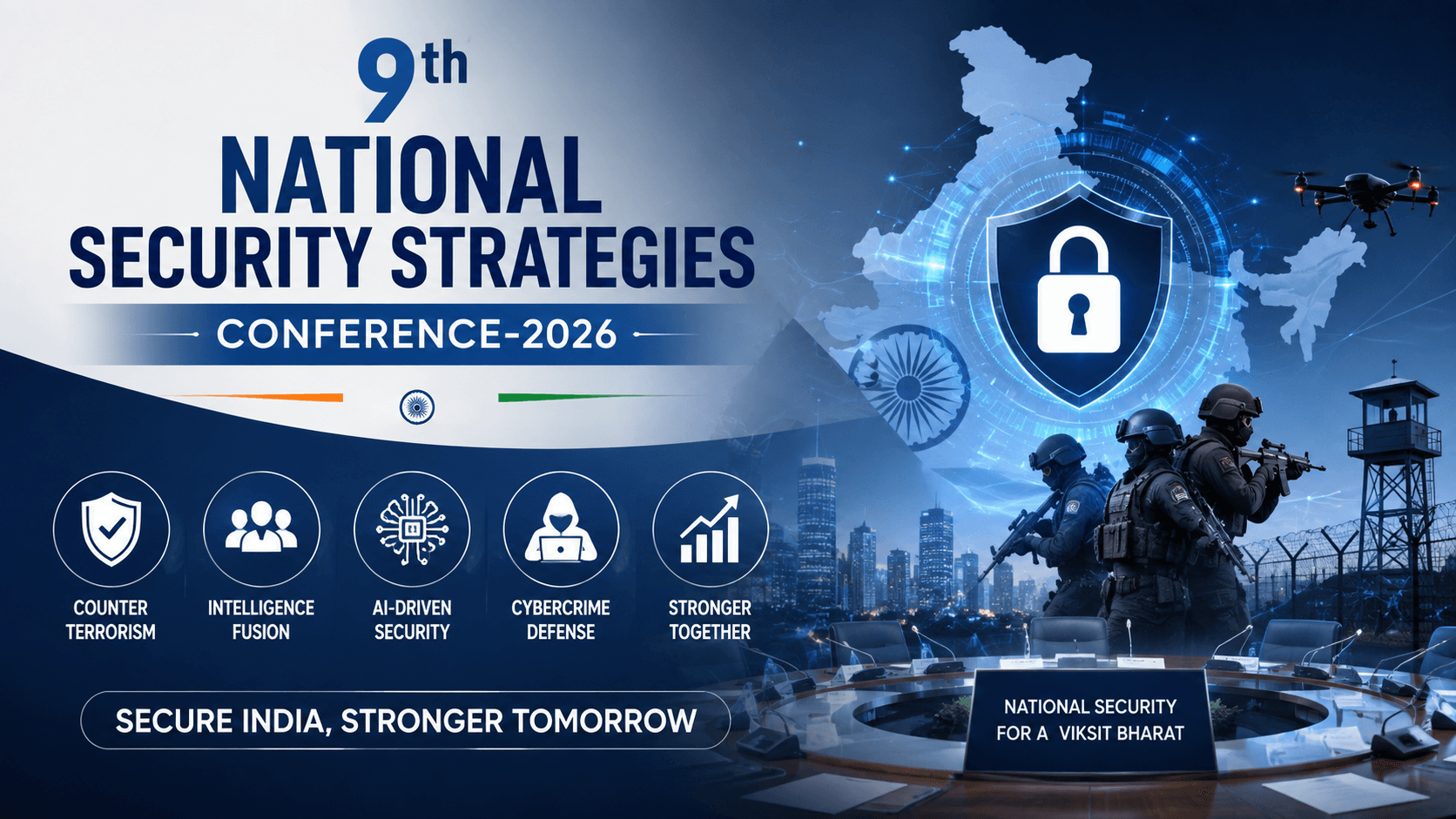
9th National Security Strategies (NSS) Conference-2026
Why in News?
Recently, Union Home Minister and Minister of Cooperation Amit Shah inaugurated the 9th two-day National Security Strategies Conference-2026 in New Delhi. The conference is a key platform where top security agencies discuss India's internal security challenges and future roadmap.
Key Highlights of the Conference
The conference focused on some of the most critical aspects of national security that directly impact internal stability.
Major discussions were held on response to counter-terrorism challenges, fusion, analysis, and operationalization of intelligence through the Multi Agency Centre (MAC), the vision document on narcotics control, detection and deportation of illegal migrants, and the policy framework to combat cybercrime and proxy warfare by Pakistan.
The Union Home Minister gave clear directions. He directed that AI-based analysis of information available on MAC platforms should be done to create SOPs to counter various national security threats. He also directed all agencies to take strict measures against infiltration and illegal migration.
What is MAC?
MAC is the common intelligence-sharing platform created after the 26/11 Mumbai attacks under the Intelligence Bureau. It brings together all security and intelligence agencies to share and analyze inputs in real time. Use of AI on MAC data will make intelligence more predictive and actionable.
Other Major Emphases
The Home Minister also stressed three important points for better implementation. First, training for the implementation of MHA's PRAHAAR scheme, which is aimed at modernizing policing and internal security.
Second, expediting trial by bringing back fugitives and using trial in absentia provisions under new criminal laws—Bharatiya Nagarik Suraksha Sanhita.
This will help in cases where the accused are abroad. Third, undertaking a comprehensive and integrated approach while investigating UAPA cases to ensure better conviction.
In simple words, the 9th NSS Conference shows India's shift towards tech-driven, integrated, and proactive internal security—from intelligence fusion to cybercrime, from narcotics to infiltration, with AI as a force multiplier.
What is NSS?
A national security strategy is the master document of a country that defines its security objectives and how to achieve them. It is a clear statement of what we want to protect, what threatens us, and what ways we will use diplomacy, the military, the economy, intelligence, and technology.
A good NSS must cover both traditional threats that affect only the state like war, border conflict and terrorism, and non-traditional threats that affect state, individual and entire humanity like cyber-attack, pandemic, climate change and energy security.
For India, it must also remain within the framework of the Constitution and democratic principles. Major powers like the USA, the UK, and Russia have NSS, China has a Comprehensive National Security Strategy, and Pakistan has National Security Policy 2022-26. India still does not have a public one.
India's Past Attempts
India has tried several times, but a formal public NSS never materialized. After the Kargil War, the Kargil Review Committee Report in 2000 gave detailed recommendations on national security reforms but did not lead to NSS. In 2012, the Naresh Chandra Task Force submitted a report on defense and intelligence reforms; again, no formal strategy was released. The National Security Advisory Board (NSAB), which has experts on security, has reportedly prepared draft NSS documents for successive governments, but they were not adopted. The most significant private attempt was by Lt. Gen. D.S. Hooda in 2019, who prepared a comprehensive national security strategy document, which is often quoted as a blueprint for India.
What Should India's NSS Contain?
A standard NSS should have four core elements. First, a working definition of national security and its objectives. Second, an appreciation of the emerging security environment considering geopolitical changes like China's rise, the Indo-Pacific, and technology wars. Third, an honest assessment of India's strengths and weaknesses in dealing with challenges. And fourth, identification of military, economic, diplomatic, and intelligence resources needed to meet those challenges.
In simple words, NSS brings clarity, avoids ad hoc and reactive decisions, helps better resource allocation, and sends a strong signal to adversaries and partners about India's intent. For an aspiring power aiming for Viksit Bharat 2047, India needs a public NSS for a whole-of-government approach and strategic coherence.
Conclusion:
The 9th NSS Conference-2026 shows India's clear shift from reactive to proactive and tech-driven internal security. By integrating intelligence through MAC, using AI for threat analysis, and focusing on counter-terror, narcotics, cybercrime, and infiltration, the government is aiming for a whole-of-government approach. Emphasis on PRAHAAR, trial in absentia, and stronger UAPA investigation will help in faster justice and better deterrence. This conference is a perfect example of how internal security is now linked with technology, border management, and legal reforms to achieve Viksit Bharat.