India and UK : 25th Defence Consultative Group Meeting
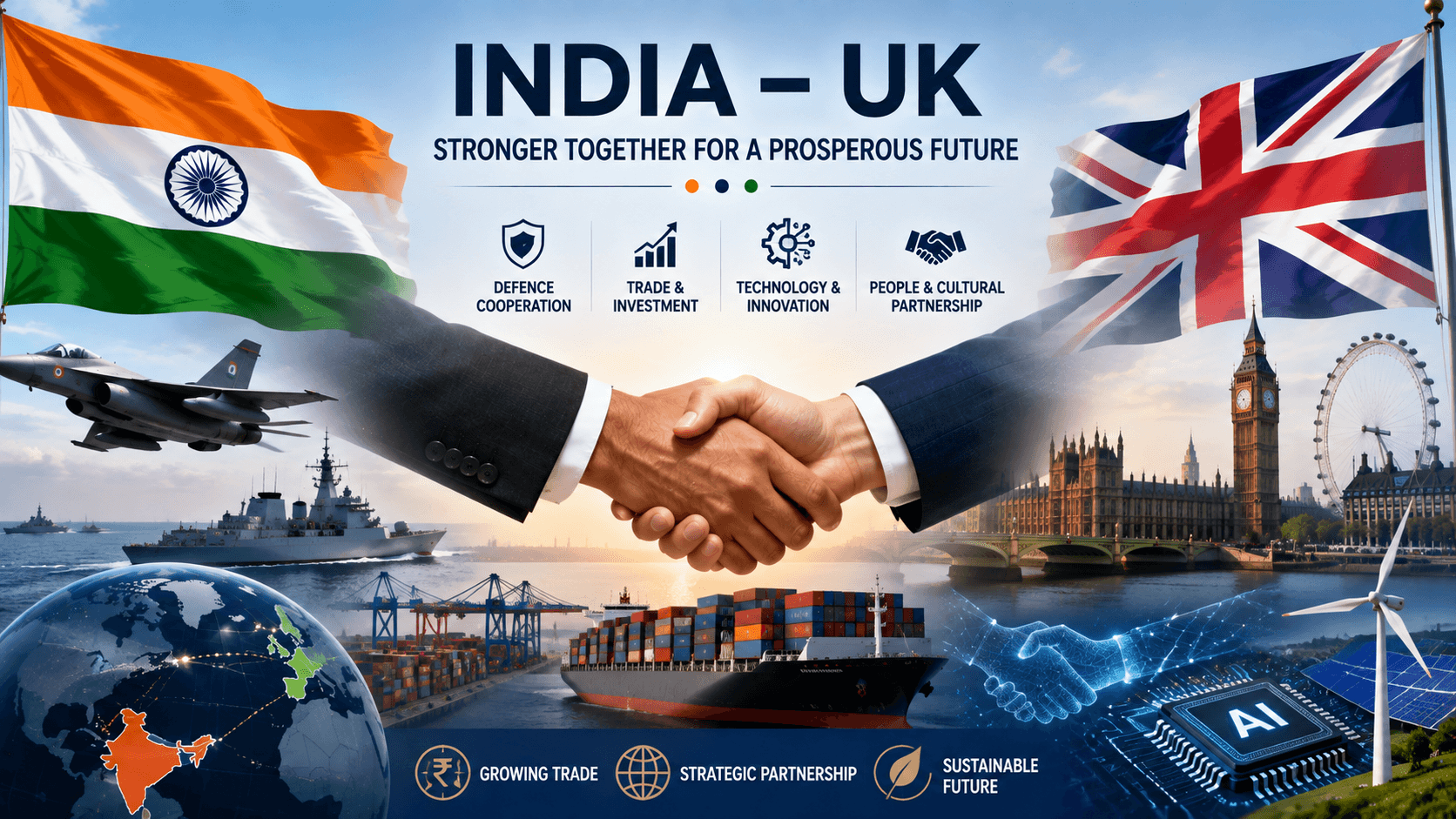
Recently, India and the UK held their 25th Defence Consultative Group meeting in New Delhi. Both sides reviewed their growing defense industrial cooperation under India-UK Vision 2035 and the 10-year Defense Industrial Roadmap, with a focus on joint R&D.
They agreed to deepen ties through more joint exercises, training building, and capacity building and acknowledged their strong maritime security collaboration in the Indo-Pacific, including the new Regional Maritime Security Centre of Excellence under IPOI.
Current Status of India-UK Bilateral Trade
As of 2025, India and the UK are both economic heavyweights—India's GDP at USD 3.96 trillion and the UK's at USD 3.84 trillion.
- Trade in goods (FY 2025-26): Bilateral merchandise trade stood at USD 25.12 billion. India exported USD 13.44 billion and imported USD 11.68 billion, leaving India with a surplus of USD 1.76 billion.
- Trade in services (2024): Services trade was even bigger at USD 35.44 billion. India exported USD 21.66 billion and imported USD 13.78 billion, giving India a surplus of USD 7.88 billion.
- Investments: The UK is India's 6th largest investor with USD 35 billion in cumulative FDI (till Sept 2024), while India's investment in the UK reached USD 19 billion. Over 971 Indian companies operate in the UK, employing more than 1 lakh people.
About India-UK CETA
As officially announced by the Ministry of Commerce & Industry, the India-UK CETA and the Double Contribution Convention (DCC) / Social Security Agreement entered into force on July 15, 2026. CETA: Zero-duty access on ∼99% of India's exports to the UK, covering nearly 100% of trade value. Tariffs up to 70% on processed foods, 21.5% on marine, 18% on engineering, 16% on leather/footwear, 12% on textiles, and 8% on chemicals/pharma have been eliminated. Sensitive sectors like dairy, millets, edible oils, and apples were protected. It was concluded in May 2025 after 14 rounds and signed in July 2025, under the Roadmap 2030 goal of doubling bilateral trade to USD 100 billion by 2030.
DCC: The period of exemption from double social security contributions has been extended from 3 years to 5 years. Indian professionals posted temporarily in the UK for up to 60 months will pay only in India (EPFO) and not pay UK NICs, saving costs and protecting their contribution record. This is being called India's most comprehensive trade pact with a developed economy, directly linking to the Viksit Bharat @2047 vision.
Key Highlights of India-UK CETA:
- Market Access: The UK has given zero-duty access on nearly 99% of India's exports, covering almost 100% of trade value. In return, India has offered concessions on 89.5% of its tariff lines (91% of UK exports)—24.5% get immediate duty-free access; the rest will be phased in.
- Sensitive sectors protected: India has given no concessions on dairy, agriculture, millets, apples, edible oils, and gold.
- Services boost: The UK has opened all 12 major service sectors and 137 sub-sectors—its most comprehensive offer ever—giving huge access to Indian IT, healthcare, finance, and engineering professionals.
- Mobility: CETA ensures clear rules for temporary movement of professionals, with no hidden quotas or economic needs tests.
- Strategic safeguards: Concessions for the Make-in-India and PLI sectors are phased over 5, 7, and 10 years. For automobiles, opening is quota-based and phased, with affordable EV concessions starting only from Year 6.
- Steel: Both sides agreed to protect Indian steel exporters from UK safeguard measures and minimize disruptions.
Why it matters:
- Textiles: Zero duty removes disadvantage vs. Bangladesh/Pakistan in the UK's USD 28.8 bn market. Plantation, marine, oilseeds: Duty-free access for coffee, tea, spices, and seafood (UK market USD 4.9 bn)—boost for coastal states like AP, Kerala, Gujarat, TN, Odisha, and WB.
- Engineering & electronics: Exports are expected to cross USD 7.5 bn by 2029-30.
- Pharma & chemicals: Access to the UK's USD 30 bn pharma and USD 35.8 bn chemicals market.
- Leather, plastics, toys, gems & jewelry: Duty-free access makes India more competitive vs. Vietnam, China, and Bangladesh; jewellery exports set to double in 2-3 years, creating jobs in Surat, Jaipur, and Mumbai.
- Inclusive growth: Benefits farmers in AP, TN, Punjab, Maharashtra, Gujarat, Kerala, and the Northeast.
Despite close ties, several frictions remain between India and the UK:
| Migration and visas: | The UK's restrictive post-Brexit visa rules clash with India's demand for easier mobility for IT workers, healthcare professionals, and students. This was a key reason for delays in FTA talks. |
| Extradition: | India accuses the UK of sheltering fugitives. High-profile cases like Vijay Mallya remain pending, with the UK hesitant to extradite those wanted for financial crimes and terrorism, which hurts trust. |
| Russia-Ukraine stance: | The UK firmly backs Ukraine, while India has maintained strategic autonomy and neutrality, avoiding condemnation of Russia or joining sanctions—leading to diplomatic differences. |
| Climate rules—CBAM: | The UK's Carbon Border Adjustment Mechanism, coming in by 2027, worries India. India sees it as green protectionism that will hit its steel and iron exports, as the world's second-largest steel producer. |
| Khalistani extremism: | Pro-Khalistan protests and activities, including incidents outside the Indian High Commission in London, remain a sore point. India sees it as a sovereignty issue that the UK has not curbed effectively. |
| Trade barriers: | India has protected its market with high tariffs—up to 150% on British whisky and 100% on cars—while the UK wants greater access, especially in services. Under the new deal, whisky duty will be halved to 75% and then cut to 40% over 10 years, but differences persist. |
| Intellectual Property: | The UK pushes for stronger IP protection, which conflicts with India's focus on affordable medicines and its generics industry that supplies the world. |
UK: To take India-UK ties to the next level, India can focus on a few practical steps:
| Fix the visa issue: | Push for a flexible, win-win visa regime for skilled professionals, students, and workers, especially in IT and healthcare. As C Raja Mohan notes, with a 36-million-strong diaspora and global demand for Indian talent, easier mobility will directly boost people-to-people ties and help the UK's post-Brexit economy. |
| Double down on tech: | Build joint research and innovation hubs in AI, quantum computing, and green tech. Deeper collaboration on tech startups and infrastructure will make India a key partner in the UK's global tech leadership. |
| Use cultural soft power: | Showcase India's films, arts, crafts, and heritage through cultural exchange programs in education and digital media. This helps move beyond colonial narratives and builds emotional connection. |
| Stronger security cooperation: | Lead joint initiatives in the Indo-Pacific on maritime security, counterterrorism, and cyber defense. Closer coordination in frameworks like Quad will make both countries stronger pillars of a rules-based order. |
| Joint climate action: | Set up joint platforms for research on renewable energy, sustainable agriculture, and carbon capture. This will align with the UK's net-zero goals and position India as a leader in the green transition. |
| Make trade work: | whisky, |
Conclusion
India and the UK are natural partners moving from a colonial past to a future-focused partnership. Built on democracy, rule of law, and a growing economic and strategic convergence, the relationship today spans trade, defense, technology, climate, and the Indo-Pacific. Frictions over visas, extradition, and trade barriers remain, but mechanisms like Vision 2035, the Defence Industrial Roadmap, and CETA have given it real structure. If both sides manage sensitivities and deliver on mobility, market access, and joint innovation, the India-UK partnership can become a model for how two major economies can anchor a rules-based, equitable multipolar world.
India and the UK bilateral cooperation falls under General Studies Paper 2 (GS-2) under the section for International Relations and Current Affairs in the BPSC Mains syllabus.