India's Sugar Industry: Why Prices Are Up?
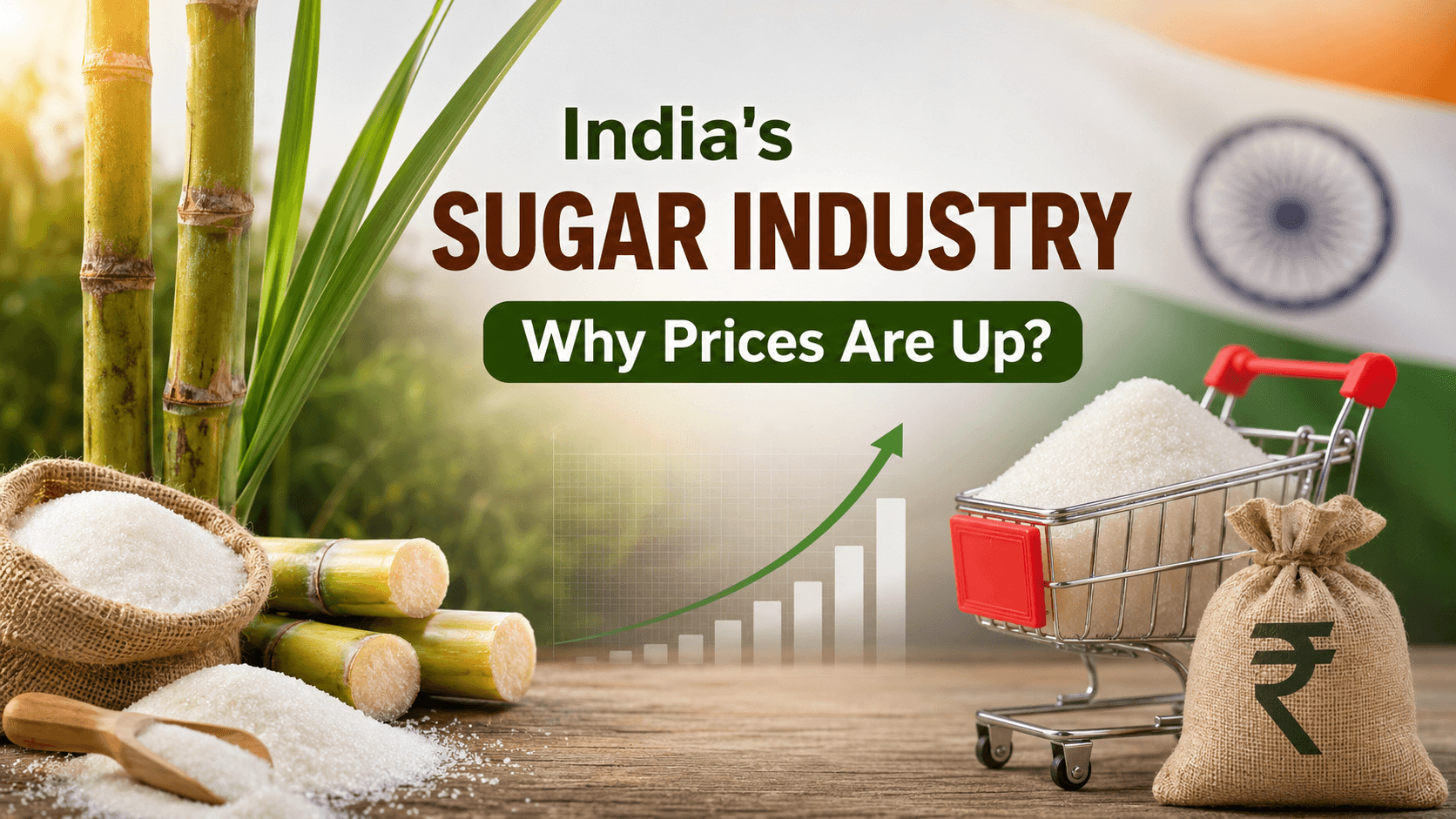
If you went to buy sugar last week, you must have felt the pinch. From Rs 48 to nearly Rs 56 or 65 now a kg in just one month, the sudden jump has left many households worried—is there a sugar shortage coming? That panic is exactly why the government has stepped in to clarify. The Press Information Bureau (PIB) has released a detailed fact-checked backgrounder on the sugar situation, and the story is quite different from what the rumors suggest. In this article, we break down that report in simple terms—how much sugar India produces, where ethanol really fits in, why prices have spiked for now, and what steps the government is taking to keep your kitchen budget stable.
Industry at a Glance—More Than Just Sweetness
India is the world's second-largest sugarcane producer, and sugar is a livelihood for nearly 5 crore farmers and 5 lakh factory workers. The sector has grown strongly. Production has touched 500 MMT in 2025-26, up 43.5% from 348 MMT in 2015-16, and the area has increased to 58.87 lakh hectares. UP and Maharashtra remain the top producers. FRP for 2026-27 is set at Rs 365/quintal, Rs 135 more than in 2016-17. Exports have jumped from 0.47 lakh MT to 8 lakh MT, going mainly to Sri Lanka, West Asia, and East Africa.
Does Ethanol Blending Eat into Our Sugar? No.
A common myth is that ethanol is causing a sugar shortage. The fact is the opposite. Sugar diverted for ethanol has fallen from 12% in 2022-23 to 9% in 2025-26. Today, nearly 75% of ethanol comes from grains, especially maize. Ethanol has helped the industry. India produces 300-340 lakh MT of sugar against a domestic need of 280-290 lakh MT.
In surplus years, excess stock blocks mill funds and delays farmer payments. Diverting surplus to ethanol improved mill finances. As of Aug 20, 2026, 97% of cane dues for 2025-26 are already paid, and mills depend less on government support. And retail prices remained stable, rising only about 3% annually between Aug 2024 and July 2026.
Then why the current spike?
Retail price rose from Rs 48.18/kg on July 20 to Rs 55.70/kg on Aug 20, 2026—a 15.6% jump in a month. This is a short-term blip, not a long-term trend.
Five reasons behind it:
| 1. | lower domestic production |
| 2 | festive season demand |
| 3 | crop damage due to red rot, |
| 4 | topbore, and waterlogging from excess rain, |
| 5 | ight global supplies, and speculation/hoarding. |
Production is now estimated at 306 LMT against an initial estimate of 343 LMT. But stocks are still adequate till new crushing starts in October. Globally too, the sugar deficit for 2026-27 is estimated at 33 lakh MT, and international prices jumped from $474/tonne on June 30 to $552/tonne on Aug 20—over a 16% rise.
| Myth vs. Fact | People think India faces a sugar shortage or production has collapsed. Reality is stocks are adequate, and 306 LMT is lower than the estimate but not a collapse. Global prices have not been stable; they have shot up. And ethanol is not taking away your sugar. |
Government Action
To curb hoarding and cool prices, the government has acted swiftly: a 400-tonne stock limit on dealers till Nov 30, 2026; bulk consumers cannot hold more than 15 days' consumption from Sept 1; joint Centre-State teams verifying stocks physically; permission for duty-free import of 10 lakh MT raw sugar; and an advisory to start crushing early from Oct 15—which will raise October production from the usual 3-4 lakh MT to over 10 lakh MT for festive availability.
What is FRP?
FRP, or Fair and Remunerative Price, is the minimum price that sugar mills are legally bound to pay to farmers for their sugarcane. It is not an advisory price; it is mandatory under the Sugarcane Control Order, 1966, of the Essential Commodities Act, 1955.
It is decided on the recommendation of CACP, which is an advisory body under the Agriculture Ministry, and finally announced by the CCEA chaired by the Prime Minister. The formula is based on the Rangarajan Committee report.
For fixing FRP, the government looks at several factors like the cost of cane production, returns from alternative crops, the fair price for consumers, the price at which mills sell sugar, the recovery rate of sugar from cane, income from by-products like molasses, bagasse, and press mud, and a reasonable profit margin for farmers to cover their risk.
Payment is linked to recovery. Recovery means how much sugar you get from crushed cane, expressed as a percentage. Higher recovery means higher FRP. For example, FRP was fixed at Rs 2900 per tonne at 10% base recovery in 2021-22. For 2026-27, it is Rs 365/quintal at 10.25% recovery.
The law says mills must pay within 14 days of cane delivery. They can pay in installments if they have an agreement with farmers. If they delay, they must pay up to 15% interest, and the Sugar Commissioner can even attach mill property to recover dues as revenue arrears.
About Sugarcane
Sugarcane is a tropical crop that loves hot and humid weather. It grows best at 21-27°C with 75-100 cm of rainfall and needs deep, rich loamy soil that is well drained. It can actually grow in a wide range of soils, from sandy loam to clay loam, as long as drainage is good.
It is a labor-intensive crop, needing manual work from sowing to harvesting, but it is the backbone of our sugar economy. It is the main source of sugar, gur (jaggery), khandsari, and molasses.
India is the second largest producer after Brazil. Within India, Uttar Pradesh, Maharashtra, Karnataka, Tamil Nadu, and Bihar are the top states.
To support farmers and mills, the government runs schemes like SEFASU (Scheme for Extending Financial Assistance to Sugar Undertakings) and the National Policy on Biofuels, which links sugarcane to ethanol and green energy.
Beyond the Hike
The current pressure is temporary, driven by weather, seasonality, and the global market. In the long run, India's sugar sector has become diversified—supporting farmers, mills, green energy, and exports. The focus remains on balancing consumer price, timely farmer payment, and industry stability.
Conclusion
The recent jump in sugar prices may look alarming, but as the PIB fact-check shows, it is a short-term phenomenon driven by weather damage, festive demand, global tightness, and some hoarding—not a structural shortage.
India’s sugar story is one of growth and resilience. Production has risen 43% in a decade, exports have multiplied, FRP has ensured better prices for farmers, and 97% of dues are already cleared this season. Ethanol blending, far from hurting consumers, has strengthened mills and reduced dependence on government support.
With stock limits, verification drives, duty-free imports, and early crushing from October 15, the government is moving quickly to cool prices. In the long run, India’s sugar industry has evolved from just a sweetener producer to a diversified ecosystem supporting farmers, energy security, and exports. The current pinch will pass, but the sweet balance between farmer, mill, and consumer remains the priority.