India Rejects Pak-China Pact
Why in News?
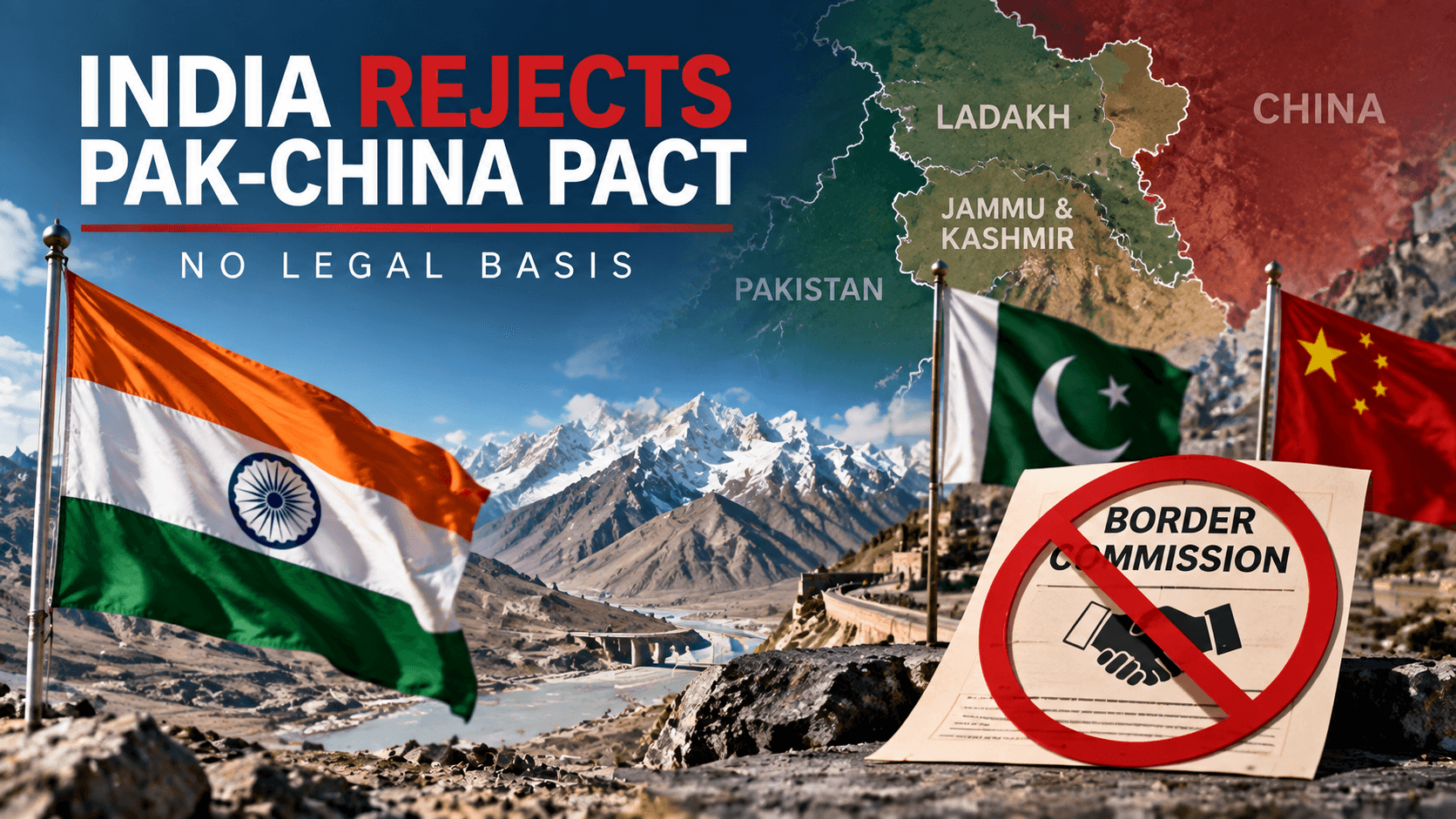
Recently, India has strongly rejected the newly formed Pakistan-China Boundary Joint Commission. India stated that this commission has no legal basis. It reiterated that there is no legally recognized boundary between Pakistan and China in the concerned territory, as the area is an integral part of India. India has made it clear that it does not recognize any such joint mechanism in its own territory.
About the Commission:
Pakistan and China operationalized this Joint Commission in September 2026, and its first meeting was held in Islamabad. It is meant to be a coordination mechanism for border management, joint surveys, trade flows, and people-to-people connectivity through the Khunjerab Pass.
Origin: The Commission comes from the 2013 Pakistan-China Agreement on the Boundary Management System. Article 45 of that agreement provides for setting up a joint commission to oversee border management arrangements.
India's Position: The Ministry of External Affairs (MEA) has strongly rejected it. India reiterated that the Union Territories of Jammu & Kashmir and Ladakh are integral and inalienable parts of India. Pakistan has no locus standi to enter any arrangement concerning territory that is under its illegal occupation.
Background
The 1963 Agreement: India has never recognized the 1963 China-Pakistan Boundary Agreement. Under this agreement, Pakistan illegally ceded about 5,180 sq. km of the Shaksgam Valley (Trans-Karakoram Tract) to China. India maintains that this agreement is completely illegal and invalid.
Issue of Aksai Chin: India considers Aksai Chin as part of Ladakh, while China claims it as part of its Xinjiang region. China had built a highway in the 1950s connecting Xinjiang and Tibet through Aksai Chin, which became a major reason for India-China tensions.
Opposition to CPEC: This boundary is crucial for connectivity through Khunjerab and the China-Pakistan Economic Corridor (CPEC). India opposes CPEC because a large part of it passes through Pakistan-occupied Kashmir, which is Indian territory claimed by India.
Bilateral relations between India and Pakistan
Origin of India-Pakistan Relations:
The roots of India-Pakistan relations go back to the Two Nation Theory, which ultimately led to the partition of the country in 1947. This partition was seen by many as unnatural, as it divided people who had lived together for centuries based on religion. Since then, India and Pakistan have often been described as 'brother enemies.' They share common history, culture, and language, but their political journey has been full of ups and downs, marked by wars, mistrust, and brief periods of dialogue.
Nature of India-Pakistan Relations:
India-Pakistan relations have been a complex mix of historical grievances, territorial disputes, and occasional diplomatic engagement. Since the partition of British India in 1947, the two countries have seen more conflict than cooperation. This relationship remains one of the most critical geopolitical issues in South Asia, as it directly affects regional stability, global diplomacy, and economic growth. Over the decades, the relationship has been shaped by wars, cross-border terrorism, and intermittent peace efforts.
Recent Development: The bilateral ties saw a major low after the recent Pahalgam terror attack in April 2025. The attack, allegedly carried out by a Pakistan-based terror group, led to the tragic loss of many innocent civilian tourists.
In response, India launched 'Operation Sindoor' on 7th May 2025. This was a coordinated counter-terrorism operation to neutralize the infiltrators and dismantle their support infrastructure. The operation also marks a shift in India's security doctrine, showing a more assertive stance and a clear zero-tolerance policy towards terrorism and cross-border militancy.
Historical Roots:
The roots of India-Pakistan relations go much deeper than 1947. During the colonial period, the British policy of "divide and rule" deepened the religious and political divide between Hindus and Muslims, creating communal tensions. This divide led to the demand for a separate Muslim homeland by the All-India Muslim League under Muhammad Ali Jinnah, which finally resulted in the creation of Pakistan.
Partition and Its Aftermath:
The partition in 1947 had a traumatic start. It triggered massive communal violence and large-scale forced migration and left behind deep animosity that still influences relations. Today, the India-Pakistan boundary stretches for about 3,323 km, including the Line of Control (LoC) in Jammu and Kashmir.
Core Issues:
Kashmir Dispute: This has remained the main flashpoint and has led to four major wars in 1947, 1965, 1971, and 1999 along with regular skirmishes and ceasefire violations.
Persistent Irritants: Cross-border terrorism, ceasefire violations, and mutual political suspicion have continued to strain ties.
Role of International Players:
International actors have also played an indirect but significant role:
- United Nations (UN): Has consistently called for a peaceful resolution, especially on Kashmir.
- United States: Has played a role in mediation through dialogue and back-channel diplomacy.
- China: Its strategic alliance with Pakistan has a major impact on the bilateral dynamics. Despite occasional peace talks and confidence-building measures, the relationship remains fragile and continues to affect regional security in South Asia.
India-Pakistan Relations - Timeline
The relationship has been marked by major events like the Partition, four wars, peace talks, terror attacks like Pulwama and Pahalgam, and continuous diplomatic ups and downs.
Partition and First Kashmir War (1947-48): The partition created a territorial dispute over the princely state of Jammu and Kashmir. Both nations fought their first war in 1947-48, which ended with the establishment of the Line of Control (LoC).
Wars of 1965 and 1971:
1965 War: Again, centered around Kashmir.
1971 War: This war led to the creation of Bangladesh, with India playing a decisive role in the secession of East Pakistan, now Bangladesh.
Nuclear Tests (1998): Both India and Pakistan became declared nuclear powers in 1998. This raised tensions significantly but also led to international pressure for diplomacy to prevent any nuclear escalation.
Kargil Conflict (1999): In 1999, Pakistani soldiers and militants infiltrated Indian territory in Kargil, Kashmir. India launched a military operation and won, but the conflict further strained relations.
Major Terror Attacks in 2000s:
2001: Terror attack on the Indian Parliament in New Delhi by LeT and JeM.
2008: Mumbai terror attacks, where terrorists opened fire at multiple sites.
2016: Pathankot airbase attack by JeM.
Uri Attack (2016): On 18th September 2016, four heavily armed terrorists attacked an Indian Army base in Uri, Jammu and Kashmir. India responded with surgical strikes across the LoC, targeting terror launch pads.
Pulwama Attack (2019): On 14th February 2019, a suicide bomber from Pakistan-based Jaish-e-Mohammed attacked a CRPF convoy in Pulwama, killing 40 personnel. It was the deadliest attack in decades and led to Balakot airstrikes by India.
Pahalgam Terror Attack (2025): In April 2025, militants targeted tourists in Pahalgam, Jammu and Kashmir, causing major casualties. In response, India closed its main land border with Pakistan and suspended the Indus Waters Treaty, accusing Pakistan of supporting cross-border terrorism.
India-Pakistan - Conflict Zones
The relationship is marked by several conflict zones like the Kashmir dispute, cross-border terrorism, water-sharing disputes, and military standoffs at Siachen.
| Cross-Border Terrorism: | This remains the core concern for India. India accuses Pakistan of supporting terror groups operating in Kashmir and other parts of India, while Pakistan denies it. The Pulwama attack in 2019, where 40 security personnel were martyred, is a stark example of this. |
| Territorial Disputes: Kashmir: | Both countries claim the entire region but control only parts of it. The Line of Control (LoC) is the ceasefire line established after the 1947 conflict. Even the China-Pakistan Economic Corridor (CPEC) passes through this disputed territory. |
| Sir Creek: | It is a 96-km-long estuary in the Rann of Kutch, which separates Gujarat (India) and Sindh (Pakistan). The dispute is over the maritime boundary. Pakistan claims the entire creek based on a 1914 agreement, while India says the border lies in the mid-channel as per a 1925 map. |
| Siachen Glacier: | It is in a disputed and undemarcated region of Kashmir. The entire glacier is claimed by both sides. In 1984, the Indian Army launched Operation Meghdoot and occupied the Siachen-Saltoro ridge. |
| Water Dispute: | For almost 60 years, the Indus Waters Treaty (IWT) survived despite wars and tensions. However, recent upstream dam projects have revived the dispute. In 2018-19, both sides discussed projects like Pakal Dul, Lower Kalnai, and the Ratle hydropower projects on the Chenab. Recently, India sent a formal notice to Pakistan to modify the treaty as per present realities. After the Pahalgam Terror Attack in April 2025, India has suspended the Indus Waters Treaty. |
| Trade and Commerce: | India gave Most Favoured Nation (MFN) status to Pakistan in 1996, but Pakistan never reciprocated and followed a restrictive trade policy. After the Pulwama attack in 2019, India withdrew MFN status and hiked customs duty on Pakistani goods to 200%. Pakistan then suspended all bilateral trade. After the Pahalgam attack in April 2025, India imposed a complete ban on the import and transit of goods from Pakistan, both direct and indirect. As a result, bilateral trade, which was close to USD 3 billion in 2018, fell to around USD 1.2 billion by 2024. |
Areas of Cooperation
Despite tensions, India and Pakistan have found some areas to cooperate, which helps in keeping communication channels open.
| Cultural and Sports Exchanges: | Cultural ties and sports, especially cricket, have often helped improve people-to-people relations. Initiatives like "cricket diplomacy" have been used in the past to reduce tensions. |
| Religious Tourism: | Pilgrimage has remained a strong area of cooperation. Under the 1974 Bilateral Protocol on Visits to Religious Shrines, Indian Hindu and Sikh pilgrims visit 15 sites in Pakistan every year, while Pakistani pilgrims visit 7 shrines in India. The best example is the Kartarpur Corridor, inaugurated on 9th November 2019. It is a visa-free crossing connecting Dera Baba Nanak in India with Gurdwara Darbar Sahib in Kartarpur, Pakistan, where Guru Nanak Dev Ji spent his final years. It allows Indian Sikhs to visit the shrine without a visa and is a major confidence-building measure. |
| Regional Cooperation: | Both countries are members of regional groups like SAARC and the Shanghai Cooperation Organization (SCO), which provide platforms for multilateral engagement. |
| Trade Agreement: | An India-Pakistan Trade Agreement was signed on 1st July 1949 to facilitate commerce. India granted MFN status to Pakistan in 1996 to promote fair trade. But after the Pulwama attack in 2019, India revoked it, and Pakistan suspended all trade. As of May 2025, after the Pahalgam attack, India has imposed a complete ban on all direct and indirect imports from Pakistan on national security grounds. Now formal trade is fully suspended. |
Recent Developments in India-Pakistan Relations
| Pulwama Attack and Balakot Airstrike (2019): | The Pulwama terror attack killed 40 CRPF personnel. India responded with airstrikes on a militant camp in Balakot, Pakistan, leading to aerial engagements between the two air forces. |
| Revocation of Article 370 (2019): | In August 2019, India revoked Article 370, which gave special status to Jammu and Kashmir. Pakistan strongly opposed it and downgraded diplomatic ties and suspended trade. |
| Ceasefire Agreement (2021): | In 2021, both sides recommitted to the 2003 ceasefire agreement along the Line of Control (LoC), which reduced cross-border firing and gave hope for stability. |
| Pahalgam Terror Attack (April 2025): | On 22nd April 2025, terrorists attacked tourists in Baisaran Valley, Pahalgam, killing at least 26 people, including 25 Indians and one Nepali. India blamed Pakistan-based groups. In response, India took strong measures: Closed the main land border with Pakistan. Suspended the Indus Waters Treaty. Withdrew diplomats from Islamabad. Both countries imposed restrictions on each other's airspace. Pakistani troops violated the ceasefire along the LoC with unprovoked firing, to which the Indian Army responded firmly. The Ministry of Home Affairs directed civil defense exercises across India. The UN Security Council urged both sides to show restraint. |
| Operation Sindoor (May 2025): | As a direct response to the Pahalgam attack, India launched Operation Sindoor on 7th May 2025. It was a precision military campaign targeting 9 locations in Pakistan and Pakistan-occupied Kashmir to dismantle the infrastructure of groups like Lashkar-e-Taiba and Jaish-e-Mohammed. The strikes were carried out using Rafale jets with SCALP missiles. While India said it targeted only terrorist infrastructure, Pakistan claimed civilian casualties and called it infrastructure; this escalated tensions between the two nuclear-armed neighbors, leading to international calls for restraint. |
Way Forward
- Sustained Dialogue: Regular talks at political, diplomatic, and military levels to address core issues like Kashmir and terrorism constructively.
- End to Terrorism: Pakistan must take verifiable action against terror groups. No peace is possible without zero tolerance for cross-border terrorism.
- Soft Diplomacy: Promote people-to-people ties through cultural exchanges, cricket diplomacy, tourism, and initiatives like the Kartarpur Corridor to build trust.
- Economic Cooperation: Revive trade ties. Economic interdependence creates a stake in peace and can act as a bridge for wider dialogue.
- Confidence Building Measures: Strengthen military hotlines, strictly follow the Ceasefire Agreement on LoC, and cooperate on humanitarian issues to prevent accidental escalation.
Conclusion
India-Pakistan relations have been defined by a complex legacy of shared history, partition trauma, territorial disputes, and cross-border terrorism. Despite four wars, nuclearization, and major terror attacks, from Parliament attacks to the Pahalgam attack, dialogue and cooperation in areas like religious tourism and SAARC have kept a window open. The recent developments, the suspension of the Indus Waters Treaty, and Operation Sindoor show India's shift to a more assertive, zero-tolerance policy on terrorism. In the long run, lasting peace in South Asia is not possible without a stable India-Pakistan relationship. It will require firmness on security, sincerity in dialogue, and focus on people-to-people and economic ties.