India’s middle-income trap: Shining GDP, Struggling Workers
Why in News?
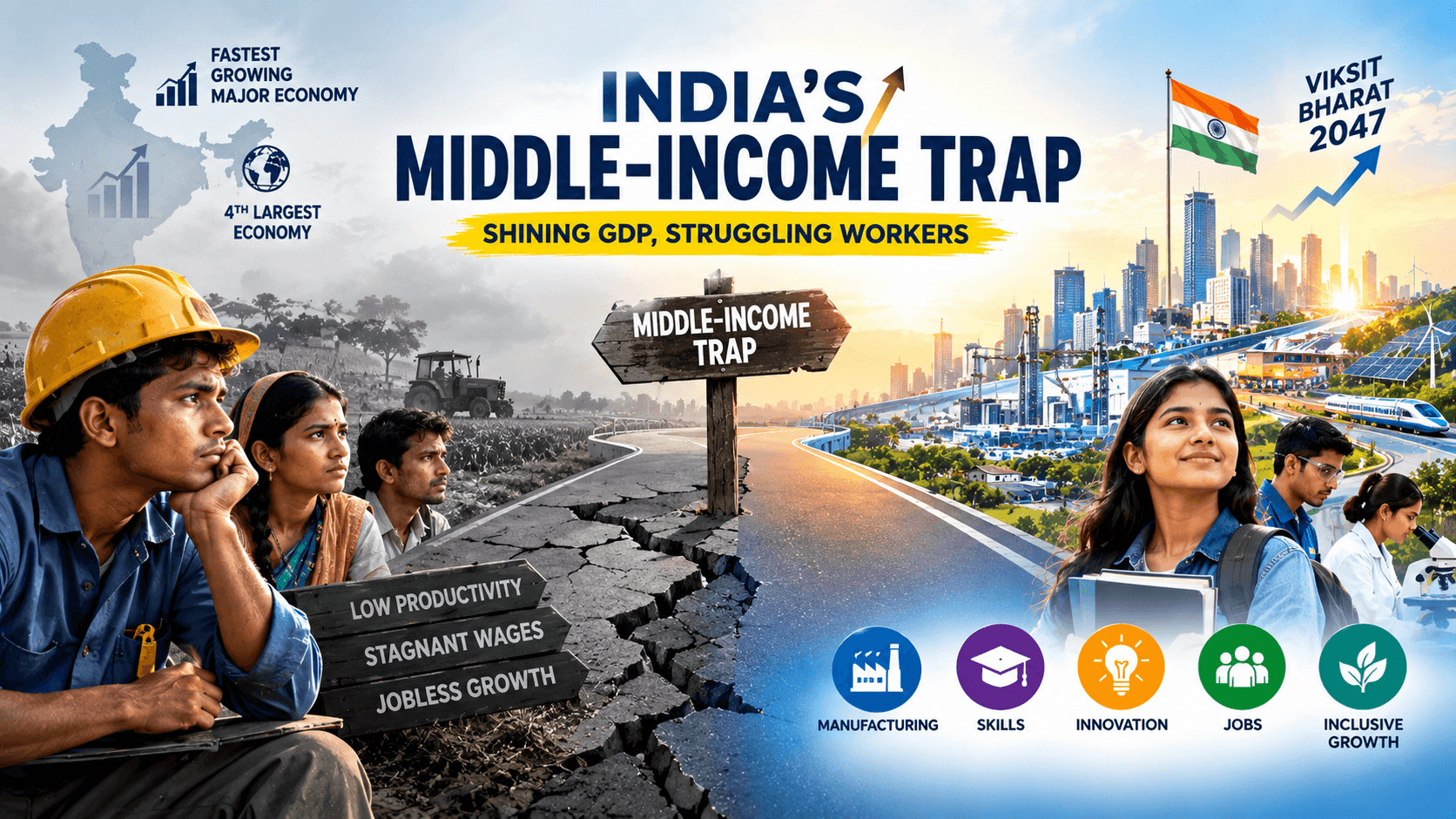
Even though India is the world's fastest-growing major economy and now the fourth largest globally, challenges remain. Issues like youth protests, weak private investment, stagnant wages, and low consumption have raised concerns that India could get stuck in a middle-income, low-productivity trap.
India faces the risk of falling into the middle-income trap, where fast growth exists alongside weak manufacturing, jobless growth, stagnant wages, low skill levels, and poor R&D, all of which limit productivity and inclusive growth.
To come out of this trap, India needs to focus on labor-intensive manufacturing, stronger skill-based education, higher R&D spending, better technology adoption, and investment in human capital. This can be supported by the 3i strategy, such as Investment, Infusion, and Innovation.
What is the Middle-Income Trap?
The term was coined by World Bank economists in 2007. It describes a situation where a developing country reaches a middle-income level (per capita income between USD 1,136 and USD 13,845 as per the World Bank) by using cheap labor and basic manufacturing but then gets stuck there. It fails to become a high-income, innovation-led economy.
The Dual Squeeze:
On one side, as wages rise, the country can no longer compete with low-wage developing nations. On the other side, it lacks the technology, strong institutions, and high productivity needed to compete with advanced economies.
Global Reality:
In the last 60 years, only a few countries, like South Korea, Taiwan, and Singapore, have managed to escape this trap. Many countries in Latin America and Southeast Asia have remained stuck in it for decades.
Global Experiences with the Middle-Income Trap
Argentina, The Danger of Stagnation:
Till the 1930s, Argentina grew fast on the back of agriculture. But as Nobel laureate Philippe Aghion points out, it failed to shift from agriculture to an innovation-driven industrial economy. Too much dependence on primary exports made it vulnerable to global shocks, leading to a long-term decline in per capita income compared to the US.
China, Focus on Human Capital and Manufacturing:
China focused heavily on mass education along with state-led manufacturing. Between 1990 and 2019, 78.6% of its population above 25 years had completed secondary education, compared to only 51.6% in India. This created a skilled industrial workforce.
South Korea—Strategic Protectionism:
South Korea escaped the trap by creating and protecting large industrial groups (chaebols) before opening its economy. Experts note that many developed countries used tariffs and subsidies strategically during their catch-up phase, instead of following pure free-market policies.
What Drives India Towards the Middle-Income Trap?
| Premature De-industrialization: | Unlike East Asia, India is skipping mass manufacturing. Manufacturing share in GVA has been stuck at 14-17% for 20 years. So it cannot create enough jobs, and over 45% of workers are still stuck in low-productivity agriculture. |
| Service-Led Jobless Growth & Skills Mismatch: | Services like IT are capital-intensive and create few jobs. The employment rate is stuck at ∼63%. In 2023, 67% of unemployed youth (1.1 crore) were graduates, up from 32% in 2004. We have many degrees but not enough good jobs or relevant skills. |
| Stagnant Wages & Weak Demand: | The ILO India Employment Report 2024 shows real wages stagnated or fell between 2012 and 2022. This reduces purchasing power, lowers private consumption (PFCE), and discourages private investment. |
| Underinvestment in Vocational Training: | Less than 3% of the workforce has formal vocational training. ITIs have 25 lakh seats but only 48% intake. Outdated courses and a preference for white-collar degrees create a skills gap. |
| Crisis of "Firm Dwarfism": | The World Development Report 2024 notes an Indian firm, after 40 years, only doubles in size, while a US firm grows 7x. Most Indian firms are micro-enterprises (<5 employees) due to weak management, family-run structure, and poor credit access. |
| Capital Bias & Low R&D: | Policies make capital cheaper than labor, pushing automation in a labor-rich country. India's R&D (GERD) is only 0.64% of GDP vs 2-3% in the US, Korea, and Israel. In FY24, the private sector contributed 51.8% of R&D for the first time, but it is still far from 70-80% in advanced economies. |
| K-Shaped Recovery: | Post-pandemic, the large digital economy gained, while the informal sector (90% of the workforce) lagged, widening inequality. |
| Social Hierarchies: | Caste and occupational biases devalue manual and vocational work, blocking dignified blue-collar jobs. |
| Technological Disruption: | The IIM Ahmedabad study shows 68% of white-collar workers fear automation in 5 years, with AI threatening routine coding and cognitive jobs. |
Measures Are Needed to Avoid the Trap?
1. Shift to Productivism: Focus on the real economy, manufacturing, and productive services, over financial speculation. Proactive government role to create mass jobs and give dignity to skilled work.
2. Employment-Linked Industrial Policy: Link PLI and other schemes to actual job creation, not just capital investment.
3. Overhaul Vocational Training: Modernize ITIs via PPP, and adopt the German-Swiss dual apprenticeship model (classroom + shop floor). Measure success by wages and placement, not just enrollment.
4. Restore Dignity to Trades: Campaigns to value craftsmanship, standardize certification under NSQF, and create clear wage and career growth for vocational workers.
5. Ramp Up R&D and Tech Diffusion: Take R&D to 1.5-2% of GDP, and ensure universities and labs share useful knowledge with MSMEs.
6. Strengthen Human Capital: Invest heavily in early childhood education, foundational literacy and numeracy (FLN), and primary healthcare to raise future productivity.
Conclusion
India is at a decisive point. Rapid growth alone will not be enough to become a developed nation by 2047. Without strong manufacturing, quality jobs, rising wages, and innovation, growth will remain top-heavy and risk pushing India into the middle-income trap. Escaping this trap needs a shift from a consumption-based, capital-led model to a jobs-creator productivity-led model through employment-linked manufacturing, modern vocational training, dignity for technical trades, higher R&D, and strong foundational human capital. This is where the 3i strategy, such as investment, infusion, and innovation, becomes key. Investing in people, infusing technology into MSMEs, and innovating for the future will help India move from just growing fast to growing well and ensure broad-based prosperity.