India Gets an ‘A’: What It Really Means
Why in News?
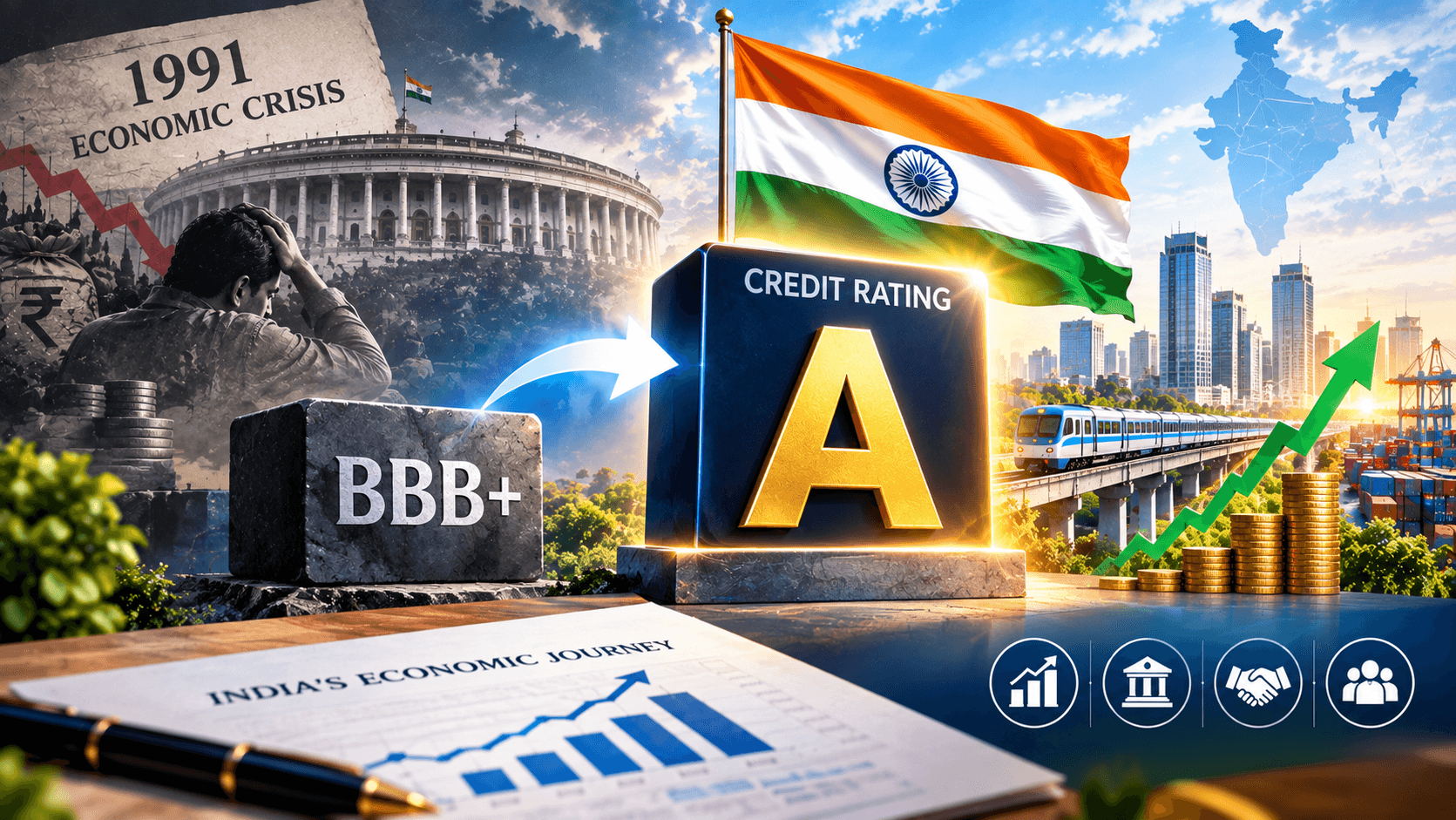
Recently, an article titled "Lost and Found: An 'A' for India's Long Game" by 15th Finance Commission Chairman N.K. Singh was published in The Indian Express. The article is in context of Japan Credit Rating Agency (JCRA) upgrading India's long-term sovereign credit rating from BBB+ to A, a significant improvement in India's creditworthiness.
The piece makes an important distinction between economic growth and economic credibility; sustaining investment requires more than just high GDP growth. We will examine the core points of this article and its critical stances.
India Regains Its ‘A’ Rating
The Japan Credit Rating Agency (JCRA) upgraded India’s long-term sovereign credit rating from BBB+ to A.The upgrade is important because India had lost its A-grade rating during the economic difficulties surrounding the 1991 balance of payments crisis. The author views the return to the A category as the outcome of India’s long-term economic journey rather than a short-term achievement. However, the development should be viewed as a milestone rather than a final assessment of India’s economic performance. A sovereign credit rating primarily measures a country’s creditworthiness and capacity to meet its financial obligations; it does not capture the entire picture of development, welfare, or quality of life.
Lessons from the 1991 Economic Crisis
The article recalls that India’s economic performance in the 1980s was accompanied by high fiscal and current account deficits, rising external debt, and declining foreign-exchange reserves. The situation worsened with the Gulf War and rising oil prices, eventually contributing to the 1991 crisis. The author uses this history to underline an important lesson: economic growth must be supported by sound fiscal and external fundamentals. At the same time, the historical experience underlines that high GDP growth cannot be sustained without fiscal discipline and external-sector stability.
Why Has India’s Rating Improved?
According to the author, India's improved rating reflects stronger economic fundamentals. India has maintained relatively high growth, while reforms have strengthened public finances, the banking sector, and the broader economic framework. Improvements in tax administration, public investment, consumption, and structural reforms have contributed to greater economic resilience.
Banking Sector Reforms Have Made a Difference
A major factor behind India's improved economic credibility is the strengthening of the banking sector. The article highlights the decline in banks’ gross non-performing assets (NPAs) and points to measures such as the Insolvency and Bankruptcy Code (IBC) and bank recapitalization. These reforms helped address stressed assets and improve the health of India's financial system.
GDP Methodology and the Growth Debate
The author also addresses criticism surrounding India's revised GDP methodology. He argues that changes in national-accounting methods are not unusual and are intended to improve the measurement of economic activity. The article stresses that India's growth performance should be assessed through transparent methodology and economic evidence, rather than automatically attributing revised figures to political motives.
Why Does an ‘A’ Rating Matter?
A higher sovereign rating can have practical economic benefits. It can reduce the risk premium attached to Indian borrowing, potentially lower the cost of capital, and improve investor confidence. A stronger rating may also help attract greater foreign investment and deepen India's integration with global financial markets. Therefore, the upgrade is more than a symbolic achievement.
One Rating Upgrade Is Not Enough
The author cautions against excessive celebration. Although JCRA has upgraded India to A, major global rating agencies continue to place India below the A category. Therefore, the upgrade should be seen as recognition of progress, not the end of the journey. India needs broader recognition of its improved economic fundamentals from the international rating community.
The Rating System Itself Needs Reform
One of the article’s strongest arguments is its criticism of the global credit-rating system. The author believes that rating methodologies can sometimes be opaque and subjective, particularly when assessing emerging economies. He questions whether existing global rating frameworks adequately reflect the structural improvements and growth potential of countries in the Global South.
Institutions Matter as Much as Growth
The author makes an important distinction between economic growth and economic credibility. Sustaining investment requires more than high GDP growth. India must strengthen contract enforcement, regulatory predictability, commercial dispute resolution, and institutional capacity. Strong institutions can give investors greater confidence and make India's growth more sustainable.
What the Author Ultimately Wants to Say
The article is not merely celebrating India’s return to an A grade rating. Its larger message is that the upgrade validates decades of economic reform, but India should not become complacent. The real success will come when stronger fundamentals translate into lower borrowing costs, greater investment, stronger institutions, and sustained economic growth.
India’s ‘A’ rating is a milestone, not the destination. The country has rebuilt economic credibility over decades, but the next challenge is to convert that credibility into cheaper capital, stronger institutions, and more inclusive and sustainable growth.
Critical Assessment
The article is strong in connecting India’s A rating with its long-term economic reforms, especially fiscal consolidation, banking reforms, and the 1991 economic crisis. However, it adopts a relatively optimistic view of India’s economic progress and gives less attention to challenges such as unemployment, low per capita income, inequality, and regional disparities.
The author’s criticism of global credit-rating agencies is important, particularly regarding transparency and the representation of emerging economies. However, the argument should be balanced because India’s lower ratings also reflect genuine concerns such as high public debt, fiscal pressures, and institutional weaknesses.
The article also rightly highlights that a higher rating can improve investor confidence and potentially reduce the cost of capital. However, an improved sovereign rating alone cannot guarantee cheaper borrowing or higher investment, as these also depend on global interest rates, inflation, geopolitical risks, and market conditions.
Another limitation is that the discussion of fiscal consolidation focuses largely on improvement in the fiscal deficit, while the broader picture of general government debt, interest burden, and the fiscal position of states also needs consideration.
Overall, the article effectively presents the rating upgrade as a milestone in India’s economic journey, but not a clean chit.
The Way Forward for India
The author’s message is that India must continue playing the “long game.” It should maintain fiscal discipline, strengthen the banking and financial system, pursue structural reforms, improve institutional efficiency, and remain resilient to external shocks such as oil-price volatility and geopolitical tensions. At the same time, India should push for greater transparency and fairness in the international credit-rating system.
Conclusion
Overall, the article presents India’s return to the A-rating category as a significant recognition of its long-term economic reforms and improving macroeconomic fundamentals. However, the upgrade should be viewed as a milestone rather than a final verdict on India’s development. India still needs to address challenges related to public debt, unemployment, jobless growth, per capita income, severe inequality, and institutional efficiency.