PM-AASHA
Recently, PIB has released a detailed backgrounder on PM-AASHA – Pradhan Mantri Anna data Aay San Rakshan Abhiyan – giving a complete 360-degree view of the scheme with all the latest updates. Let's break it down in simple terms.
What is PM-ASHA?
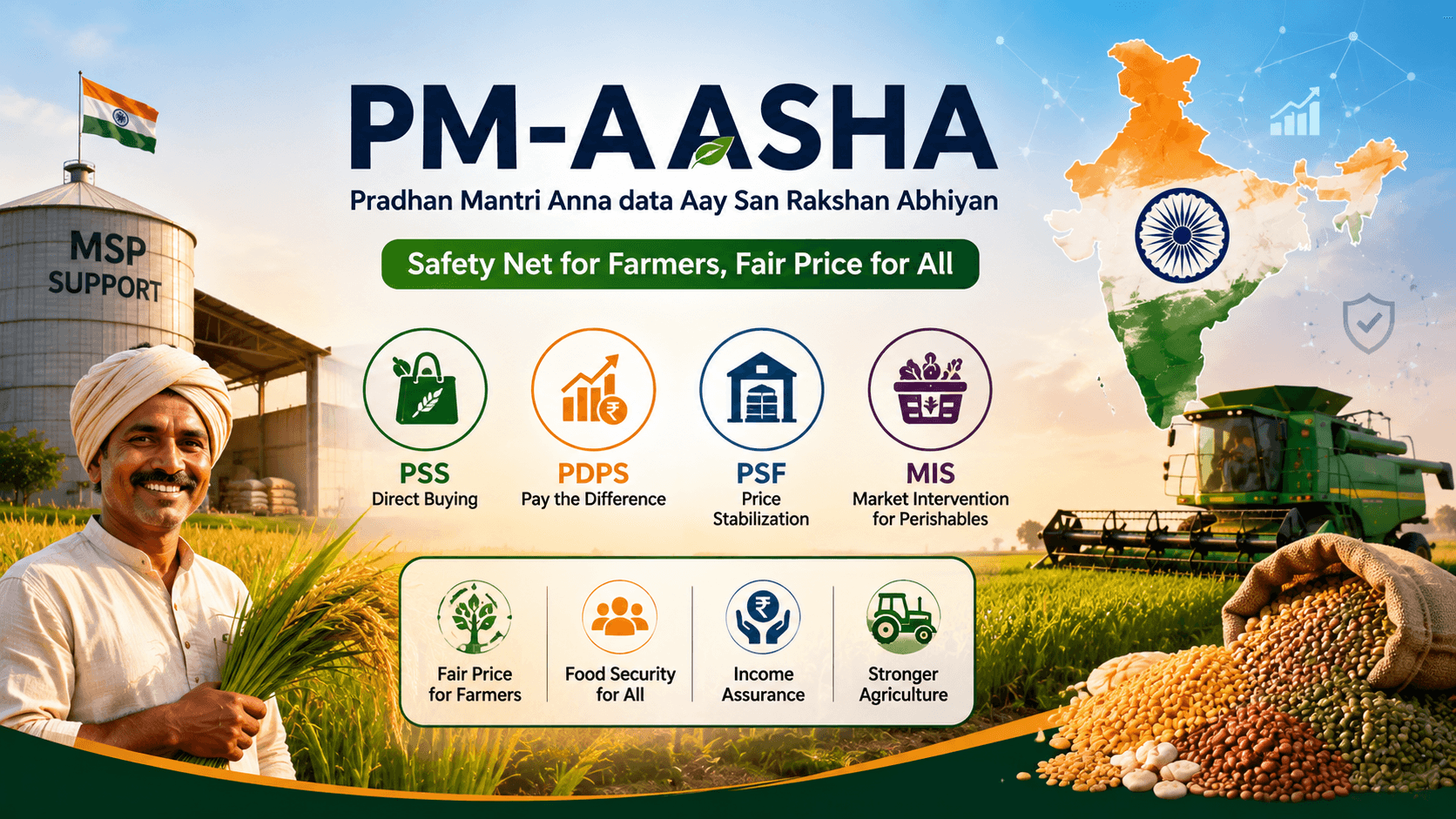
At its heart, PM-AASHA is the government's flagship safety net to ensure our farmers get a fair and remunerative price and don't have to resort to distress selling.
Launched in September 2018, it brings all price-support mechanisms under one roof.
Under this, procurement of pulses, oilseeds, and copra is done by central agencies like NAFED and NCCF along with state governments.
How does it work?
The government already announces MSP, but what if market prices crash during harvest? That's where PM-AASHA steps in. It is not one scheme but 4 schemes packed together, implemented by NAFED and NCCF along with state governments.
The 4 pillars:
| PSS - Direct buying: | If the market price falls below MSP, the government directly buys pulses, oilseeds, and copra from registered farmers. For most crops it's up to 25% of the state's production, but for Tur, Urad, and Masur, they will now buy 100%—to make India self-sufficient in pulses. |
| PSF - Price control for you and me: | The government stores pulses, onions, and potatoes when they are cheap and releases them when prices shoot up. So, farmers get a fair price, and you don't pay extra in the kitchen. |
| PDPS - Pay the difference: | Instead of buying the crop, the government just pays the difference between MSP and market price directly into the farmer's bank account. Simple, and no need for huge godowns. |
| MIS - For perishables: | Tomato, onion, and potato don't have MSP. When their prices crash by more than 10%, this scheme kicks in to buy them and support farmers. |
What's new?
The budget has gone up to ₹7,200 crore in 2026-27. Everything is now digital—Aadhaar verification, e-NAM mandis (1,656 mandis connected, trade worth almost ₹5 lakh crore).
MSP is profitable now—for wheat, a farmer spends ₹1,239 to grow and gets ₹2,585. For jute, profit is over ₹2,200 per quintal.
What is happening on the ground?
In Bihar, for the first time, masoor is being procured in an organized way. Over 800 farmers have already benefited.
In Chhattisgarh, over 35,000 tonnes of chana have been bought through 200 PACS, helping more than 27,000 farmers.
About MSP
Minimum Support Price (MSP) is the guaranteed minimum price at which the government purchases crops from farmers, acting as a safety net when market prices fall.
It is based on the recommendations of the Commission for Agricultural Costs and Prices (CACP), which came into existence in January 1965 as an attached office of the Ministry of Agriculture and Farmers Welfare.
The CACP considers various factors like cost of production, demand and supply, market price trends, and inter-crop price parity, and then the final decision is taken by the Cabinet Committee on Economic Affairs (CCEA) chaired by the Prime Minister.
MSP is announced for 22 mandated crops plus Fair and Remunerative Price (FRP) for sugarcane, which includes 14 Kharif crops, 6 Rabi crops, and 2 commercial crops.
To calculate it, CACP projects three types of costs — A2, which covers all direct paid-out costs like seeds, fertilizers, pesticides, hired labour and irrigation; A2+FL, which is A2 plus imputed value of unpaid family labour; and C2, which is the most comprehensive cost including rent for owned land and interest on fixed capital over and above A2+FL.
While MSP is fixed, giving at least 50% return over A2+FL, C2 is used as a benchmark reference to ensure MSP covers full costs in major producing states.
The need for MSP became even more critical after challenges like the twin droughts of 2014 and 2015, the impact of demonetization and GST on the rural economy, the economic slowdown after 2016-17 and the pandemic, along with rising input costs of diesel, electricity and fertilizers.
MSP ensures that farmers receive a fair and remunerative price, helps in reducing farm distress and poverty, and encourages crop diversification, making it a crucial pillar of farmer welfare and food security.
While PM-AASHA looks good on paper, its on-the-ground reality has some serious gaps:
| Procurement is still only for wheat and rice: | The entire government infrastructure—mandis, godowns, agencies—is built around just two crops. For pulses, oilseeds, and copra under PM-AASHA, procurement is very limited. |
| Very few farmers benefit: | According to the NSSO 70th round (2013) survey, only 6% of farmers can sell their produce at MSP. So, 94% are still dependent on the open market. |
| Awareness is extremely low: | A 2017 study by K.S. Aditya found that only 24% of households even knew the MSP of the crop they grow. If farmers don't know the support price, how will they demand it? |
| Limited to a few states: | Although MSP is announced for all of India, actual procurement by NAFED/NCCF happens only in a few states like Punjab, Haryana, MP, and Chhattisgarh. In states like Bihar, Bengal, or the Northeast, the system is almost nonexistent. That is why procurement quantity for non-rice-wheat crops remains very low. |
| Farmers are unhappy with the process: | A NITI Aayog evaluation report (2016) found 79% of farmers were dissatisfied with the MSP regime. |
The reasons were very practical:
| 1 | Delay in payments |
| 2 | No proper infrastructure at procurement centers |
| 3 | Centers are too far from villages |
| 4 | MSP announced very late, after sowing decisions are made. |
For PM-AASHA to truly work for the farmer, implementation is everything. Here's what needs to be done:
| Make registration easy and hassle-free: | Right now, a farmer needs land records, Aadhaar authentication, and online registration just to sell at MSP. The process should be simplified at the PACS and FPO level, with help desks and mobile registration, especially for small and marginal farmers who need it the most. |
| Focus on small and marginal farmers: | Big farmers can still reach mandis and wait for payments. The real distress is with small farmers who sell immediately after harvest at low prices. PM-AASHA should have priority windows, transport support, and direct procurement from villages for them. |
| Break the trader lobby: | Price manipulation at mandis is a reality. Traders form lobbies and artificially pull down prices. The government needs to break this by fully interlinking mandis through e-NAM, allowing transparent online bidding from across the country, so the farmer gets the best price and not the price fixed by a few local traders. |
| Build real procurement infrastructure: | We need more procurement centers closer to villages, proper weighing machines, drying yards, warehouses, and timely payment. Without godowns, staff, and funds at the local level, MSP will remain only on paper. |
| Combine price support with income support: | MSP alone cannot solve farm distress. It should be complemented with income support schemes like PM-KISAN, crop insurance, and affordable credit so that even if market prices fall, the farmer's overall income remains stable. If these steps are taken, PM-AASHA can move from just a price assurance scheme to a true income assurance scheme for Anandites. |
Conclusion
PM-AASHA is a much-needed step towards securing the hard work of our farmers. It tries to fix the oldest problem in Indian agriculture — growing more but earning less. By bringing four different mechanisms — direct procurement, price deficiency payment, buffer stocking and market intervention — under one umbrella, the government has created a comprehensive safety net for pulses, oilseeds and perishables, beyond just wheat and rice. The increase in budget to ₹7,200 crore, digital reforms, and visible impact in states like Bihar and Chhattisgarh show that the intent is right.
However, the real test is not in announcing MSP, but in ensuring that the last farmer in the remotest village can sell at MSP, without delay, without hassle and without middlemen. If the gaps in awareness, procurement infrastructure and timely payments are addressed, PM-AASHA can truly become the backbone of remunerative farming and a key driver towards doubling farmers' income and a resilient agricultural economy.
General Studies Paper-II (Economic Development and Agriculture Policies) in the BPSC Mains syllabus and under Current National Events / Indian Economy in the BPSC Prelims syllabus.