Bamboo: From Green Gold to Green Enterprises
Why in News?
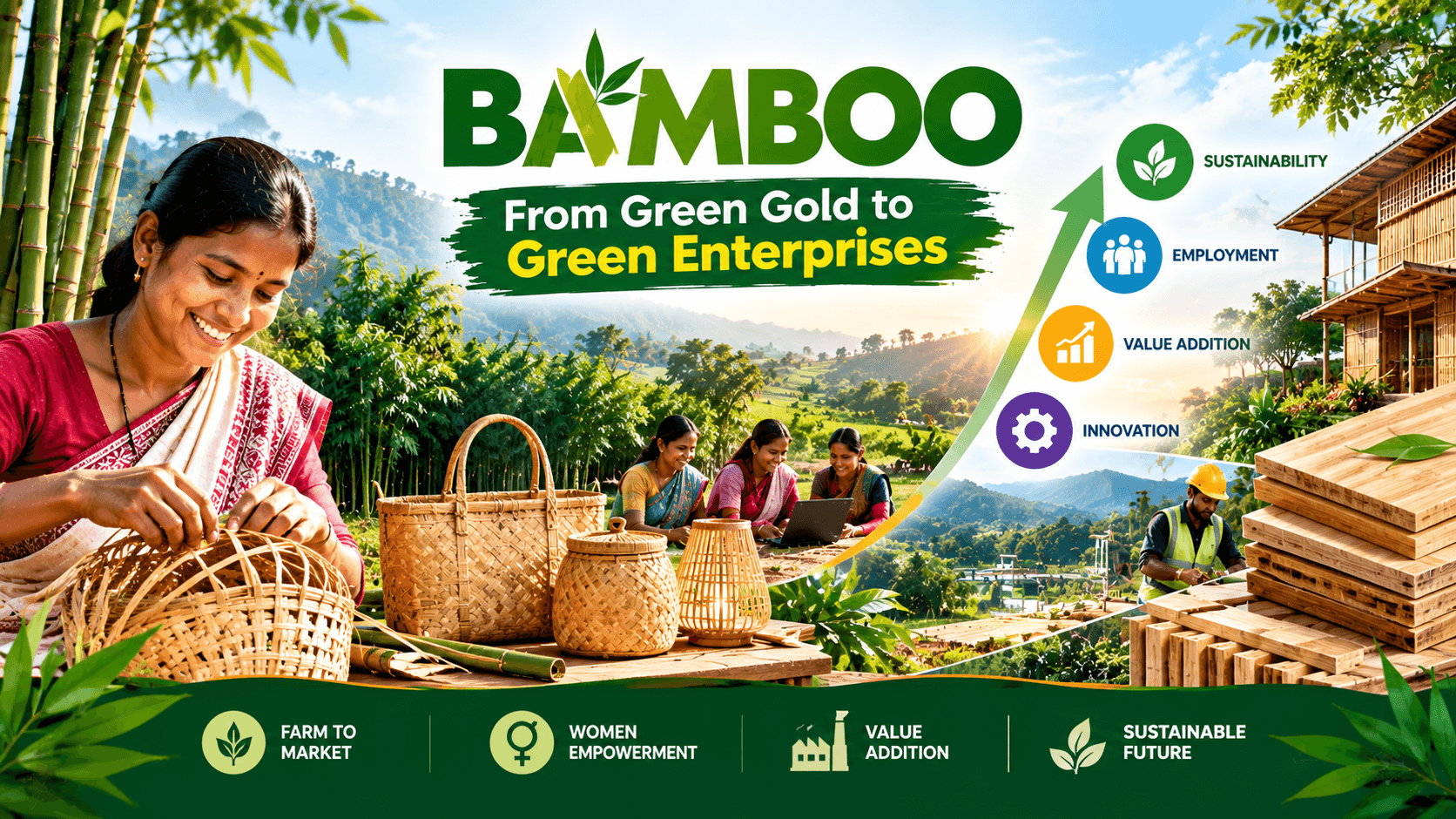
Bamboo is emerging as an important source of rural employment, women’s entrepreneurship, value addition, and sustainable development. Recent examples from across India show how technology, government support, and market linkages are transforming bamboo from a traditional resource into a modern economic opportunity.
A simple bamboo bag displayed at the SARAS Aajeevika Mela 2026 in Gurugram tells this larger story. The bag was made by Vishakha Didi from Assam, who joined a Self-Help Group (SHG) in 2014 and revived her father-in-law’s bamboo craft enterprise with new designs.
With government support and exposure to national exhibitions, her products reached wider markets. At the India International Trade Fair 2025, her bamboo creations generated around ₹2 lakh in sales. Her journey shows how a traditional resource can become a modern livelihood when it relates to skills, markets, technology, and institutional support.

2017 Reform: A Major Policy Shift
For decades, bamboo faced regulatory restrictions because it was classified as a tree under the Indian Forest Act, 1927. In 2017, the government amended the law and excluded bamboo grown outside forests from the definition of a tree.

Why was this important?
- Reduced regulatory hurdles in harvesting and transportation.
- Encouraged bamboo cultivation and private enterprise.
- Promoted processing and value addition.
- Created greater opportunities for farmers, artisans, and MSMEs.
This reform helped unlock the economic potential of bamboo, particularly in the Northeast.
National Bamboo Mission
The National Bamboo Mission (NBM) focuses on developing the bamboo value chain through:
Bamboo cultivation and quality planting material
Processing and value addition
Skill development and capacity building
Market access for farmers and producers
Support for bamboo-based enterprises
The objective is to move from simply producing bamboo to creating higher-value products and sustainable livelihoods.
Technology Is Expanding the Bamboo Economy
Bamboo is increasingly being used beyond traditional handicrafts.
The Northeast Centre for Technology Application & Reach (NECTAR) has supported bamboo technologies in areas such as
Food and agro processing
Construction materials
Manufacturing
Renewable energy
Industrial products
These interventions have reportedly generated around 30 million man-days of employment annually and increased value addition in bamboo commodities from around 10% to as high as 70%.
Engineered Bamboo
Engineered bamboo is a composite material made by binding and compressing bamboo fibers, strips, or particles.
It is being used in:
- Furniture
- Construction
- Interior design
- Disaster-relief infrastructure
More than 42 lakh sq. ft. of engineered bamboo structures have reportedly been built for disaster relief and rehabilitation, including 576 school rooms in Chhattisgarh serving around 20,000 children.

Bamboo and Women’s Empowerment
The bamboo sector is also creating opportunities for women through Self-Help Groups (SHGs). The Gadchiroli Agarbatti Project (GAP) in Maharashtra is an important example. By 2020, it had:
- 32 production centers
- Around 1,100 workers
- Nearly 90% of women workers
- Increased employment from about 45–60 days to over 225 days annually
Such initiatives provide women with income, skills, confidence, and greater economic independence, while also reducing dependence on forests for livelihoods.
Way Forward
The focus should shift from bamboo cultivation to a complete bamboo economy.
- Promote scientific cultivation and quality planting material.
- Strengthen local processing infrastructure.
- Connect SHGs and artisans with e-commerce and wider markets.
- Encourage R&D in engineered and industrial bamboo.
- Improve access to credit and technology.
- Promote skill development in design, branding, and entrepreneurship.
Conclusion
Bamboo is gradually moving from a traditional livelihood resource to a modern green enterprise. Its potential lies in creating rural employment, empowering women, supporting Northeast development, and promoting sustainable value addition. For India, the objective should not be merely to grow more bamboo but to create more value from every bamboo stem.