Disinvestment: Reform or Fiscal Rescue?
Why in News?
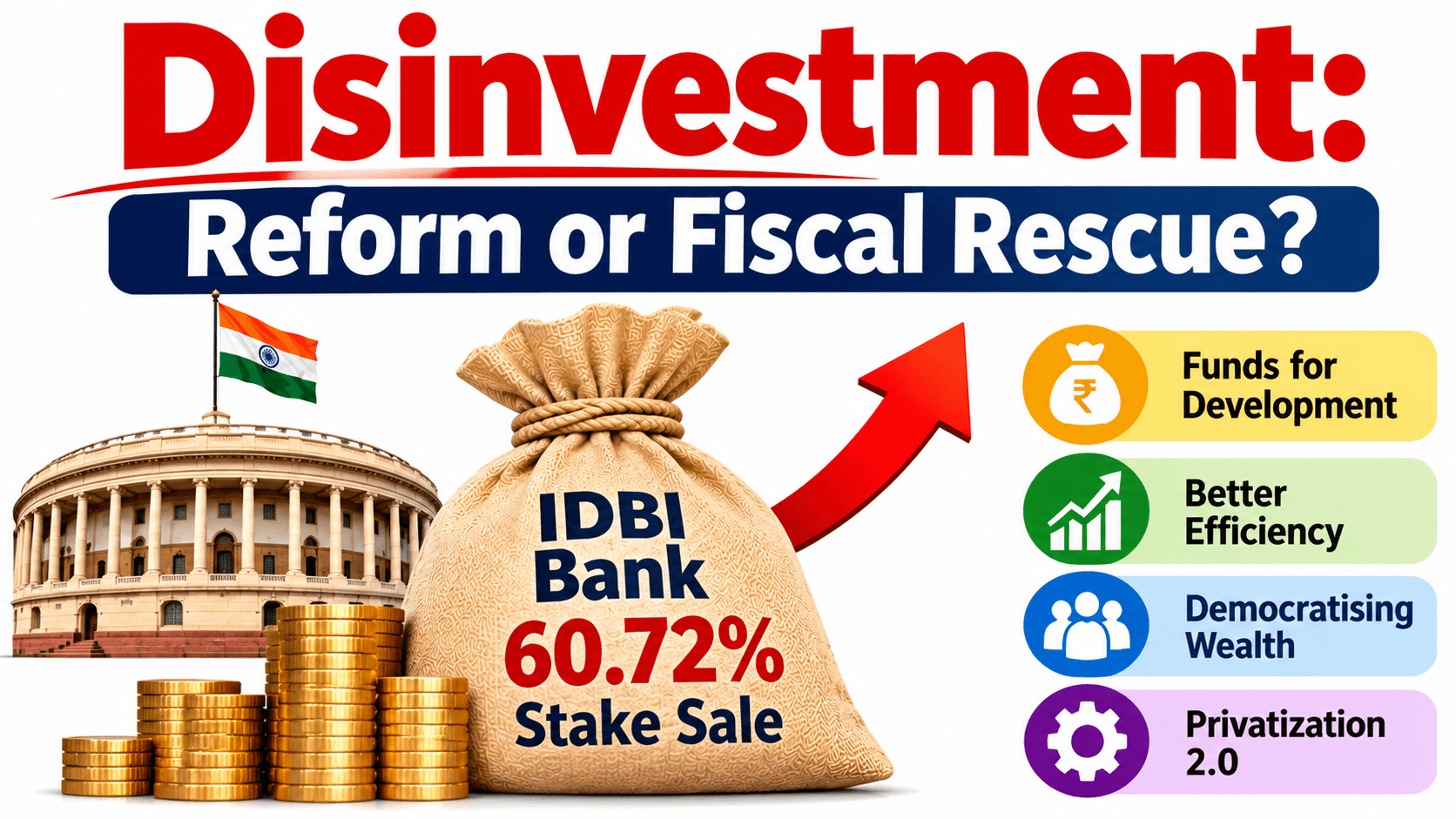
The Cabinet Committee on Economic Affairs (CCEA) has approved the strategic sale of a 60.72% stake in IDBI Bank to a private entity. It is supposed to be the biggest FDI deal in India’s banking sector. With this, the government will sell 30.48% of its own stake and LIC's 30.24%, while retaining 15% and 19%, respectively. Through this, the Rs 52,878 crore proceeds will help the Centre comfortably meet its Rs 80,000 crore disinvestment target for FY27, for the first time in 8 years. The government also plans to list other wholly owned entities like the India Infrastructure Finance Company Ltd (IIFCL), signalling a renewed, aggressive push toward disinvestment as a central macroeconomic strategy.
What is disinvestment?
It refers to the government selling or reducing its equity stake in Public Sector Enterprises (PSEs), state-owned financial institutions, or other physical assets.
It essentially means converting public assets into liquid cash by transferring ownership, either partially or completely, to private hands.
Its main objectives are to mobilize non-debt capital receipts, reduce the financial burden on the government, and improve corporate governance through market discipline.
About DIPAM
The Department of Investment and Public Asset Management (DIPAM) under the Ministry of Finance is the nodal agency responsible for handling all matters related to the sale of Central Government equity.
Types of Disinvestments: There are three main types.
Minority disinvestment is when the government sells a small portion of its stake but retains majority ownership (over 51%) and management control, usually through an IPO to list the company on the stock market, for example, the LIC IPO.
Majority disinvestment is when the government hands over management control to the buyer but keeps a minority stake.
Strategic disinvestment (privatization) is when both ownership and management control of a CPSE are transferred to a private strategic buyer. Recent examples include the sale of Air India to the Tata Group in 2022 and the ongoing 60.72% stake sale of IDBI Bank to Fairfax.
Why is Disinvestment a Key Economic Strategy?
| Funds for Development: | It unlocks money stuck in loss-making CPSEs and redirects it to health, education, and infrastructure under NIP(National Infrastructure Pipeline). This helps the government spend more on capex(Capital Expenditure) without extra borrowing and without crowding out private investment. |
| Better Efficiency: | CPSEs suffer from bureaucratic delays. Private ownership brings professional boards, modern management, and stock market accountability, which improves profitability. |
| Democratising Wealth: | IPOs of CPSEs allow common citizens to own a share in national assets and widen retail participation in the stock market. |
| Poor Performance Push: | Between 2014 and 2019, the BSE CPSE Index gave only a 4% average return, while the Sensex gave 38%. This huge underperformance was a key reason for pushing aggressive privatization. |
| Privatization 2.0: | Big strategic sales shift from just selling shares to creating investor-led, professionally managed firms that can attract large FDI. |
Policy Frameworks:
The current disinvestment push is driven by the New PSE Policy, 2021, which aims to reduce government presence in business. It divides the economy into two parts.
Strategic sectors include atomic energy, space, defense, transport and telecom, power, petroleum, coal, and banking & insurance. Here the government will keep a bare minimum presence of 1 to 4 companies and privatize, merge, or subsidize the rest.
Non-strategic sectors include all other industries like steel and hospitality, where CPSEs will be fully privatized or closed.
National Monetization Pipeline (NMP): NMP focuses on recycling capital by leasing mature brownfield public assets to private players. After achieving 90% of its Phase-1 targets, NMP 2.0 has set a target of Rs 16.72 lakh crore for FY 2026-30.
Monetization of Non-Core Assets: The Union Budget 2021-22 proposed an SPV to monetize surplus government land and other non-core assets via sale or concession.
Unlike disinvestment, asset monetization unlocks value without transferring full ownership and control of a PSE.
Committees:
Rangarajan Committee (1993) recommended diluting government ownership to 49% in strategic sectors and up to 100% in non-strategic sectors.
G.V. Ramakrishna Commission (1996) laid the core framework for disinvestment by classifying CPSEs into strategic, core, and non-core groups.
Concerns Regarding Disinvestment:
| Valuation Mismatch: | CAG values CPSEs based on huge land banks and physical assets, while private buyers value them on future cash flows. This gap leads to stalled bids and allegations of selling cheap. |
| Market Crowding: | Big government offloads like LIC OFS(Offer For Sale) suck out liquidity from the capital market, leaving less money for private startups and MSME IPOs. |
| Private Monopoly Risk: | Privatising natural monopolies like airports or rail routes without strong independent regulators can replace a public monopoly with a private oligopoly, leading to high consumer pricing. |
| Legacy Land Issues: | Non-core assets, especially leasehold land given by state governments to CPSEs, get stuck in long legal disputes (like the VSNL land issue) and delay deals. |
Measures Needed to Reform Disinvestment Policy:
| Demand-Based Approach: | Instead of the government deciding which PSE to sell, it should sell those where investors show strong interest and bid at expected valuation. |
| 3-Year Privatization Pipeline: | Announcing a rolling 3-year privatization list will give investors enough time for ensuring better participation and price discovery. |
| Calibrated Disinvestment: | Since full privatization takes time, the government should first bring down its stake to 51% in 95 listed PSEs—this alone can fetch around Rs 9 lakh crore, while it remains the largest shareholder. |
| Ring-Fencing Proceeds: | There should be a law to ensure disinvestment money is used only for creating capital assets (through NIIF: National Infrastructure Finance Limited) and not for meeting daily revenue expenses. |
| International Best Practices: | Temasek Model (Singapore): State assets managed by Temasek, an independent company working on commercial principles, separating government as regulator from government as owner. SASAC Model (China): Single body managing all state assets, pushing mergers to create globally competitive mega-firms before listing them. |
Conclusion:
While disinvestment is pitched as a reform for efficiency and fiscal prudence, in practice it has often become a desperate tool to plug budget deficits rather than a strategic exercise in value creation. Selling natural monopolies without strong independent regulators risks replacing public monopoly with private oligopoly.
Unless proceeds are ring-fenced for capital creation, a transparent 3-year pipeline is created, and the state truly separates its role as owner and regulator in the lines of the Temasek model, disinvestment will remain short-term revenue mobilization, not long-term economic reform.
Reference: