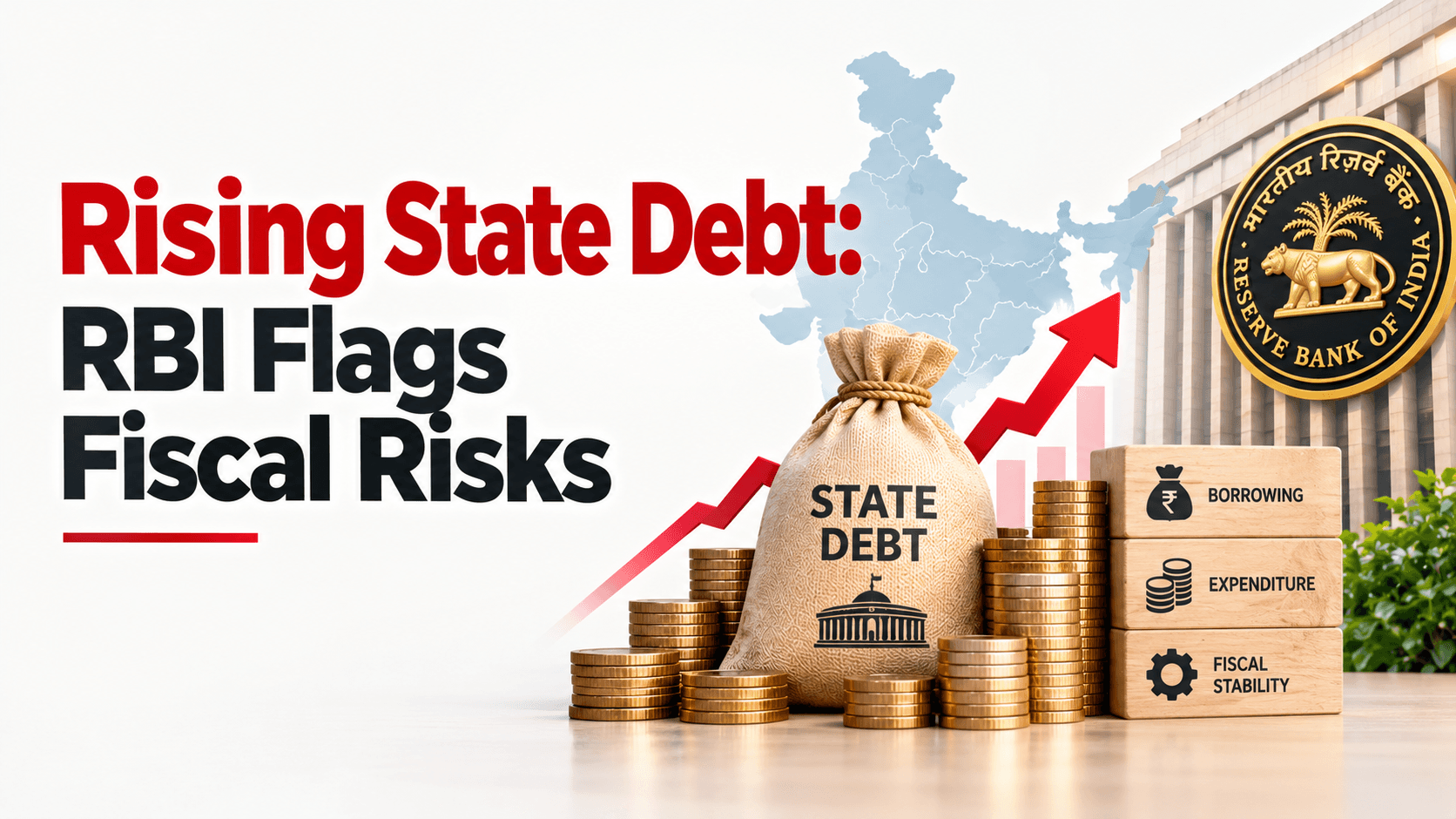
Rising State Debt: RBI Flags Fiscal Risks
Why in News?
Recently, while addressing the 36th Conference of State Finance Secretaries, Reserve Bank of India (RBI) Governor Sanjay Malhotra has advised state governments to adopt prudent borrowing strategies, improve cash management, and ensure quality expenditure to maintain long-term fiscal stability.
The governor also encouraged states to make effective use of the State Level Bankers’ Committee (SLBC) forum, adopt the Unified Lending Interface (ULI), and explore the use of Programmable Central Bank Digital Currency (P-CBDC) for Direct Benefit Transfers (DBT).
What is prudent borrowing?
Prudent borrowing means the government borrows only within its long-term capacity to repay and uses the money efficiently.
Golden Rule of Public Finance: Borrow mainly for capital expenditure (infrastructure, health, education) that creates future revenue, not for revenue expenditure like day-to-day admin costs or non-merit subsidies.
Effective Cash Management: Align the borrowing calendar with actual cash-flow needs to avoid idle cash balances that incur unnecessary interest.
Significance of Prudent Borrowing
Macroeconomic Stability: (Prevents crowding out); the government does not absorb the entire domestic credit pool, leaving affordable credit for the private sector.
The crowding-out effect is an economic concept where heavy government borrowing accidentally hurts the private sector by driving up interest rates and making it too expensive for businesses to invest or grow.
Crowding Out: The government takes up all the financial oxygen, pushing interest rates up and hurting private businesses (usually happens when the economy is already running at normal speed).
Crowding In: The government strategically invests in core sectors like transport, ports, or green energy, which actually gives private businesses the confidence to invest alongside them (usually happens during a recession).
Unified Lending Interface (ULI) : It is a technology platform designed to make the loan application and approval process faster, simpler, and more convenient.
It helps lenders, such as banks and other financial institutions, access relevant financial and other verified information about potential borrowers through a common digital framework, subject to applicable consent and access rules.
P-CBDC : Here CBDC stands for Central Bank Digital Currency.
It is a digital form of a country's official currency issued by its central bank. In India, the Reserve Bank of India (RBI) issues the digital rupee, also known as e₹. Whereas programmable means that digital money can be designed to follow certain predefined rules.
In simple words, the money can be restricted to a particular purpose, location, type of purchase, or time period.
Fiscal Space for Welfare: High debt leads to huge interest payments, consuming a large part of the Union and State revenues. Lower debt frees up budget for health, education, and green transition.
Avoid Sovereign Downgrade: High debt-to-GDP keeps the rating low (e.g., BBB-), making external borrowing expensive for Indian corporates.
Controls Inflation: Unchecked deficits, if monetized or driving demand without supply, cause persistent inflation.
Inter-Generational Equity: Ensures current consumption is not financed by putting an unsustainable tax burden on future generations.
Current State of Fiscal Health of Indian States
General Government Debt (Centre + States) is 81-85% of GDP, one-third of which is state debt. Health is highly asymmetric.
Debt Levels:
Aggregate: State debt at 29.2% of GDP (March 2026), much above the 20% limit suggested by the FRBM Review Committee.
Stressed States: Punjab, West Bengal, near or above 40% of GSDP.
Prudent Performers: Gujarat, Maharashtra, and Odisha, within a 20% limit.
Consolidating: Kerala (35.5%) and Tamil Nadu (29.2%) cut liabilities by 4-5 points since 2021.
Fiscal Deficit Slippage: Consolidated Gross Fiscal Deficit (GFD) budgeted at 3.3% of GDP for FY 2025-26. 16 states budgeted above the standard 3% limit, due to a fall in central grants and revenue shortfalls.
Rising Costs and Rigidity: Bond yields spiked in Oct 2026, raising borrowing costs. Over 60% of revenue receipts go to committed expenses such as interest, salaries, pensions, and subsidies, leaving little for development.
Crucial Role: States do 2/3rd of total public spending and 1/3rd of total revenue. Their capex capacity, currently supported by the center's 50-year interest-free Scheme for Special Assistance to States for Capital Investment (SASCI) loans, is key for growth.
Key Issues in Current Borrowing Practices
Off-Budget Borrowings: States bypass FRBM limits via State Public Sector Enterprises (SPSEs)/Special Purpose Vehicles (SPVs) with state guarantees, avoiding legislative scrutiny.
Revenue vs. Capital Use: Borrowing for Capex is justified (multiplier ∼2.45, creates assets). But states increasingly borrow for revenue expenditure, such as subsidies, waivers, and freebies, with no future returns.
Contingent Liabilities: Guarantees to DISCOMs are a fiscal time bomb if they default.
Market Volatility: Uncalibrated borrowing calendars by the center and states spike bond yields, disrupting monetary transmission.
Measures for Long-Term Fiscal Health
1. Leverage Digital Platforms: The RBI Governor advised onboarding to the Unified Lending Interface (ULI) and using Programmable CBDC (P-CBDC) for DBT to plug leakages and ensure targeted use.
2. Use SLBC Forum Effectively: The State Level Bankers’ Committee should be used to monitor credit, resolve priority lending bottlenecks, and boost rural infrastructure financing to raise revenues.
3. Strict FRBM Adherence: Stick to the fiscal deficit glide path, typically 3-3.5% of GSDP.
4. Independent Fiscal Council: As recommended by the 13th & 14th Finance Commissions and the N.K. Singh Committee (2016), set up an independent body to check forecasts, debt sustainability, and off-budget financing transparency.
5. Cap Off-Budget Borrowings: The RBI and the Finance Ministry must enforce strict accounting. The union's move to count off-budget borrowings under Article 293(3) limits is a positive step.
6. Dynamic Debt Management: Follow RBI's Compendium on Cash and Debt Management, align borrowings with actual needs, and adopt Benchmark Issuance Strategy to improve liquidity.
Conclusion
Prudent borrowing is not about borrowing less but borrowing right, for capex, not revenue spending, and within repayment capacity. With states accounting for two-thirds of public spending, their off-budget borrowings, guarantee risks to DISCOMs, and expenditure rigidity (60%+ revenue locked in interest, salaries, and subsidies) directly threaten macroeconomic stability, private credit, and shrink fiscal space for welfare.
Sustaining long-term health needs strict FRBM adherence, capping off-budget loans under Article 293(3), an independent Fiscal Council for transparency, and modern tools like ULI, P-CBDC, and dynamic debt management.
Reference;