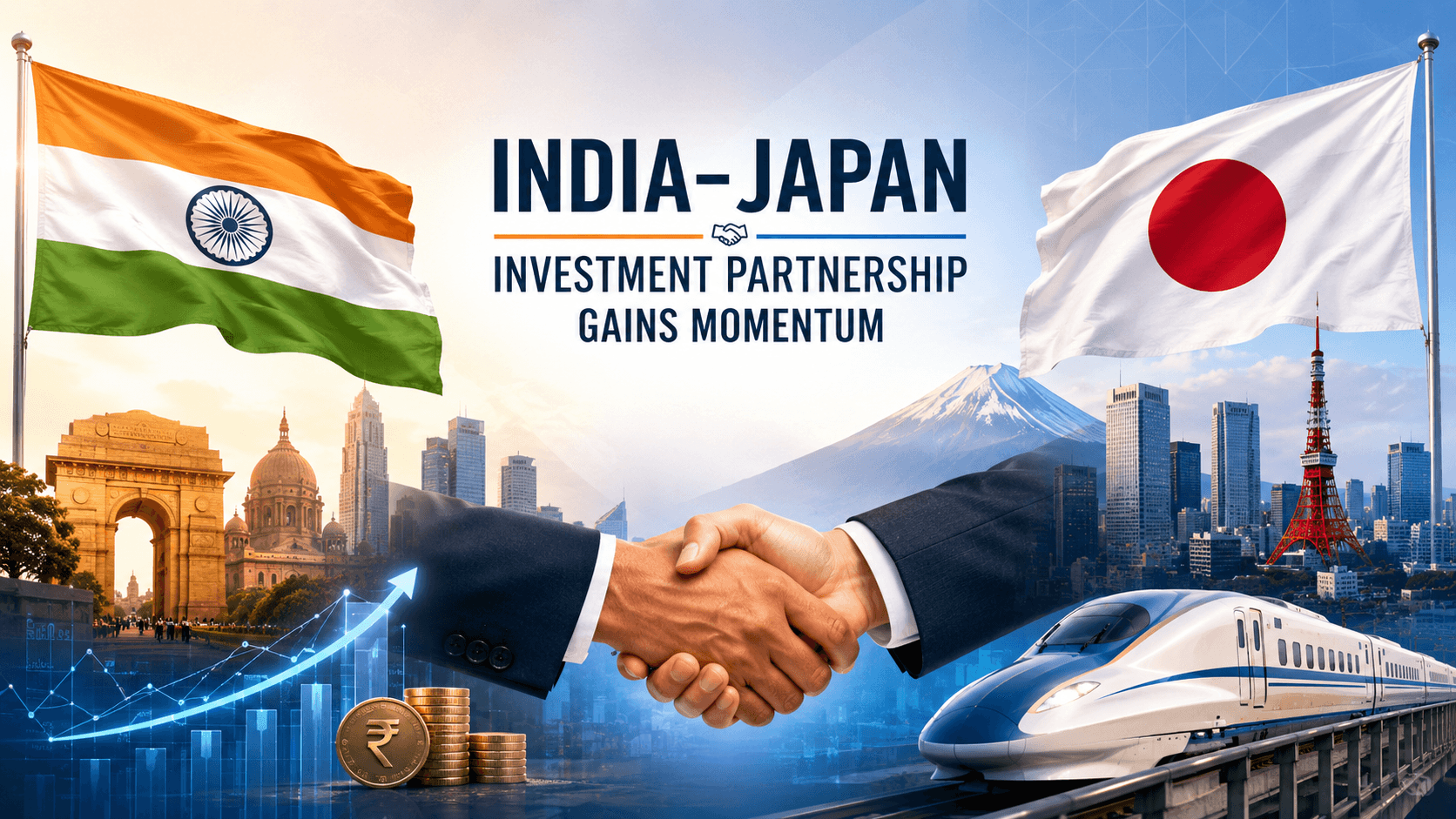
India-Japan: Investment Partnership Gains Momentum
Why in News?
Recently, Union Commerce Minister Piyush Goyal held discussions in Tokyo with top Japanese financial institutions like MUFG, Mizuho, DBJ, Morgan Stanley, Nomura, and Nippon Life to deepen long-term capital flows and Japanese investment in India.
Key Highlights of the Meeting
The minister highlighted India's economic resilience—7.7% growth last year despite global uncertainties and the vision to become a USD 30 trillion economy by 2047. He underlined the strong banking sector with robust capital adequacy, low NPAs, an expanding middle class, and rising disposable incomes as key growth drivers.
He invited Japanese investors in sunrise sectors—semiconductors, AI, data centers, renewable energy, green hydrogen, advanced manufacturing, and digital infrastructure.
He noted India's expanding renewable capacity and national grid support energy-intensive digital industries, while the India Semiconductor Mission is creating new opportunities. He also assured Japan on IP protection, high-quality talent, and policy reforms.
This is part of the larger goal of mobilizing 10 trillion yen of Japanese private investment in India over the next decade.
What Japanese Institutions Said?
Japanese institutions showed strong confidence in India. MUFG highlighted around USD 4 billion investment in Shriram Finance and interest in renewable and hydrogen. DBJ shared its dedicated India strategy in property development and venture capital.
Mizuho noted the improving profitability of Japanese companies in India and its Global Capability Centre in Pune. Morgan Stanley said India is one of its most important global locations, with 19,000+ employees moving to high-value capital markets.
Nomura highlighted its role in connecting Japanese firms with Indian opportunities in AI and cybersecurity. Nippon Life emphasized the importance of long-term patient capital and strong returns from India.
They also suggested simplifying profit repatriation, improving access to capital markets, and greater regulatory predictability. Currency movements and policy issues influence short-term decisions, but the long-term outlook remains strongly positive.
Role of GIFT City
The meeting also explored GIFT City as a gateway for international capital into India and a platform for cross-border flows between Japan and India.
Significance
India is seeking not just capital but long-term partnerships that bring technology, innovation, manufacturing, employment, and integration with global value chains.
Historical Roots—More Than Just Diplomacy
India-Japan ties are not new. They go back to the 6th century with the spread of Buddhism from India to Japan, which created a deep cultural affinity. In modern times, after World War II, when Japan was isolated, PM Nehru sent an elephant to Tokyo's Ueno Zoo in 1949 as a symbol of optimism and friendship.
PM Nobusuke Kishi visited India in 1957, and Japan gave its first formal yen loan to India in 1958—the first it gave to any country. That trust still defines the relationship.
- From strategic partnership from Global Partnership in 2000 to special strategic and global partnership in 2014, the ties have grown fast. Annual summits have happened since 2006, and there are 70+ dialogue mechanisms, including the 2+2 Foreign and Defence Dialogue. There is strong strategic convergence. India's Act East Policy, SAGAR, and Indo-Pacific Oceans Initiative (IPOI) perfectly align with Japan's Free and Open Indo-Pacific (FOIP). Both want a rules-based Indo-Pacific, which makes Japan a key partner in the Quad as well.
- Economic Relations: The Comprehensive Economic Partnership Agreement (CEPA) came into effect in 2011. It covers goods, services, movement of persons, investment, and IPR. Tariffs on 94% of items were reduced by Trade data is important for prelims: In FY25-26, total trade is USD 27.48 billion—exports USD 6.04 bn and imports USD 21.44 bn. So, India has a trade deficit. In 2024-25, India ranked 18th in Japan's total trade, and Japan ranked 17th in India's trade. India mainly exports organic chemicals, vehicles, aluminum, fish, and aquatic products. India imports from Japan nuclear reactors & machinery, copper articles, electrical machinery, inorganic chemicals, and iron & steel.
- Defense Cooperation: Defense is becoming the strongest pillar. There are regular Army, Navy, and Air Force staff talks and joint exercises like Dharma Guardian (Army), JIMEX (Navy), and Veer Guardian (Air Force) and participation in MILAN.
Key agreements:
2014 Defence Cooperation MoU, 2015 agreements on Defence Technology Transfer and Protection of Classified Information, 2018 Navy cooperation, and 2020 Reciprocal Provision of Supplies and Services (RPSS)—used since MILAN 2022 for logistics support.
The first-ever co-development of defense equipment is also happening—UNICORN radio antenna masts for the Indian Navy.
Connectivity and Development Projects
Mumbai-Ahmedabad High Speed Rail (MAHSR)—India's first bullet train project. 508.17 km long with 12 stations across Maharashtra, Gujarat, and Dadra & Nagar Haveli, with Japanese technical and financial help based on Shinkansen technology. It also promotes Make in India and skill development.
The Act East Forum, founded in 2017, focuses on economic development of Northeastern India under the Act East Policy and FOIP—covering connectivity, infrastructure, and people-to-people ties. The last meeting was in Science, Technology, and Space 2025-26 has been declared the India-Japan Year of Science, Technology & Innovation.
Collaboration started in 1985.
ISRO-JAXA cooperate in satellite navigation, space situational awareness, and lunar exploration. The flagship project is the Lunar Polar Exploration Mission (Chandrayaan-5 / LUPEX), with an agreement signed in 2025 and a launch scheduled for 2026-27.
Education, Culture, and People Over 100 joint research projects every year, hundreds of students exchanged via LOTUS and Sakura programs, and Japanese language programs in India. The 2025 MoU on Cultural Exchange renewed cooperation in arts, museums, and heritage.
Around 59,000 Indians live in Japan—mainly IT professionals, engineers, and the business community—acting as a bridge.
Why This Partnership Is So Important
| Geopolitical Balance in the Indo-Pacific | Both India and Japan are champions of the Free and Open Indo-Pacific (FOIP). This is not just a slogan. It is a counter to regional unilateralism and aggressive expansion in the South China Sea and East China Sea. Both support rules-based maritime order, freedom of navigation, and ASEAN centrality. They also engage third countries like Indonesia together, going beyond bilateral ties. For India, Japan supports its leadership in the Indo-Pacific; for Japan, India gives strategic depth. |
| Perfect Economic Complementarity | This is a classic win-win. Japan has what India needs—advanced technology, strategic patient capital, and industrial expertise. India has what Japan needs—a huge and rapidly rising market, world-class Digital Public Infrastructure (UPI, ONDC), and a large youthful workforce. This fits perfectly into the China+1 strategy for Japanese companies. |
| Multilateral and Supply Chain Resilience | Both countries are building resilient, de-risked supply chains through Quad with the US and Australia, G20, and Supply Chain Resilience Initiative (SCRI). Focus is on semiconductors, critical minerals, and green energy so that no single country can weaponize supply chains. |
| Maritime and Defense Convergence | Cooperation is moving beyond simple exercises. Now focus is on complex exercises using unmanned systems and multi-domain operations. This enhances strategic and operational convergence. It helps India's goal of military manufacturing and shipbuilding under Make in India and secures Japan's interest in safe maritime routes from the Strait of Malacca to the Indian Ocean, which are lifelines for its energy. |
Issues and Concerns—Why Trade Is Still Low?
| Weak Trade—Below Potential | Bilateral trade is just USD 27.5 billion. For two of the world's largest economies, this is very small. Both leaders accept it is a fraction of potential. India's trade deficit with Japan is also a concern. |
| Regulatory and Market Friction | Japanese companies complain about India's complex regulations, Bureau of Indian Standards (BIS) compliance, land acquisition, and tax predictability. On the other side, Indian exporters—especially food, pharma, and agri products—face very stringent phytosanitary standards and quality checks in Japan, making market entry difficult. |
| Defense Production Bottlenecks | Despite many exercises, actual defense co-production has not taken off. The classic example is the ShinMaywa US-2 amphibious aircraft deal, which has been stuck for years due to pricing issues, technology transfer concerns, and procurement delays. The UNICORN mast is the first co-development, but we need more. |
| Different Geopolitical Positions | India asserts strategic autonomy—like its position on the Russia-Ukraine war and not joining Western sanctions on Russia. Japan is strongly aligned with the G7 and the US alliance system. On Eurasian security, there are differences. Managing this divergence while maintaining strategic convergence is a diplomatic challenge. |
Conclusion
The India-Japan partnership is one of India's most trusted and strategic relationships without any historical baggage. From the cultural link of Buddhism to the Special Strategic and Global Partnership, both countries share the vision of a free and open Indo-Pacific, a rules-based order, and resilient supply chains. Japan brings technology, patient capital, and industrial expertise; India offers market, talent, and digital public infrastructure—a perfect complementarity for achieving 30 trillion economies by 2047 and a 10 trillion-yen investment target.
Challenges like low trade of USD 27.5 billion, regulatory friction, delayed defense co-production, and differing positions on Russia need to be addressed through simplification of norms, faster execution of MAHSR, and new co-development projects like UNICORN and Chandrayaan-5.
Overall, this partnership is not just bilateral but critical for the stability of the Indo-Pacific and for the Global South. If India-Japan ties move from dialogue to delivery, they can become an anchor for multipolar Asia.